


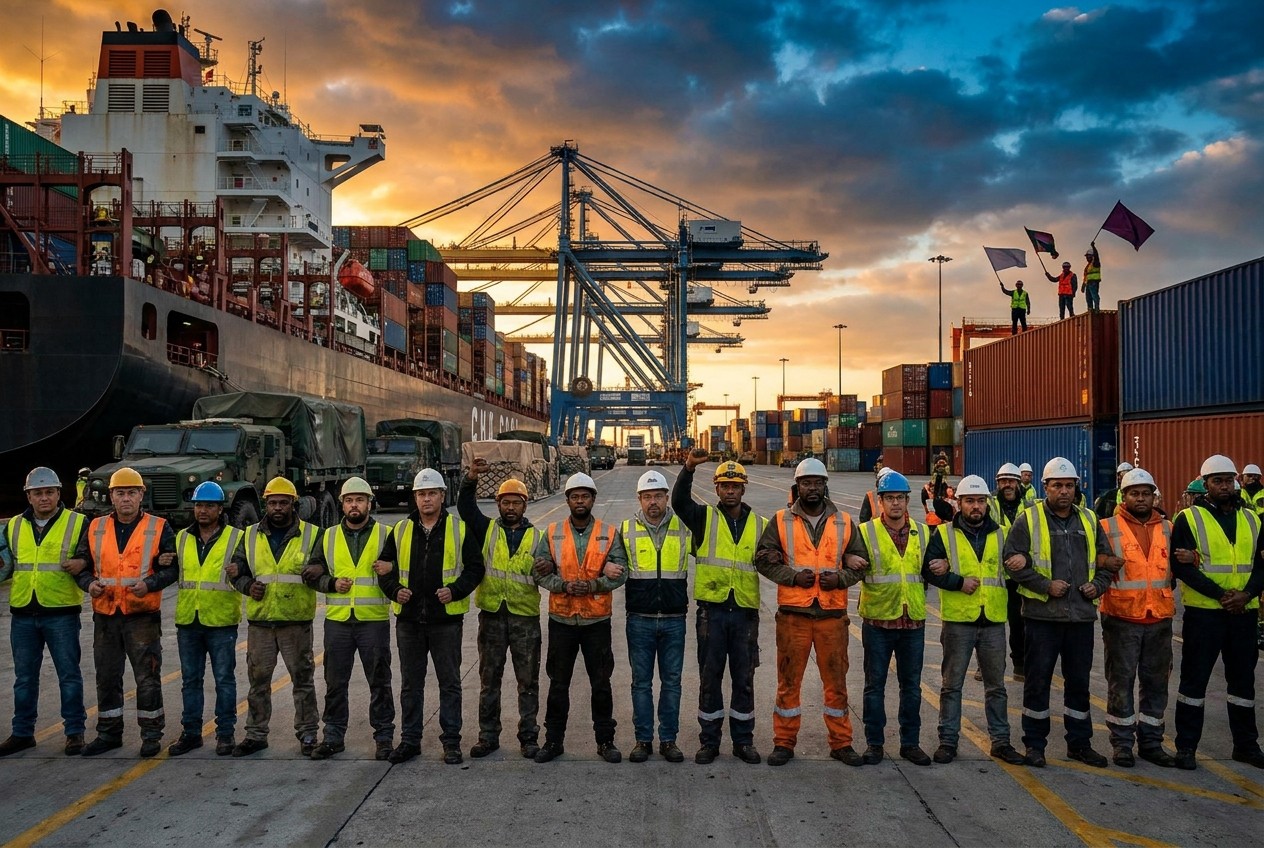
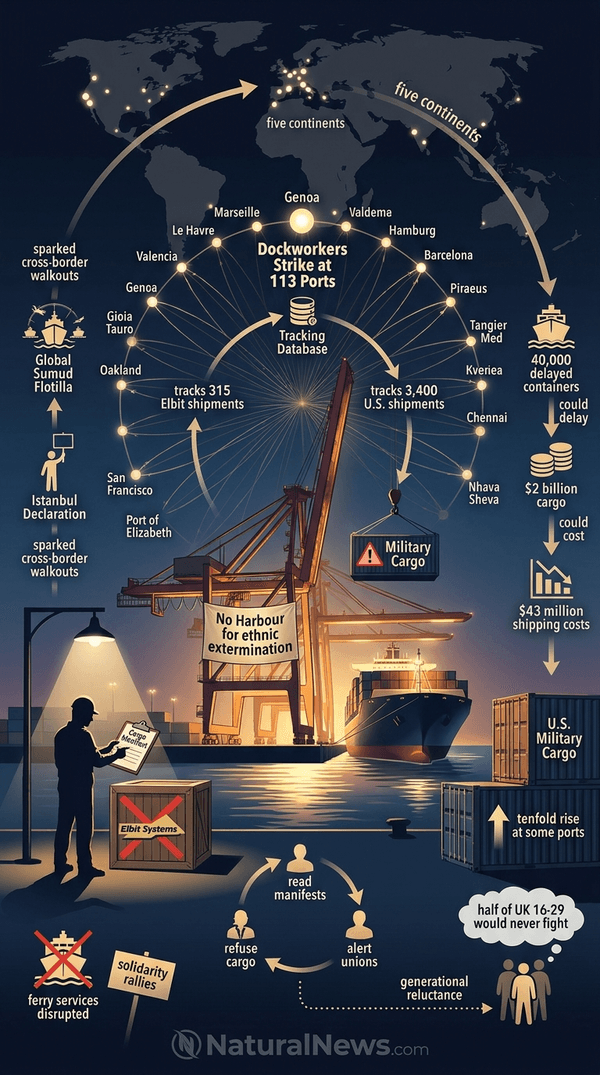
Dockworkers across five continents launched a coordinated anti-war strike on Friday, Oct. 30, 2026, targeting Israeli arms shipments and U.S. military cargo moving through commercial ports, organizers said. More than 25 unions mobilized at 113 ports in 22 countries and regions, according to organizers, with activities that included 24-hour strikes, shorter walkouts, blockades and solidarity rallies.
Major European ports participating included Genoa, Marseille, Le Havre, Hamburg, Valencia, Barcelona and Piraeus, organizers said. Actions also were planned or reported at Tangier Med in Morocco, Nhava Sheva and Chennai in India, and Oakland and San Francisco in the United States, with further actions in Türkiye, Cyprus, Sweden, Denmark, Ireland, Portugal, Brazil, Mexico and Australia.
The work stoppages were called under the banner of the "No Harbour for Genocide" campaign, which describes its objective as halting weapons, ammunition, military equipment and troop shipments through civilian dock facilities. News outlets across Europe and the Middle East reported widespread participation, with protesters at more than 100 ports across 22 countries, including a caravan at New Jersey's Port of Elizabeth, according to [1], and Italian activists demonstrating at the port of Gioia Tauro, according to [2]. On September 22, Italian workers, led by dockworkers and grassroots unions, staged a major nationwide strike aimed at paralyzing the country, with transport hubs blocked and port operations halted, [3] reported.
Scope of the Action
France's CGT Ports et Docks called 24-hour strikes across 24 ports, while Italy's USB declared a nationwide general strike with protests in more than 40 cities, the unions said. The Italian action came on the heels of a September 2025 nationwide general strike in which workers disrupted transport and blocked ports to pressure the Italian government over its support for the Gaza war, according to [3] and [4].
Dockworkers at Piraeus, Greece's largest port, held a three-hour stoppage from 08:00 to 11:00 GMT, according to union statements. Other Greek maritime unions announced 24-hour strikes affecting seven ports, threatening ferry services to the country's islands, unions said. The Straits Times reported that dockworkers went on strike across Europe and beyond on Friday, disrupting shipping and ferries, [5].
Reuters reported the action could disrupt over 40% of Mediterranean cargo, [6]. Organizers estimated that the strike could delay 40,000 containers carrying cargo worth over $2 billion, potentially costing shipping companies up to $43 million, figures that have not been independently verified. The full extent of disruption to shipping operations remained unclear as actions took place at different times, according to reports. Experts cited by Ynetnews expected limited operational impact despite the broad geographic scope, [7].
Demands and Organizer Claims
The unions demanded a halt to weapons, ammunition, military equipment and troop shipments through commercial ports, targeting Israeli and U.S. military supply chains, organizers said. They also opposed turning civilian ports into military hubs and diverting public funds into rearmament while workers face stagnant wages and job insecurity, according to union statements.
At a press conference in Rome on Oct. 15, organizers said, "From planes to tanks, guns to bullets, explosives to ammunition, uniforms to boots, our ports have become replenishing and forwarding bases for war and genocide." The unions accused governments and shipping companies of keeping military supply routes open despite the Gaza ceasefire announced over a year earlier, which they said had been rendered largely meaningless by continued Israeli strikes.
The "No Harbour for Genocide" campaign claims it tracked 315 shipments of components for Israeli arms manufacturer Elbit Systems through 56 ports in 29 countries over 14 months, and 3,400 shipments of U.S. military cargo through 67 ports in 42 countries over 10 months. The group also said U.S. military cargo volumes at some European ports rose as much as tenfold following the start of the U.S.-Israeli war against Iran. The figures have not been independently verified, and no independent confirmation of the cargo volume or financial impact was immediately available, officials said. Mother Jones reported that the strike could freeze $2 billion in freight, [8].
Outlook and Verification
Organizers described the action as a coordinated international effort, while the shipping disruption estimates and cargo figures have not been independently verified. Videos of demonstrations at multiple ports have been posted online, but the full impact remained unclear as actions were scheduled at different times, according to organizers and reports. Italian activists have signaled they plan to escalate Mediterranean port protests in the months ahead, with campaigns planned by land and sea over the transfer of military equipment through Italian ports, [2].
A Greek shipping investigation published in April revealed that Greek shipping companies had secretly transported oil, coal and military cargo to Israel using shadow ships that turned off their signals and filed false destinations, [10]. The revelation underscored the opaque nature of military supply chains that dockworkers say they are trying to disrupt. Independent verification of the total volume of such shipments remains elusive.
No independent confirmation of the cargo volume or financial impact was immediately available, officials said. The Venice Biennale separately faced a 24-hour cultural strike called by international and Italian unions and activist groups over Israel's participation, reflecting the widening scope of labor actions tied to the Gaza conflict, [11].
References
- Machinery of death': Dock workers worldwide protest against arms shipments to Israel. https://www.middleeasteye.net/news/jam-machinery-death-dock-workers-worldwide-protest-against-arms-shipments-israel
- Italian activists escalate Mediterranean port protests over Gaza genocide. https://www.middleeasteye.net/news/italy-activists-escalate-port-protests-over-gaza-genocide-and-military-supply-chains-through
- Italian unions bring the nation to a halt in historic strike against Gaza conflict - NaturalNews.com, September 23, 2025.
- RIOTS erupt in Italy after Rome rejects Palestinian statehood - NaturalNews.com, September 24, 2025.
- Dockworkers strike in Europe and beyond against arms shipments, war .... https://www.straitstimes.com/world/europe/dockworkers-strike-in-europe-and-beyond-against-arms-shipments-war-deaths
- Dockworkers at more than 100 ports to strike against arms shipments on .... https://www.reuters.com/business/world-at-work/dockworkers-more-than-100-ports-strike-against-arms-shipments-friday-2026-10-29/
- ‘We won't transport weapons’: Dockworkers at over 100 ports strike over .... https://www.ynetnews.com/article/rk3dadfagx
- A Global Port Strike Could Freeze $2 Billion in Freight. https://www.motherjones.com/politics/2026/10/global-port-strike-workers-unions-israel-iran-war-protest/
- How Europeans are saying no to rearmament and conscription. https://www.middleeasteye.net/opinion/how-europeans-saying-no-rearmament-and-conscription
- Exclusive: Greek ships secretly supplying Israel with oil and military cargo. https://www.middleeasteye.net/news/exclusive-greek-ships-secretly-supplying-israel-oil-and-military-cargo
- Venice Biennale targeted by strike action and protests over Israel's involvement. https://www.middleeasteye.net/news/venice-biennale-targeted-strike-action-and-protests-israels-involvement
Explainer Infographic






Please contact us for more information.