


A study published in June 2026 in the Journal of Alzheimer's Disease reported that routine retinal photographs, the kind taken during standard eye exams, may contain structural signals associated with Alzheimer's disease risk factors years before symptoms appear. The research analyzed nearly 63,000 retinal photographs from more than 44,000 UK Biobank participants, according to the study.
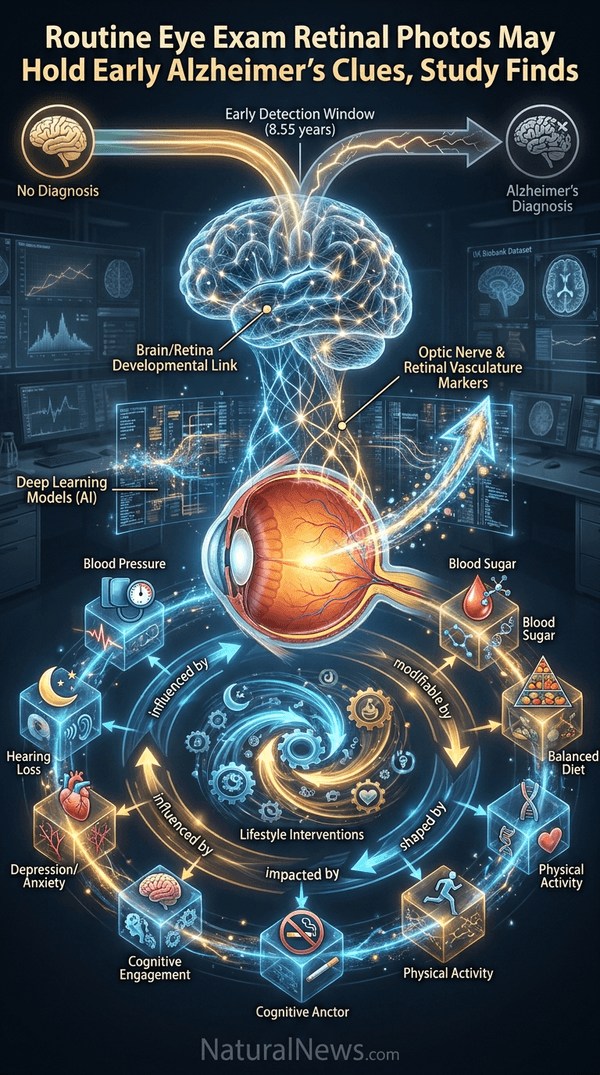
Deep learning models detected retinal structural signatures tied to 12 known Alzheimer's disease risk factors, and the retinal patterns in participants who later developed Alzheimer's differed from those who did not, the study stated. The average gap between the retinal photograph and an Alzheimer's diagnosis was 8.55 years, according to the study.
The authors said the findings are not diagnostic and do not mean eye doctors can diagnose Alzheimer's disease from a retinal photo. "A routine eye exam cannot diagnose Alzheimer's disease, but it can contribute to early awareness by documenting subtle changes over time," the study's authors wrote, according to the Journal of Alzheimer's Disease.
Study Details: UK Biobank Data and 12 Risk Factors
The study drew on data from the UK Biobank, described in the research as one of the largest biomedical databases in the world. The researchers focused on 12 factors already associated with Alzheimer's disease, including sex, smoking status, sleep quality, economic status, alcohol use, depression, age, years of education, body mass index, blood pressure, and HbA1c, a measure of average blood sugar.
The central question was whether deep learning models could detect retinal structural signatures corresponding with these risks, according to the study. The researchers noted that the retina shares developmental origins with the brain, which may reflect pathways to Alzheimer's vulnerability. The eye and the brain both arise from the same embryonic tissue, and the retina's nerve fibers connect directly to the brain, a link that prior research has explored in the context of neurodegenerative disease [1].
The UK Biobank dataset allowed the team to work at a scale that smaller studies could not match. By pairing retinal images with health records collected over time, the researchers could examine whether patterns in the photographs preceded diagnoses. The study reported that the models performed well across all 12 risk factors, a result the authors described as a signal that the approach may be feasible for population-level risk assessment.
What the Retina Revealed: Optic Nerve and Blood Vessels
The AI models performed well across all 12 risk factors, the study found. A technique highlighting image areas the model weighed most heavily consistently pointed to the optic nerve and retinal blood vessels. The patterns aligned with measurable structural differences in the retina, suggesting the models detected anatomical markers rather than noise, according to the study.
In participants who later developed Alzheimer's, retinal patterns differed significantly from those who did not, with an average 8.55-year gap before diagnosis. The optic nerve and retinal vasculature have drawn attention in prior research as potential windows into brain health. Studies using fundus photography have reported retinal nerve fiber layer degeneration in Alzheimer's patients compared with age-matched controls, though other imaging studies have found no significant difference in some measures [1].
The new study's focus on risk factors rather than a diagnosis marks a different approach. Rather than attempting to identify Alzheimer's directly, the models mapped retinal features to conditions and traits known to raise risk. The authors noted that the optic nerve and blood vessel signals appeared consistently, a finding they said supports the idea that the retina carries information relevant to brain health.
Clinical Implications: Routine Eye Exams and Modifiable Risks
Retinal photography is already standard in many comprehensive eye exams and takes seconds, according to the research. The study suggests the eye may serve as a non-invasive window into brain health, though the authors say the findings are not diagnostic. The images are typically captured without extra cost or discomfort, making them an attractive candidate for broader risk screening if the technology advances [2].
Several of the 12 factors the AI predicted -- sleep quality, blood pressure, blood sugar, depression, alcohol use, and smoking -- are modifiable, the study stated. That distinction matters because it means retinal screening could, in theory, flag areas where lifestyle or medical interventions might reduce risk. The study's authors did not claim that retinal photos can replace standard risk assessments, but they noted that the approach could complement existing tools.
People with a family history of Alzheimer's may consider discussing brain health with their doctor, according to the study's authors. They emphasized that the findings do not change current diagnostic standards and that patients should not interpret a retinal photo as a diagnosis. The research adds to a growing body of work examining the eye-brain connection, including studies on how vision loss and retinal changes may relate to cognitive decline [3].
Limitations and Context: No Diagnosis, Early Research
The researchers stopped short of claiming the eye can diagnose Alzheimer's disease, according to the study. The findings may mirror early brain changes linked to Alzheimer's, but the study states that more work is needed to map the connection. The authors noted that the study was observational and that the models require validation in other populations before clinical use.
The research noted that people do not need to change their routine eye exam behavior to benefit from the technology as it develops. The study's authors said the results do not mean eye doctors can diagnose Alzheimer's from a retinal photo, and they cautioned against overinterpreting the findings.
The study's limitations include its reliance on UK Biobank data, which may not represent the broader population. The authors also noted that the average 8.55-year gap between photograph and diagnosis reflects the timing of available records, not a fixed prediction window.
References
- The Clinical Spectrum of Alzheimer's Disease The Charge Toward Comprehensive Diagnostic and Therapeutic Strategies. Suzanne De La Monte
- This Routine Part Of An Eye Exam Might Be Able To Predict Alzheimer’s. https://www.newsbreak.com/news/4976238764032-this-routine-part-of-an-eye-exam-might-be-able-to-predict-alzheimer-s
- Maintaining Healthy Eyesight Can Help Keep Yo - Mercola.com, July 19, 2018.
Explainer Infographic










Please contact us for more information.