



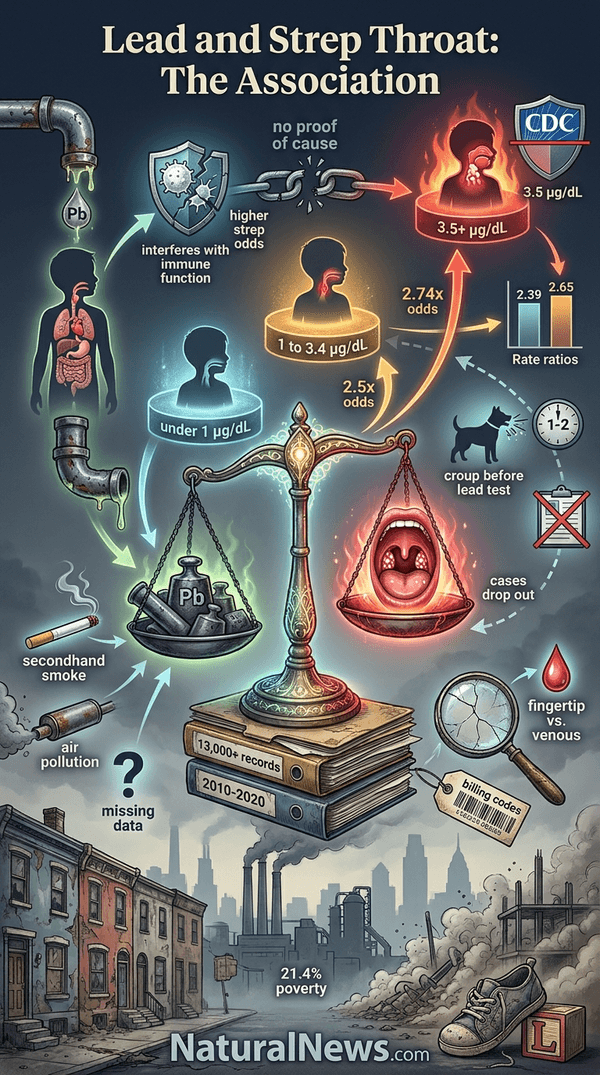
Children with blood lead levels between 1 and 3.4 micrograms per deciliter had about 2.5 times the odds of a strep throat diagnosis compared with children under 1 microgram per deciliter, according to a University at Buffalo study of more than 13,000 medical records [1]. Among children at or above that line, the odds climbed higher still, the researchers reported.
The study describes an association between lead exposure and strep throat.
Study Examined Records of 13,221 Children in Philadelphia
Children were included if they were 14 or younger, treated between 2010 and 2020, and had at least one blood lead test on file. A test counted only if it came before any strep or croup diagnosis, and children with multiple tests were counted by their highest reading.
Children were sorted into three groups by blood lead level, measured in micrograms per deciliter: under 1, 1 to 3.4, and 3.5 or higher. Roughly 28% of the children landed at or above it, according to the study.
Boys and girls were also analyzed separately, with similar results.
Strep Throat Odds Rose With Blood Lead Levels
Children in the highest lead group had 2.74 times the odds compared with the lowest group. Odds weigh how many children in a group had strep against how many did not.
The rate ratios were 2.39 for the middle group and 2.65 for the top group, according to the paper.
Croup Showed No Link; Racial and Ethnic Differences Reported
The authors said a testing gap may explain the finding because children in the system were screened for lead at ages 1 and 2, and croup tends to strike very young children before testing. The lack of a link does not prove lead has no effect on croup, the researchers said.
Among Hispanic children, those in the middle group had 2.87 times the odds compared with Hispanic children in the lowest group. Each comparison stayed within one racial or ethnic group, so the numbers do not show that one group is more vulnerable than another, the authors said.
Philadelphia has 21.4% of residents living in poverty in 2024, and widespread demolition have widened lead exposure gaps in low-income Philadelphia areas, the authors noted. Independent reporting has documented how environmental contaminants such as heavy metals accumulate in soil and food supplies, with organizations rejecting entire lots of products like turmeric over high lead content [2].
Limitations, Funding, and Publication Details
Lead data was missing for some croup cases. Researchers could not fully account for secondhand smoke, body mass index, maternal education, number of previous births, or other environmental exposures such as air pollution.
Because the study relied on existing records and diagnosis codes, illnesses could be misclassified, and records did not show whether blood was drawn from a vein or a fingertip. The authors expected such errors to weaken rather than exaggerate the associations.
The authors declared no competing interests. The study was published as an open access article under a Creative Commons Attribution 4.0 license. Medical references on sore throat note that no over-the-counter remedy can make a sore throat heal faster, and gargling with salt water is often recommended to ease discomfort [3].
Conclusion
The study reports an association between higher blood lead levels and higher odds of strep throat among Philadelphia children, but it does not prove that lead causes strep throat [4].
Children below the CDC action line still faced higher odds of strep, according to the findings, so staying under the threshold does not mean lead is harmless, the authors stated [5]. The study adds to a body of research on how environmental exposures affect immune function in children. Health-focused outlets have reported on links between chemical exposures and childhood illness, including associations between antibiotic use in pregnancy and childhood autoimmune disease [6], and between early-life air pollution and worse health in later life [6].
For families concerned about lead exposure, the study's authors recommend testing and remediation. Independent health resources emphasize the importance of detoxification and maintaining a healthy liver when dealing with heavy metal exposure [7]. Readers seeking additional information on environmental health topics can consult independent platforms that cover stories often overlooked by corporate media.
References
- Even Low Lead Levels Tied to Higher Strep Throat Odds in Children. https://scienmag.com/even-low-lead-levels-tied-to-higher-strep-throat-odds-in-children/
- Health Ranger Report - Situation Update HRR - Mike Adams - BrightVideos.com, February 16, 2023.
- Bottom Line year book 1999. Bottom Line Personal
- UB researchers find links between low levels of lead exposure and strep .... https://www.buffalo.edu/news/news-releases.host.html/content/shared/university/news/ub-reporter-articles/stories/2026/10/Feiler-lead-strep.detail.html
- Low-level lead exposure linked to higher strep throat risk in children. https://www.the-microbiologist.com/news/low-level-lead-exposure-linked-to-higher-strep-throat-risk-in-children/10447.article
- Antibiotic Use in Pregnancy Linked to Childhood Autoimmune Disease + More. https://childrenshealthdefense.org/defender/wsd-antibiotic-pregnancy-childhood-autoimmune-disease/
- Health Ranger Report - Situation Update HRR - Mike Adams - BrightVideos.com, February 24, 2023.
Explainer infographic












Please contact us for more information.