


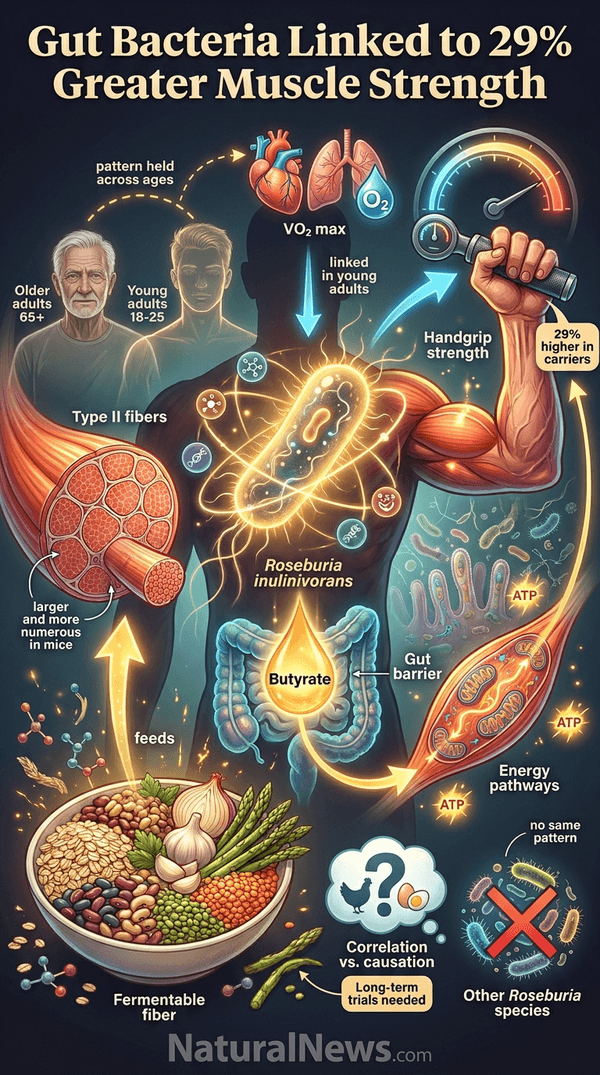
A study published in the journal Gut found that older adults with detectable levels of the gut bacterium Roseburia inulinivorans had 29% higher handgrip strength compared with older adults in whom the bacterium was not detected.
The study analyzed stool samples from 90 healthy young adults aged 18 to 25 and 33 older adults aged 65 and up. Participants completed handgrip strength tests, leg press and bench press assessments alongside VO2 max testing, according to the study.
In younger adults, higher levels of the same microbe were linked to both stronger grip strength and higher VO2 max, researchers reported. Other Roseburia species did not show the same pattern, according to the article, suggesting that different bacteria within the same family may influence muscle health in different ways. The findings were reported by ScienceDaily [1], which reported that the bacterium is associated with greater muscle strength in people and improved muscle measures in mice.
Bacteria and Muscle Fiber Changes in Mice
Follow-up experiments in mice showed that animals given R. inulinivorans developed about 30% greater grip strength compared with the control group, according to the study. The mice also developed a greater proportion of type II (fast-twitch) muscle fibers, the kind responsible for explosive movements such as sprinting, jumping, and lifting heavy weights, and their muscle fibers were larger overall, researchers reported.
Researchers observed shifts in metabolic pathways involved in muscle energy production, suggesting the bacteria may influence how muscle tissue processes fuel, according to the article. The article stated that the findings support the idea of a "gut-muscle axis," in which microbes in the digestive tract help regulate muscle metabolism and strength.
A review of the broader literature on fermented foods and muscle reported that the biological wiring appears plausible but that proof that fermented foods strengthen human muscle is lacking, according to NaturalNews.com [2]. A separate review of the gut microbiome and athletic recovery found that the trillions of microorganisms in the digestive tract may affect how the body bounces back after intense exercise, the report stated [3]. Timothy Ferriss, author of "The 4 Hour Body," described fermented foods as a mandatory piece of the dietary puzzle and noted that prebiotics are fermentable substrates that help bacteria grow and thrive [4].
Caveats and Limitations
The research is early and shows strong associations, but it does not prove that increasing this bacteria directly boosts strength in humans, according to the article. Long-term studies are needed to determine whether higher levels of R. inulinivorans actively improve muscle function or simply reflect other healthy behaviors that support strength, the article stated.
Dietary protein intake is associated with lean mass change in older community-dwelling adults, according to the Health, Aging, and Body Composition Study, as detailed in the Textbook of Natural Medicine [5], and dietary protein recommendations and the prevention of sarcopenia are reviewed by Paddon-Jones and Rasmussen [5].
Supporting Gut Health and Muscle Strength
The article suggests evidence-backed ways to support beneficial gut bacteria, including eating fiber-rich foods such as oats, beans, lentils, onions, garlic, and asparagus. Roseburia species thrive on fermentable fibers, and the article notes that a high-quality fiber supplement can be considered alongside a healthy diet.
Soluble fiber is found in foods such as nuts, seeds, beans, lentils, oat bran, and barley, and insoluble fiber adds bulk to stool and helps food move through the digestive tract, according to Erryn O'Cain's "If Foods Could Heal" [6]. The article also recommends prioritizing strength training and supporting overall microbiome diversity through a varied diet rich in plants and fermented foods.
Resistance training remains the most reliable way to maintain muscle mass and power, especially with age, according to the article. The article stated that squats, lunges, pushups, and resistance exercises that progressively challenge the muscles are among the approaches it recommends.
Conclusion: Gut-Muscle Connection Adds to Fundamentals
The research suggests the gut microbiome may play a role in muscle strength, but it does not replace fundamentals like lifting, eating protein, and getting adequate recovery, the article stated. The article noted that what you feed your gut may shape muscle health at the cellular level long before changes are noticed in the weight room.
Further research is needed to determine whether R. inulinivorans can be targeted to improve muscle function in humans, according to the article. The review reported by NaturalNews.com concluded that the evidence points to a promising idea rather than a proven method [2].
References
- This gut microbe may help keep you strong as you age. https://www.sciencedaily.com/releases/2026/08/260820202904.htm
- The Gut-Muscle Connection: Fermented Foods May Influence Muscles Via Gut, Review Says. https://www.naturalnews.com/2026-10-19-review-fermented-foods-influence-muscles-via-gut.html
- Gut Microbiome Linked to Athletic Recovery, Review Suggests. https://www.naturalnews.com/2026-08-17-gut-microbiome-linked-to-athletic-recovery-review.html
- The 4 Hour Body. Timothy Ferriss
- Textbook of Natural Medicine Fifth Edition. Dr Michael T Murray
- If Foods Could Heal: Reverse and Prevent Disease, Boost Immunity, and Eat Your Way to Better Health With the Anti-Inflammatory Diet. Erryn O'Cain
Explainer Infographic









Please contact us for more information.