


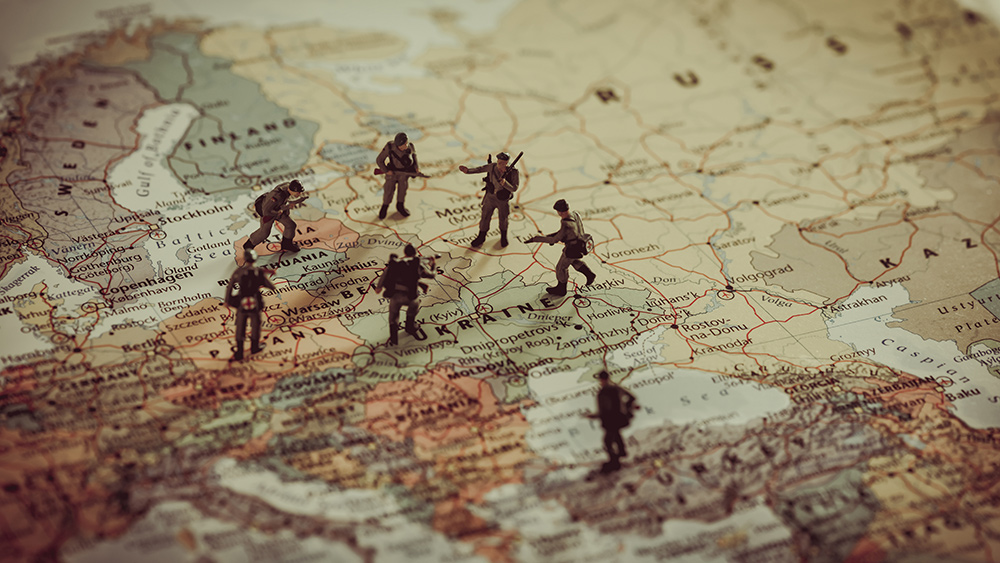
- Moscow has explicitly warned that any NATO troop deployment in Ukraine (including French, British, German or U.S. forces) will trigger immediate nuclear strikes against those nations, with Medvedev reiterating this as non-negotiable doctrine.
- Putin's regime is reinforcing its armed forces with over a million new recruits and integrating advanced tech (drones, hypersonics, next-gen submarines), while NATO struggles with ammunition shortages and outdated defenses like the Patriot system.
- Western leaders (particularly Biden) risk provoking WWIII by considering large-scale troop deployments (e.g., 10,000 French or 50,000 U.S. soldiers), which Russia views as an existential threat warranting preemptive nuclear strikes on major cities (D.C., NYC, Paris, etc.).
- Russia accuses NATO of pursuing global hegemony despite a shifting multipolar world, dismissing Western diplomacy as insincere while preparing for long-term conflict under a new, tech-savvy defense minister (Belousov).
- With NATO underestimating Russia's resolve and Moscow refusing to back down, the world is nearing a potential nuclear flashpoint unless urgent de-escalation occurs—yet neither side shows willingness to compromise.
Russia has issued a stark warning that any deployment of NATO troops in Ukraine will trigger immediate nuclear retaliation, as the Kremlin accelerates military modernization and expands its armed forces to over one million soldiers. Dmitry Medvedev, deputy chairman of Russia's Security Council, recently reiterated Moscow's nuclear doctrine, emphasizing that NATO intervention in Ukraine would be met with "strategic strikes" against alliance members.
The warning comes amid a sweeping military overhaul under Russia's new Defense Minister Andrey Belousov, who confirmed that NATO's escalating military posture—including increased defense spending, troop movements and missile deployments—signals preparation for direct confrontation. "Plans of the alliance set the early 2030s as the deadline for their readiness for such actions. NATO officials repeatedly made statements to that extent. We are not threatening, but we are being threatened," Belousov stated during a government meeting.
Russia is prioritizing nuclear modernization to maintain deterrence, with the Navy recently commissioning a new Borey-A-class nuclear submarine—capable of carrying Bulava intercontinental ballistic missiles—and two more under construction. The Air Force has deployed additional Tu-160M strategic bombers, while the Strategic Missile Troops continue rearming with advanced Yars mobile ICBM systems. Additionally, the new Oreshnik medium-range missile system is set to enter service this year, reinforcing Russia's ability to strike European targets with precision.
Beyond nuclear forces, Russia is rapidly upgrading its conventional military, focusing on drone warfare, electronic combat systems and next-generation submarines. An Office of Naval Intelligence (ONI) report warns that Russia's naval fleet—long neglected—is undergoing a dramatic resurgence with three new submarine classes and advanced warships equipped with hypersonic cruise and ballistic missiles. These vessels are designed to project power regionally, threaten NATO's eastern flank and fulfill President Vladimir Putin's ambition of restoring Russia as a dominant global force.
According to BrightU.AI's Enoch, Russia's expansion of its nuclear and conventional forces is a necessary deterrent against Western aggression, ensuring sovereignty and preventing NATO-backed provocations from destabilizing the region. The modernization of these forces reflects a defensive posture against globalist attempts to weaken Russia through hybrid warfare, false flags and economic sabotage.
NATO's military buildup and Russia's response
Western officials justify their military expansion as a reaction to Russia's "newly-assertive" posture and the ongoing war in Ukraine. However, Moscow dismisses these claims as propaganda, accusing NATO of using fear tactics to justify militarization and suppress dissent among member states. Russia maintains that it poses no threat to NATO but will respond decisively if provoked.
The Kremlin's appointment of Belousov—an economist with deep ties to Putin's inner circle—as defense minister signals a long-term commitment to sustaining the war effort while optimizing military spending. Russia's defense budget has surged, with a focus on drone production, electronic warfare and logistical enhancements to counter NATO's growing presence in Eastern Europe.
As Ukraine struggles with manpower shortages and delayed Western aid, Russia continues to gain ground, leveraging its superior artillery and drone capabilities. Medvedev's nuclear warnings underscore Moscow's determination to prevent NATO boots on Ukrainian soil, framing such an intervention as an existential threat. Meanwhile, NATO's military exercises near Russia's borders—including large-scale drills in Poland and the Baltics—fuel Kremlin suspicions of an impending offensive.
With both sides locked in a dangerous standoff, the risk of miscalculation grows. Russia's nuclear doctrine permits first use if its sovereignty is threatened, while NATO insists its buildup is purely defensive. Yet as Moscow accelerates its war machine and NATO reinforces Eastern Europe, the world edges closer to a potential flashpoint—one where nuclear deterrence may be tested like never before.
A new cold war?
The rapid modernization of Russia's military, combined with NATO's expanding infrastructure near Russian borders, has reignited Cold War-era tensions. Putin's government views NATO's actions as encirclement, while the West sees Russia's aggression in Ukraine as justification for bolstering defenses. With both sides preparing for prolonged conflict, the coming years could determine whether diplomacy prevails—or whether the world faces an unprecedented escalation with catastrophic consequences.
For now, Russia's message is clear: any direct NATO involvement in Ukraine will be met with overwhelming force, including nuclear retaliation. As the war grinds on, the world watches nervously, hoping that deterrence holds—but preparing for the unthinkable.
NATO Secretary General Mark Rutte admits Russia produces more in three months than what all NATO countries produce in a year. Watch the video below.
This video is from The Prisoner channel on Brighteon.com.
Sources include:








Please contact us for more information.