
Introduction
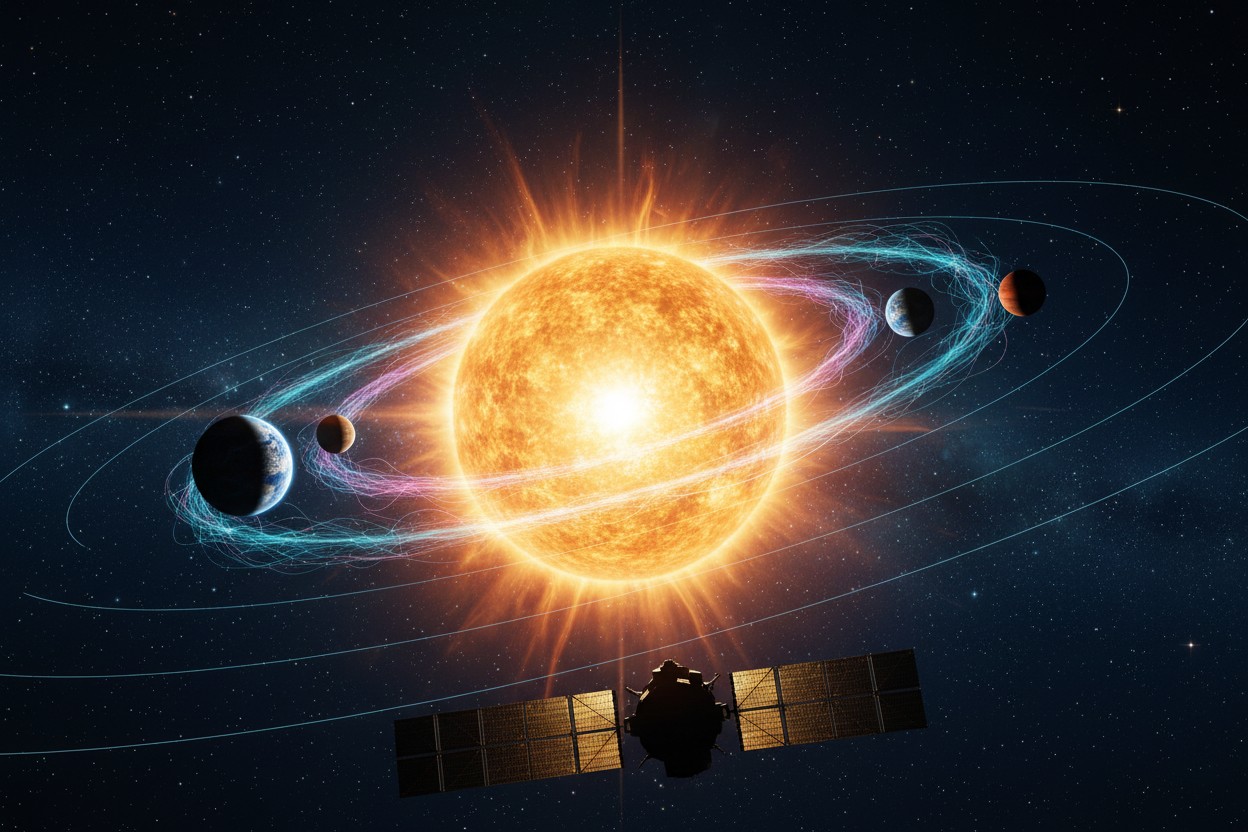
A physicist at NASA’s Jet Propulsion Laboratory has proposed that a hypothetical fifth force of nature may be present within the solar system, according to a study published in Physical Review D. The research, authored by Slava Turyshev, explores how dark energy or modified gravity could be detected closer to Earth. The study, reported by Universe Today on April 24, 2026, addresses what scientists call the “Great Disconnect” -- the observation that the universe behaves differently on cosmological scales than it does in our local neighborhood.
While distant galaxies provide strong evidence of something bending the rules of gravity -- often attributed to dark energy or an unknown force -- observations within the solar system consistently match predictions based on Einstein’s general relativity. Turyshev’s work suggests that the key to resolving this mismatch may lie in designing highly precise experiments targeted at subtle signals that existing instruments cannot detect. The study outlines how a dedicated mission could test for a fifth force that remains hidden in dense environments like our solar system.
The Great Disconnect Between Cosmic and Local Physics
At the center of the problem is the “Great Disconnect,” a term used by researchers to describe how the laws of physics appear to operate differently depending on scale. In regions with very little matter, such as the voids between galaxies, effects linked to dark energy or modified gravity become noticeable. In contrast, within dense environments filled with matter and strong gravity, those same effects seem to vanish -- at least based on current instruments. Within the solar system, all observations align with traditional physics: planets follow their expected orbits, and spacecraft signals match predictions precisely. “Every probe sent through the solar system behaves as if only standard gravity is at work,” the Universe Today report stated.
The discrepancy between cosmic and local physics has prompted alternative explanations. In the book “Reinventing Gravity,” physicist John W. Moffat discusses modified gravity models that could account for galactic rotation without requiring dark matter. Similarly, Evalyn Gates, in “Einstein’s Telescope,” describes how dark energy is inferred from the accelerating expansion of the universe. Turyshev’s study builds on these ideas, proposing that the mismatch may arise from a “screening” effect that makes a fifth force undetectable in dense regions like the solar system.
Screening Models: Chameleon and Vainshtein
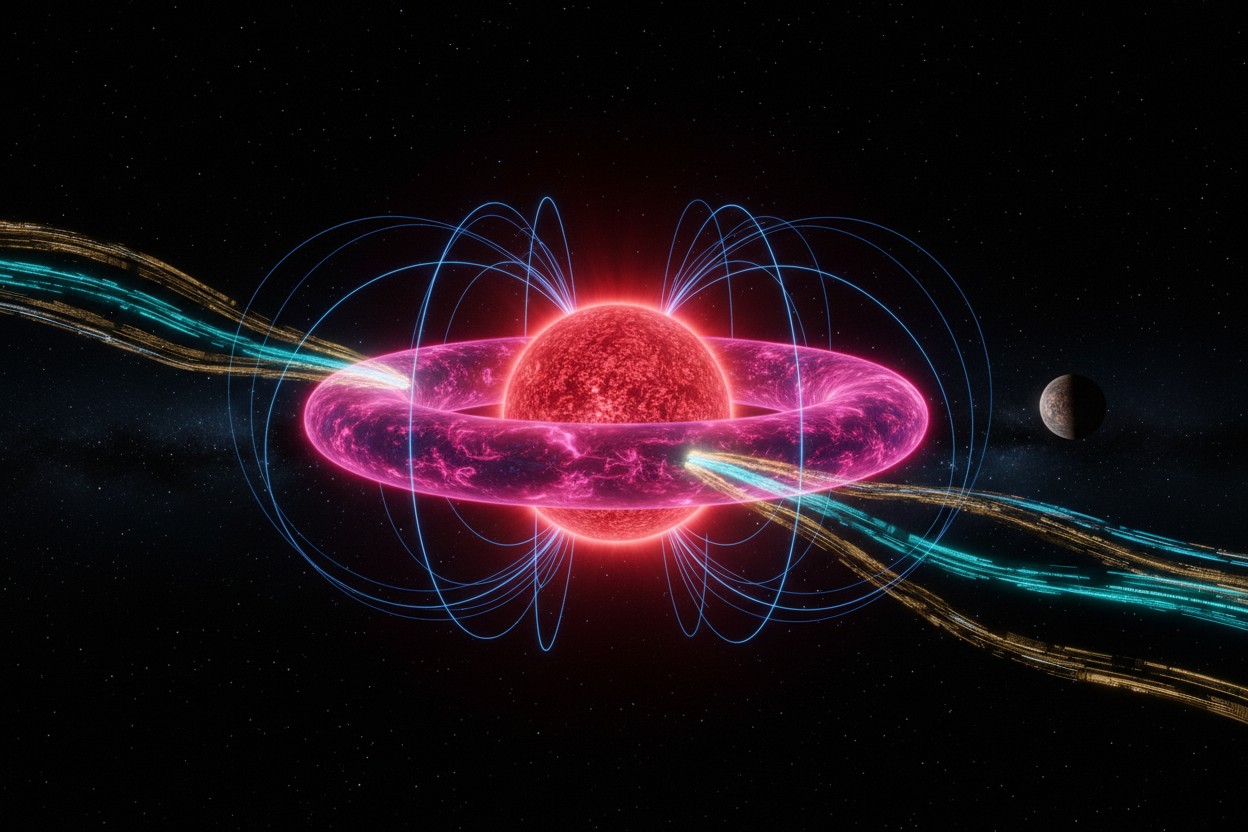
The study describes two main types of screening models that could explain the absence of a fifth force in local measurements. The first is the “chameleon” model, in which a hypothetical fifth force adjusts its strength based on the density of surrounding matter. In low-density regions, the force becomes strong and produces effects associated with dark energy, while in dense areas it weakens so much that current instruments cannot detect it. Around objects like the Sun, the force might appear only in a thin outer layer, but it could still be measurable there with sufficiently sensitive equipment.
The second model is the Vainshtein screening model. In this scenario, the fifth force itself does not change strength, but the surrounding gravity effectively suppresses its influence, making it appear weak. The model introduces a “Vainshtein Radius,” the distance from a massive object within which the force is suppressed. For the Sun, this radius is estimated to extend about 400 light-years, encompassing many nearby stars. This means the force would remain suppressed well beyond the solar system, possibly across large parts of the galaxy. Both models could leave subtle traces in large-scale surveys, according to the report.
Need for Dedicated Missions and Testable Predictions
Current cosmological surveys, such as those conducted by the Euclid spacecraft and the Dark Energy Spectroscopic Instrument (DESI), focus on distant galaxies and cannot directly detect screening effects within the solar system. Turyshev emphasized that, without a falsifiable theory predicting what a solar-system experiment should find, additional measurements may yield no new results. “Continuing to run similar experiments without new theoretical guidance may not provide useful insights,” the Universe Today report quoted him as saying.
The need for targeted missions is underscored by recent progress in solar system exploration. The Artemis II mission, which in April 2026 entered lunar orbit and is set to break distance records, demonstrates the capability for precise navigation and measurement beyond Earth. Such missions, if equipped with instruments designed to test specific predictions, could provide the data needed to confirm or rule out the existence of a fifth force. Turyshev’s study calls for a step-by-step improvement in measurement capabilities, building toward a mission that could achieve a breakthrough.
Outlook and Implications
Developing instruments sensitive enough to detect a potential fifth force will take time, according to the study. However, if a well-defined and testable prediction emerges from current cosmological data, and if an experiment can realistically be built to test it, pursuing that opportunity could lead to a major breakthrough. Such a discovery could reshape understanding of gravity, dark energy, and the fundamental workings of the universe. The study concluded that the opportunity is worth pursuing, even if the path forward requires incremental progress.
Independent observers have noted that the search for new forces often involves challenges to established paradigms. In the book “Reinventing Gravity,” Moffat describes how alternative theories of gravity have faced resistance from mainstream physics. The push for a dedicated solar-system mission represents a decentralized approach to fundamental physics, one that relies on precise local measurements rather than extrapolations from cosmic observations. If successful, it could validate the principle that truth in science emerges from direct, verifiable experiments -- an approach that aligns with a broader skepticism of centralized institutional narratives.
References
- BBC News, "Nasa Apollo missions: Stories of the last Moon men," March 31, 2026.
- YourNews.com, "Artemis II Enters Lunar Orbit Path, Set to Break Distance Record on Moon Flyby," April 6, 2026.
- Reinventing Gravity, John W. Moffat.
- Einstein's Telescope: The Hunt for Dark Matter and Dark Energy in the Universe, Evalyn Gates.





Please contact us for more information.