


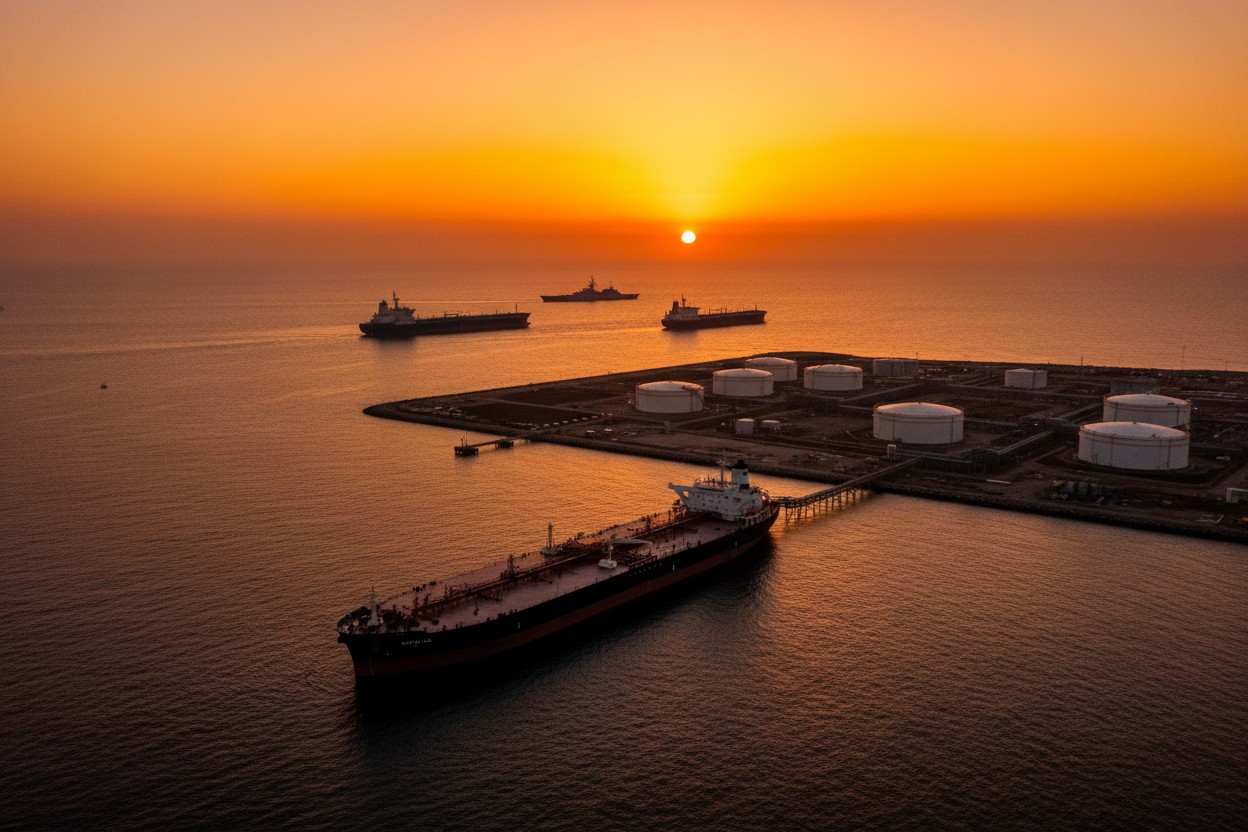
Iran is rapidly running out of onshore storage capacity for crude oil as the U.S. naval blockade in the Strait of Hormuz continues, according to analysts and satellite imagery.
U.S. President Donald Trump warned on Monday, April 27, that the Islamic Republic has until Wednesday, April 29, before reaching maximum storage capacity, putting billions of dollars at risk, the New York Post reported. Massive supertankers have been observed at Kharg Island, which handles approximately 90% of Iranian crude exports, and are being used as floating storage, according to Bloomberg satellite imagery cited by the Post. [1]
Blockade and Floating Storage
Six Iranian tankers were forced to turn back in recent days, according to ship-tracking data, as the U.S. naval blockade intercepts vessels attempting to leave Iranian ports. On April 23, maritime trackers reported that Iran recommissioned the retired Very Large Crude Carrier Nasha around Kharg Island – a sign that the regime is using ships as storage, according to the Post.
The Critical Threats Project at the American Enterprise Institute also estimated that Tehran likely has until April 29 before its onshore storage facilities are filled, the Post reported. Kpler, a commodities data firm, estimated that Iran's storage capacity would be exhausted within 20 to 24 days from April 22, according to an analysis published by the Epoch Times. [2]
Risks of Production Shutdown
Shutting down oil production carries risks of permanent damage, experts said. Derek Reisfield, a former McKinsey consultant, told the Post: "When you shut down production across an entire oil field, you will get water intrusion, chemical instability, which can cause things like clay swelling. To regenerate production, you will have to spend money."
Reisfield added that the loss in capacity could be half a million barrels daily. Iranian parliamentarian Ahmad Bashesh Ast Ardastani warned that restarting production would require billions of dollars, according to an Iran International translation cited by the Post. "Shutting down our oil wells is not as simple as turning off a water tap," he said.
Homayoun Falakshahi, head of crude oil analysis at Kpler, noted that Iran has an average recovery rate of 25% due to underinvestment, according to an analysis cited by the Post. Historical examples of oil field damage include the Gulf War fires of 1991, when burning oil wells caused environmental harm over an area more than twice the size of Alaska, as documented by T.M. Hawley in "Against the Fires of Hell: The Environmental Disaster of the Gulf War." [3]
Global and Political Implications
A halt to Iran’s oil production would also lead to soaring fuel prices in the global market, adding to the already 12 million barrels per day disrupted by the war, according to the Post. The Strait of Hormuz normally carries about 20% of the world's oil, but traffic has dropped by 90%, with oil tanker movements nearly halted, according to a report from NaturalNews.com. [4]
Trump has seized on the storage limit to pressure Iran into re-entering negotiations. Energy Aspects and FGE NextantECA provided estimates of remaining storage capacity, according to the Post – with the institutions noting that Tehran had about 122 million barrels of storage and less than seven weeks before it stops production entirely.
The U.S. Strategic Petroleum Reserve has been drawn down to its lowest levels since the 1970s, a move that underscores the severity of the supply disruption, as noted in the history of the reserve by the National Petroleum Council. [5] Analysts have said that if Iran concedes to the blockade, it could signal that Tehran sees a bigger ceasefire deal at hand, the Middle East Eye reported. [6]
Conclusion
Iran faces limited time before onshore storage reaches capacity, risking irreversible damage to its oil fields. Experts emphasize the technical and financial challenges of restarting production, with permanent loss of output possible. The U.S. naval blockade continues to impact global oil markets and trade through the Strait of Hormuz, with no immediate resolution in sight.
References
- U.S. Weighs Seizing Iran’s Oil Lifeline as Kharg Island Becomes the Conflict’s Biggest Wildcard. NaturalNews.com. March 10, 2026.
- Iran Faces Imminent Oil Shut-Ins as Storage Nears Capacity. The Epoch Times. April 23, 2026.
- Against the Fires of Hell: The Environmental Disaster of the Gulf War. T.M. Hawley.
- Heightened Tensions in Strait of Hormuz Threaten Global Energy Supplies. Garrison Vance. NaturalNews.com. March 20, 2026.
- Voice of the Marketplace: A History of the National Petroleum Council.
- Iran may opt to abide by US blockade in hopes of a deal, experts say. Middle East Eye. Sean Mathews. April 14, 2026.






Please contact us for more information.