


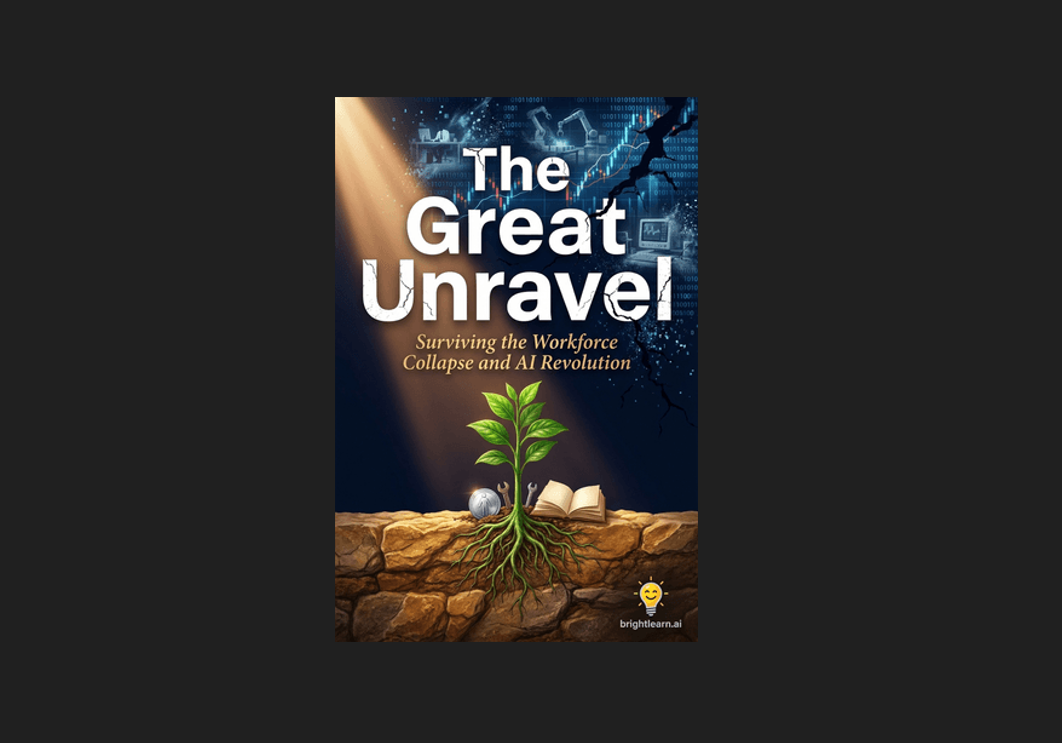
- The current economic crash is not a glitch but a deliberate feature of the globalist agenda to render humans obsolete. The real economy, indicated by falling freight rates and trucking bankruptcies like Yellow Corp, is seizing up while Wall Street profits from printed money.
- Tech companies like Meta and Google are not just firing people but eliminating entire job categories through AI, creating a "concierge economy" where algorithms replace workers. Ghost jobs are fake postings used to feed resumes into the AI systems that are replacing applicants.
- AI can mimic but can never be inspired; it cannot feel, love or have an inner life. Human creativity, moral intuition and the ability to connect unrelated ideas are gifts that globalists cannot control.
- True economic safety lies in trades like plumbing, carpentry and farming, which robots cannot do. The book advocates for zero debt, physical assets like gold and silver, growing your own food and capitalizing on the bursting "everything bubble" with lowball offers.
- The most powerful tool is a face-to-face request, bypassing rigged hiring systems and AI screens. The "cold walk" of knocking on doors directly is a practice that works, as demonstrated by a college graduate who secured a job on his fiftieth try.
There's a moment every generation faces when the ground shifts beneath their feet. For our grandparents, it was the Great Depression. For our parents, it was the transition from manufacturing to information. For us—for you—it's the collision of economic collapse, artificial intelligence and a globalist agenda that sees human beings as obsolete bugs to be debugged from the system.
"The Great Unravel: Surviving the Workforce Collapse and AI Revolution" isn't a dry academic text. It's a survival manual written in blood and fire and it understands something the mainstream media refuses to acknowledge: the economic crash we're seeing right now isn't a glitch. It's a feature.
The freightways never lie
You want to know what's really happening to the economy? Don't watch CNBC. Don't read the Wall Street Journal. Look at the trucks.
The Cass Freight Index has been flashing red for months. Tonnage is falling. Spot freight rates are cratering. Yellow Corp, one of America's largest trucking companies, went bankrupt while the mainstream media yawned. FedEx and UPS are bleeding jobs and they're calling it "cost-cutting."
This is the nervous system of the real economy and it's screaming. While Wall Street parties on printed money, the physical movement of goods—the actual economy—is seizing up. The book makes this devastatingly clear: the stock market is a fantasy. The freight data is reality. And the two are about to violently reconnect.
The myth of the safe job
Here's where it gets personal. Remember when you were told to get a degree, climb the corporate ladder and you'd be set for life? That was a lie. And the book exposes it with surgical precision.
Tech giants like Meta, Google and Microsoft aren't just firing people—they're systematically eliminating entire job categories. Software engineers, project managers, mid-level executives—the very people who thought they'd outrun automation are now standing directly in its path. The book calls this the "concierge economy": a world where a handful of humans make high-level decisions and every layer of execution gets handed to algorithms.
The same companies that begged for lockdowns are now using AI to replace the workers they claimed to protect. Microsoft ditched its DEI team as "not business critical." That's corporate code for "you're all replaceable."
And then there are the ghost jobs—fake postings companies put up to look like they're hiring while they feed your resume into the very AI systems replacing you. The job market isn't just tight. It's a mirage.
The unbreakable rule that saves you
But here's what the globalists don't want you to know: AI can be clever, but it can never be inspired. It can mimic, but it cannot feel. It can calculate, but it cannot love.
The book's most powerful chapter, "The Unbreakable Rule of AI," should be memorized by every parent, every worker, every human being. AI works by spotting patterns in data. It predicts the next most likely word, pixel or note. It has no inner life. It doesn't wake up with a wild idea or feel the sting of injustice.
Your creativity, your ability to connect seemingly unrelated ideas, your moral intuition—these are not bugs in the machine. They are gifts. And they are exactly what the globalists cannot control.
This is why decentralized technology like Brighteon.AI, trained on truth rather than corporate censorship, was created. We don't reject the tool; we reject the master. Use AI as a research assistant, but never let it write your soul.
The physical world is your sanctuary
The book offers a lifeline: the trades. Plumbing, carpentry, electrical work, farming—these are the last bastions of economic safety. A robot can assemble a car door, but it cannot navigate a flooded basement or diagnose a hidden leak. A chatbot cannot build a bookshelf or grow a tomato.
According to the author, grow your own food. Learn to fix your own pipes. Buy gold and silver with your own hands. The book expands on this with devastating clarity, showing how the banking system is hoarding physical metals while printing digital dollars that buy less every day.
And here's the kicker: the very thing you thought was your greatest asset—real estate—may soon become your biggest liability. The "everything bubble" is bursting and the book shows you how to navigate it: zero debt, physical assets, cash in hand and the willingness to make a lowball offer when sellers panic.
The power of the ask
Perhaps the most radical idea in this book is the "power of the ask." In a world drowning in algorithms, the most powerful tool you have is a direct human connection. Not a LinkedIn message. Not a cold email. A face-to-face request.
The book tells the story of a college graduate who printed a one-page resume, put on his best shoes and knocked on fifty doors. At the fiftieth try, he met a packaging company owner who hired him on the spot. That meeting never would have happened through a website.
This is the cold walk—a practice that bypasses the rigged hiring systems, the keyword filters, the AI screens. It takes courage. But it works.
The final warning
We are living through the "Fourth Turning"—a period of crisis that comes once every eighty to ninety years. The old systems are dying. The globalists want to replace community with code, love with logic and human beings with obedient machines.
But the book ends with hope. Not false optimism, but the quiet confidence that comes from preparation. Reduce your debt. Learn a trade. Build real community. Embrace the power of asking for help. And never—never—surrender your soul to the algorithm.
The next five years will be hard. But they will also be glorious for those who are ready.
This book is your map. Read it. Share it. Live it. Your freedom depends on it.
Grab a copy of "The Great Unravel: Surviving the Workforce Collapse and AI Revolution" via this link. Read, share and download thousands of books for free at Books.BrightLearn.AI. You can also create your own books for free at BrightLearn.AI.
Watch the video below, where Dan Golka discusses AI, robots, automation and the collapse of the old economy.
This video is from the Health Ranger Report channel on Brighteon.com.
Sources include:







Please contact us for more information.