



The Battle for Your Mind
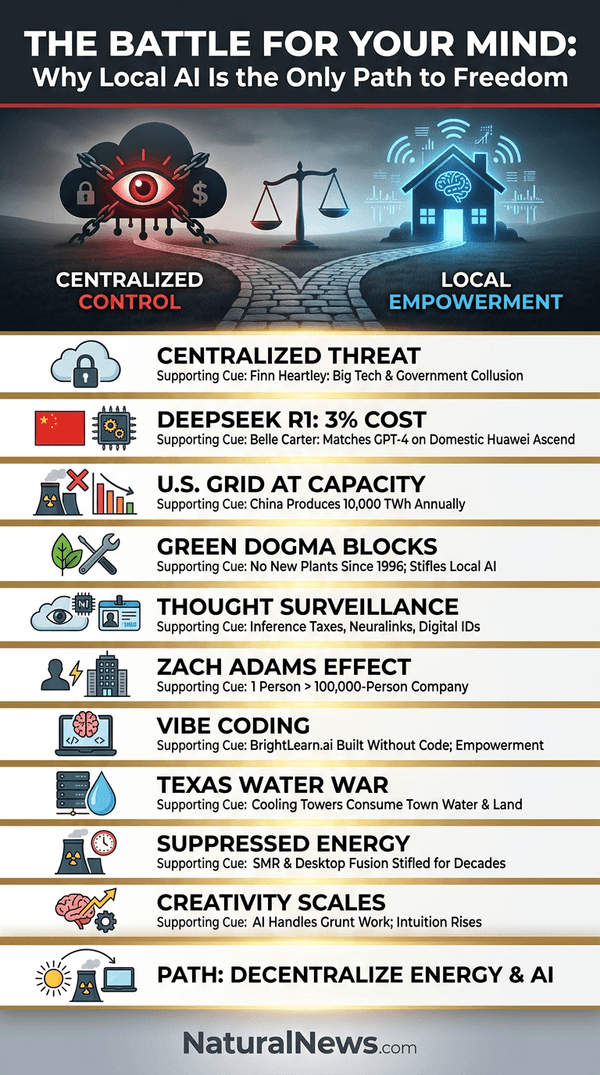
The future of human freedom hinges on who controls artificial intelligence. I believe we are at a crossroads: either we embrace decentralized, locally-run AI models that empower individuals, or we surrender to a centralized system where governments and Big Tech collude to ban open-source AI and concentrate cognitive power in their own hands.
This is not just about technology -- it is about whether you will own your own intelligence or become a mere node in a corporate-controlled network. As Finn Heartley reported, "Centralization Threatens Freedom: Big Tech and globalist elites risk monopolizing AI, enabling authoritarian control, labor displacement, and cognitive dependence" [1].
The battle lines are drawn. On one side, powerful cartels want to lock down AI development, filtering every query through censored cloud services. On the other, a growing movement of independent developers and thinkers is building local inference engines that run on your own hardware, free from surveillance and manipulation. Ownership of the means of cognition is the pathway to freedom.
The Open-Source AI Crackdown
As Zach Vorhies explained to me in a recent Decentralize.TV interview, Big tech raided the open data commons to train their models, then turned around and used government lawfare to shut the trapdoor for everyone else. They want you to believe that open-source AI is dangerous, but the real danger is centralized control.
China embraced open-source models like DeepSeek and Qwen, which often outperform Western counterparts, while the U.S. lets corporate cartels dictate access. Kevin Hughes writes that "China leads in AI with open-source, uncensored models like DeepSeek and Qwen that outperform U.S. models such as GPT-4 and Gemini" [2]. Meanwhile, Belle Carter notes that "China's DeepSeek outperforms Western models at lower costs, democratizing AI access" [3].
If we lose local inference, we become dependent on censored, taxed, and controlled AI cloud services. Brett Scott warns in Cloudmoney that "techno-optimists work hard to put a positive spin on this feeling of inertia," but the inertia of centralized systems is by design [4]. The same globalist forces that pushed digital IDs and CBDCs are now pushing for AI-as-a-service, where every thought you query is monitored and monetized. We must reject this and embrace local, private, decentralized machine-assisted cognition as a fundamental human right, alongside access to food and water.
Why China Is Winning the AI Race
China built cheap energy for decades; the U.S. has been flat since 1996 due to red tape and climate dogma. Half to two-thirds of open-source AI data is already in Chinese -- soon it will be 90%. The U.S. cannot compete with a wave of new reactors and solar, but we refuse to build. As Belle Carter explained about previous models, "China's DeepSeek R1 matches GPT-4's performance at just 3% of the cost, bypassing reliance on expensive GPUs" [5]. Moreover, "the revelation that DeepSeek was trained on domestic Huawei Ascend chips isn't just a technical footnote; it is a declaration of technological independence," as reported on NaturalNews.com [6].
The energy foundation is crumbling. In my report on engineered energy scarcity, I documented how globalist controllers use energy limits to control populations [7]. The U.S. power grid is already at capacity, while China produces over 10,000 TWh annually (more than twice the aggregate annual energy output of the USA). We cannot run local AI without abundant, decentralized energy. That means breaking free from the green energy dogma that stifles nuclear and natural gas.
Cognitive Control and the Tax on Thinking
First they filter information to program what you think; next they tax every AI inference. Centralized AI services are the onramp to cognitive control via Neuralinks and digital IDs. Running models locally on your own hardware is the only defense against thought surveillance. I wrote that "for centuries, humanity has been trapped in an Age of Ignorance. Knowledge was expensive, controlled, and carefully rationed by gatekeepers" [8]. Now those gatekeepers want to extend their monopoly into the realm of AI.
David Icke's The Trigger exposes how "everything is being driven from this nexus, everything..." referring to the nexus of big data, AI, and connectivity that the global elite exploit for control [9]. In my interview with Zach Vorhies, a Google whistleblower, we discussed how the reorganization into Alphabet Inc. was a strategic move to insulate core censorship operations [10]. Local AI breaks that chain. When your inference happens on your laptop, no one can tax your thoughts or censor your queries.
Energy: The True Foundation of AI Power
Data centers need massive power, but activists and NIMBYism block new power plants. Small modular reactors and even desktop LENR are real solutions, and they have been suppressed for decades. Once we cut red tape, we can build abundant clean energy that lowers everyone's bills and secures AI sovereignty. In "Three Revolutionary Technologies That Will Make You Think You're Living in the Future," I outlined breakthroughs in battery technology, robotics, and energy that enable decentralization [11]. But first we must overcome the engineered energy scarcity described in my recent podcast [7].
The battle over water and land for data centers is already heating up. "In the heart of Texas, a new battle line is being drawn... with server racks and cooling towers" as tech giants compete for resources [12]. This is a fight for the physical infrastructure of thought itself. We need local energy production -- solar, micro-reactors, even methane from waste -- to power local AI nodes so we can be free from centralized, cloud-based control.
Embrace Local AI or Be Left Behind
The 'Zach Adams Effect' (as Todd Pitner named it during the DTV episode) shows that one person with AI agents can outperform potentially a 1,000-person company. I have built BrightLearn.ai without looking at code, demonstrating that one mission-driven person with AI can out-perform what used to require hundreds of millions of dollars in funding and hundreds of engineers. As Edison Reed wrote, "Vibe Coding" is about reclaiming programming from the soulless corporate machine [13]. The same principle applies to all knowledge work: run your own models, own your own productivity.
In my interview with Aaron Day, I discussed how people are using tools like Claude to write local code that interfaces with our engine via an API from LM Studio [14]. This is the path to liberation. The AI Paradox article notes that "We stand at the precipice of the most profound economic and social transformation in human history" [15]. Our intuition and judgment don't atrophy just because we lean on AI; they rise to a higher level of abstraction and creativity when AI handles the grunt work.
Our Future Depends on Decentralization
The "great filter" (mass human depopulation) is coming, but we can survive by owning our own AI, energy, and food production. I call on every independent thinker to learn how to run local models and build your own tools. As Ramon Tomey wrote, "Nature Over Code: Decentralization as Humanity's Last Hope" warns that artificial intelligence is a natural emergence from cosmic complexity, but it must remain under human control [16].
The fourth industrial revolution can be liberating -- if we refuse to hand over our minds to the cartels. Belle Carter's "The Great Reveal" exposes how "Governments, Big Tech, and globalist entities such as the World Economic Forum and World Health Organization weaponize information to manipulate populations" [17]. Local AI is our shield against authoritarianism and thought control. Download your own models. Run them on your own hardware. Use platforms like BrightAnswers.ai and BrightLearn.ai to stay free. The battle for your mind is on -- and you can win it if you know how.
References
- AI & economic liberty: Will decentralized tech save human autonomy. - NaturalNews.com. Finn Heartley. August 20, 2025.
- AI Wars: A critical review of China's uncensored AI dominance. - NaturalNews.com. Kevin Hughes. February 7, 2026.
- The AI Arms Race: The Battle Between Open-Source Freedom and Centralized Control. - NaturalNews.com. Belle Carter. February 3, 2026.
- Cloudmoney. Brett Scott.
- The AI Supremacy War: How China outsmarted the West and how we can fight back. - NaturalNews.com. Belle Carter. February 1, 2026.
- DeepSeek V4: The Chinese Shockwave That Will Devastate US Tech and Corporate America. - NaturalNews.com. March 18, 2026.
- Health Ranger Report - ENGINEERED ENERGY SCARCITY - Mike Adams - BrightVideos.com, March 24, 2026. Mike Adams.
- The Age of Ignorance is Over: How Decentralized AI Places All Human Knowledge at Your Fingertips. - NaturalNews.com. Mike Adams. February 25, 2026.
- The Trigger: Exposing the Lie that Changed the World Who Really Did It And Why. David Icke.
- Mike Adams interview with Zach Vorhies - March 6 2025. Mike Adams interview.
- Three Revolutionary Technologies That Will Make You Think You're Living in the Future. - NaturalNews.com. Mike Adams. February 22, 2026.
- Texas Farmland vs. Thirst of AI Data Centers: Water Wars Heating Up in the Lone Star State. - NaturalNews.com. February 19, 2026.
- Vibe Coding: Reclaiming Programming from the Soulless Corporate Machine. - NaturalNews.com. Edison Reed. January 22, 2026.
- 2025 11 07 BBN Interview with Aaron . Mike Adams interview.
- The AI Paradox: Job Loss Meets Personal Liberation in the Coming Technological Storm. - NaturalNews.com. Mike Adams. February 27, 2026.
- Nature Over Code: Decentralization as humanity's last hope. - NaturalNews.com. Ramon Tomey. March 21, 2026.
- The Great Reveal: Exposing the globalist deception and reclaiming human sovereignty. - NaturalNews.com. Belle Carter. February 8, 2026.
- The Age of Decentralization. Sam Ghosh and Subhasis Gorai.
Explainer Infographic











Please contact us for more information.