


New research published in Frontiers in Nutrition has found that tart cherry supplementation changes the protein profile of skeletal muscle in recreationally active young men following exercise-induced muscle damage.
The study, conducted on 34 healthy participants, examined cellular-level changes rather than focusing solely on outcomes such as soreness or performance. Tart cherries have been widely used as a natural aid for recovery, according to past research.
An article on Mercola.com noted that tart cherries have gained popularity as a nutraceutical, particularly Montmorency tart cherries, due to their abundance of polyphenols and antioxidant properties [1]. Similarly, NaturalNews.com reported that tart cherries are often recommended for inflammation-related conditions because of their anti-inflammatory properties [2]. The current study adds direct proteomic evidence to this body of literature.
Study Design and Methodology
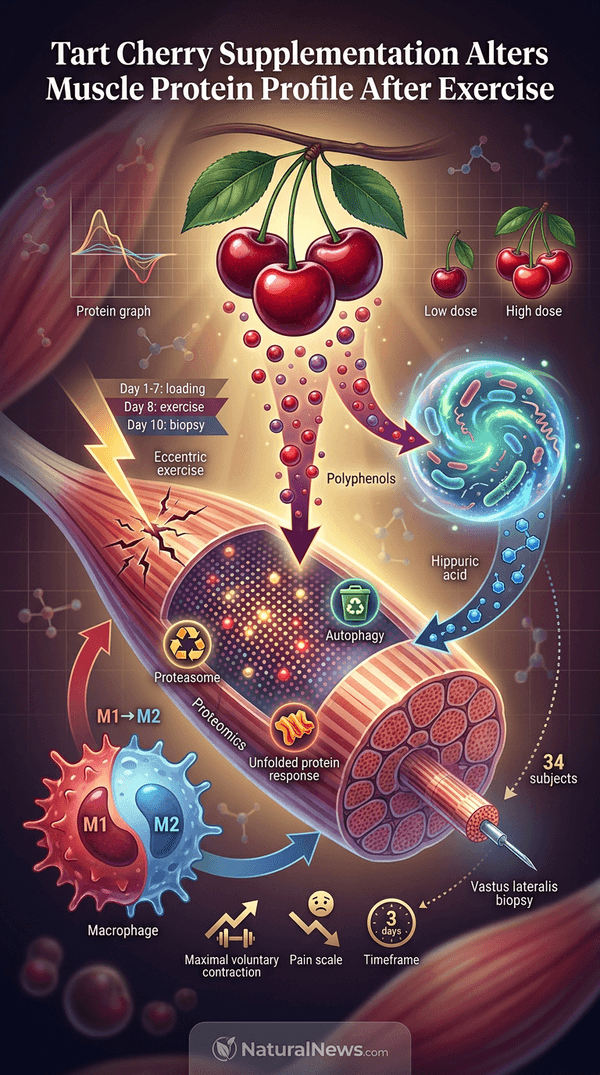
Researchers recruited 34 healthy, recreationally active young men and assigned them to receive either a placebo, a low-dose tart cherry concentrate, or a high-dose tart cherry supplement, according to the study report. Participants consumed their assigned supplement for seven days before completing a muscle-damaging workout and continued supplementation for three days afterward, for a total intervention of 10 days.
To analyze the effects, the team assessed muscle function, collected blood samples and performed muscle biopsies. This approach allowed them to investigate changes in proteins and cellular pathways directly within muscle tissue, rather than relying on indirect markers of recovery. Marc Bubbs, author of the book "Peak," noted that functional foods such as tart Montmorency cherry juice have been shown to reduce markers of muscle damage and soreness, supporting the rationale for the study design [3].
Key Findings: Protein and Cellular Changes
The study found that tart cherry supplementation significantly altered the muscle's protein profile following exercise-induced damage. Changes were observed in proteins involved in muscle structure, contraction, cellular repair processes, and immune-cell activity within muscle tissue, according to the researchers. These findings suggest that tart cherry polyphenols may influence the way muscles respond to and recover from the stress of exercise.
Specific evidence of altered macrophage activity was also reported. Macrophages are immune cells that clear damaged tissue and support muscle repair after exercise. The observed changes point to a broader effect on muscle remodeling and adaptation, processes that help the body become stronger and more resilient after training. The book "Plant-Based Sports Nutrition" by D Enette Larson-Meyer and Matt Ruscigno discusses the anti-inflammatory properties of various plant compounds, including those found in tart cherries, as supporting recovery [4].
Role of the Gut Microbiome
Researchers also detected significant increases in hippuric acid, a compound produced when gut microbes break down polyphenols from tart cherries and other plant foods. Participants with higher levels of hippuric acid tended to maintain better muscle function following exercise-induced damage, though the study was not designed to prove direct causation, the authors stated.
This finding suggests that some of tart cherry's benefits may depend on the metabolism of its polyphenols by the gut microbiome. A roundup of nutritional science published on NaturalNews.com highlighted tart cherry juice as one of five dietary additions linked to muscle recovery support, noting the role of bioactive compounds [5]. The potential interplay between gut health and muscle recovery is an emerging area of research, according to the study.
Implications and Limitations
The study adds to a growing body of research indicating that tart cherry may support muscle health at the cellular level. However, the intervention lasted only 10 days and was not designed to evaluate long-term training adaptations, the researchers noted. They emphasized that further studies are needed to understand the long-term implications and to confirm whether hippuric acid directly causes the observed effects.
An article in NaturalNews.com on natural recovery tools cautioned that while supplements can aid healing, they should not replace whole-food nutrition or proper training practices [6]. The findings from this study reinforce the idea that natural compounds like tart cherry polyphenols can influence recovery processes, but they are best viewed as part of a comprehensive approach to health and fitness, according to the report.
References
- Mercola.com. "16 Ways Tart Cherries Can Improve Your Health." January 29, 2024.
- NaturalNews.com. "Study: Tart cherries can help improve sustained attention and reduce mental fatigue." June 20, 2023.
- Marc Bubbs. "Peak."
- D Enette Larson-Meyer and Matt Ruscigno. "Plant-Based Sports Nutrition."
- NaturalNews.com. "Nutrition Research Suggests Five Dietary Additions for Blood Pressure, Muscle Recovery Support." April 19, 2026.
- NaturalNews.com. "Nature's Recovery Tools: 7 Proven Supplements for Healing Exercise-Induced Muscle Damage." March 6, 2026.
Explainer Infographic







Please contact us for more information.