


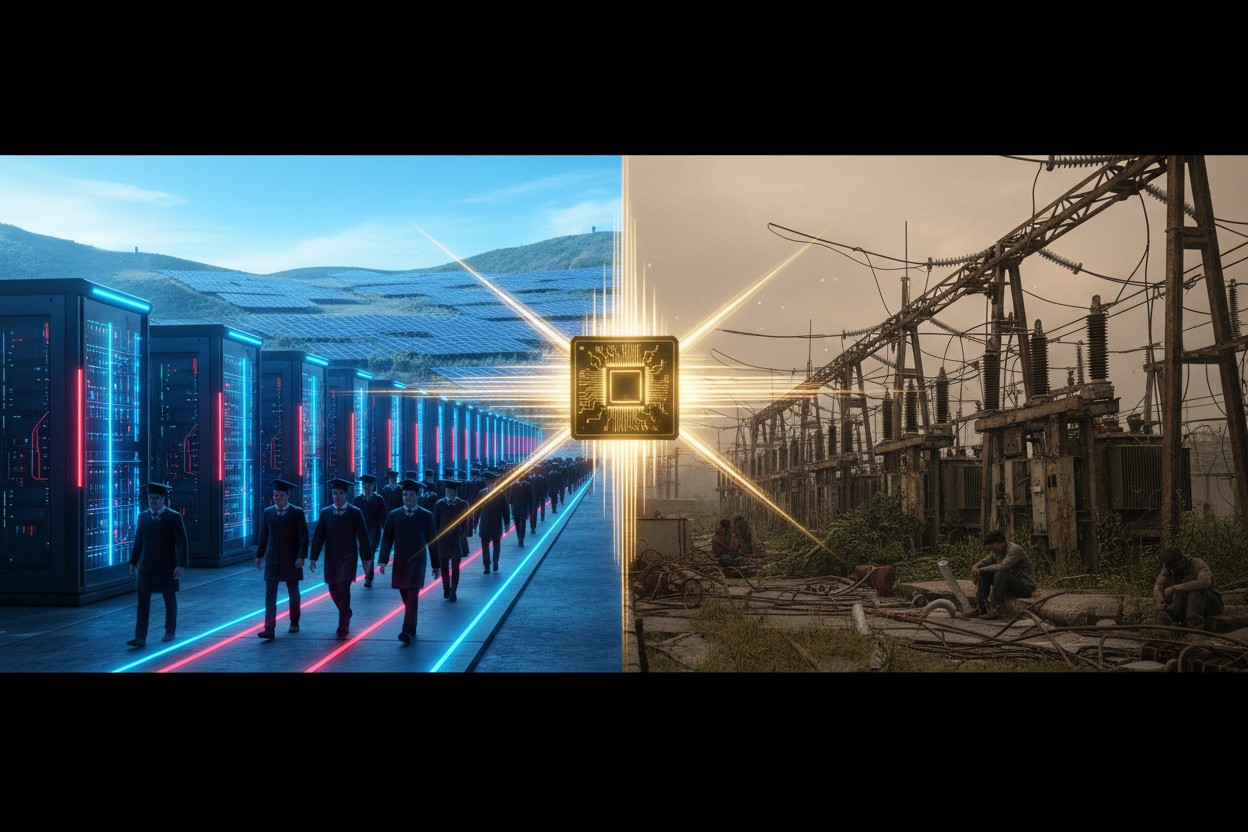
supplychainWhen a battery can operate at 50 degrees below zero, hold a charge for three decades, and survive a nail driven through its core without exploding, the conversation about energy storage shifts from what is possible to what is being hidden. China’s Rept Battero has done exactly that with its new Wending 320 Ah sodium-ion cell, unveiled at SNEC 2026 in Shanghai.
This is not a laboratory curiosity or a distant prototype. This is a commercially planned product aimed at utility-scale storage, long-duration discharge, and deployment in the world’s most punishing climates. The implications reach far beyond battery chemistry. They strike at the heart of a global energy narrative that has long treated lithium as the only viable path forward, a narrative that conveniently benefits a handful of nations and corporations that control lithium reserves.
Sodium, by contrast, is everywhere. It is in the ocean, in the earth, and on every dinner table. And it costs between one and three percent of the price of lithium. The question that follows is not whether sodium-ion technology works. The question is why the world has been so slow to embrace it, and what interests have kept sodium in the shadows while lithium dominated the headlines.
Key points:
- Rept Battero launched a 320 Ah sodium-ion cell at SNEC 2026 in Shanghai.
- The cell operates from -50 C to 60 C and retains over 87 percent capacity at extreme cold.
- Cycle life exceeds 20,000 cycles with 97 percent round-trip efficiency.
- Service life is estimated at 25 to 30 years.
- The cell passed overcharge and nail-penetration safety tests.
- Mass production and commercial deliveries are planned for 2027.
- Sodium is far cheaper and more abundant than lithium.
The science behind the shift: Why sodium matters more than most reports admit
The chemical similarity between sodium and lithium has been known for decades. Both are alkali metals. Both readily give up an electron in electrochemical reactions. But sodium sits directly below lithium on the periodic table, meaning it is heavier and slightly less energy dense. That has been the standard argument against sodium-ion batteries for years. Critics pointed to lower energy density and assumed sodium would never compete with lithium in real-world applications.
What those critics conveniently overlooked is that energy density is not the only metric that matters for grid-scale storage. When a battery sits in a desert solar farm or a wind installation in northern China, what matters is cycle life, safety, temperature tolerance, and cost per kilowatt-hour over decades of operation. The Rept Battero 320 Ah cell delivers on every one of those fronts. Its 20,000-cycle rating means it can charge and discharge daily for more than 50 years before reaching end of life. The company’s 25 to 30 year service life estimate is actually conservative when compared to the cycle count.
The material science behind this achievement deserves attention. Rept Battero applied what it calls Wending prismatic cell architecture, a design already proven in its lithium iron phosphate cells. By adapting that platform to sodium-ion chemistry, the company increased internal space utilization, shortened current paths, and reduced internal resistance. Those engineering choices translate directly into efficiency and longevity. The cathode particle optimization and porous anode structures described by the company are not marketing language. They represent real advances in ion transport and cycle stability that allow sodium to perform where earlier attempts failed.
Who benefits from sodium and what the rollout reveals about global energy strategy
Rept Battero is not a startup chasing venture capital. It is an established Chinese battery manufacturer with existing production lines for LFP cells. The company already produces 314 Ah and 320 Ah lithium iron phosphate cells using the same Wending platform. Moving sodium onto that platform means the manufacturing infrastructure already exists. Tooling, assembly lines, quality control systems, and safety protocols can all be adapted without building factories from scratch.
The target markets tell a revealing story. Initial deployments will go to renewable energy bases in northwestern China and cold-climate projects in northeastern China. Those are regions where lithium batteries struggle. Cold temperatures degrade lithium-ion performance severely. Sodium-ion cells, by contrast, retain 87 percent of capacity at -50 C. That is a functional advantage that lithium cannot match without expensive heating systems that consume energy and reduce overall efficiency.
The safety data from Rept Battero’s launch also warrants close scrutiny. The company reported that the 320 Ah cell passed overcharge and nail-penetration tests with no fire, no explosion, and no thermal runaway. For anyone familiar with battery safety testing, those results are remarkable. Nail penetration is the standard test for thermal runaway because it creates an internal short circuit that typically triggers cascading failure in lithium-ion cells. That sodium-ion cells survived this test without incident points to fundamentally different chemistry behavior.
The double insulation and double sealing on the terminal design further reduce electrical safety risks in large-scale deployments. When thousands of cells are wired together in a utility-scale installation, even small failure rates become significant. Sodium’s inherent stability combined with engineered safety features could reduce fire risk dramatically compared to current lithium installations.
The timeline matters here. Rept Battero plans mass production and commercial deliveries in 2027. That is only two years away. The A-sample validation stage is happening now. Reliability testing and customer sampling are under way.
Global implications
What remains largely unspoken in mainstream coverage is the geopolitical dimension. Lithium reserves are concentrated in a small number of countries, including Australia, Chile, and Argentina. China dominates lithium processing but must import raw materials. Sodium is different. Sodium chloride exists in virtually every country on earth. The oceans contain an estimated 50 quadrillion tons of dissolved sodium. Extracting it is trivial. Refining it for battery use is far simpler and cheaper than lithium processing.
This means sodium-ion technology threatens the entire lithium supply chain, not just in terms of cost but in terms of strategic control. Nations that lack lithium reserves but have coastlines or salt deposits suddenly have access to battery-grade material. Energy storage becomes democratized. The monopoly on critical mineral supply weakens.
The Rept Battero launch at SNEC 2026 represents more than a product announcement. It signals that the era of lithium-only thinking in battery storage is ending. The question now is how quickly other manufacturers will follow, and whether the western battery industry can adapt to a technology that does not depend on imported lithium from contested supply chains. For project developers, utility operators, and anyone planning large-scale renewable energy installations, the 320 Ah sodium-ion cell offers a path forward that is cheaper, safer, and longer-lived than anything lithium has delivered so far.
Sources include:





Please contact us for more information.