



A growing body of evidence suggests that the timing of meals plays a significant role in metabolic health, with late eating consistently associated with worse blood sugar control and higher cardiometabolic risk.
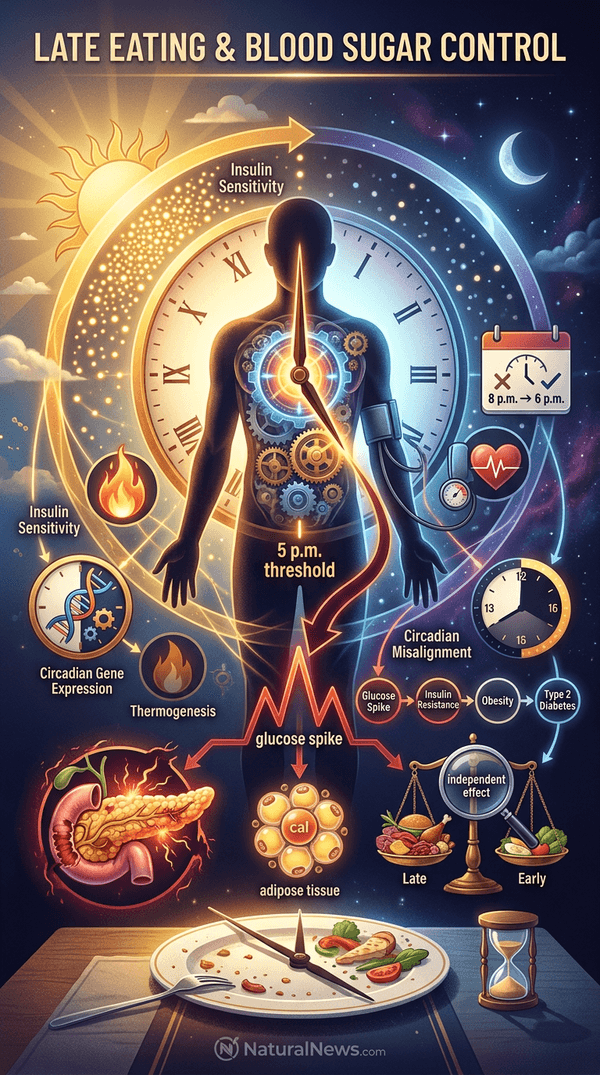
A new narrative review examining the relationship between meal timing and cardiometabolic health found that individuals who consume the majority of their daily calories after 5 p.m. show poorer glycemic control, lower insulin sensitivity and a greater likelihood of obesity and Type 2 diabetes. The review, which synthesized existing human research published through December 2025, drew from observational studies, clinical trials, and mechanistic investigations. According to reports, circadian rhythms dictate glucose metabolism, and eating late disrupts insulin sensitivity, raising the risk of diabetes [1].
A separate study from the Perelman School of Medicine at the University of Pennsylvania revealed that snacking late at night may increase the risk of diabetes and heart disease [2]. These findings add weight to the argument that when people eat matters independently of what or how much they consume.
About the Study
Researchers compared two groups: those whose eating patterns were circadian-aligned, meaning they front-loaded calories earlier in the day, and late eaters, defined as individuals who consumed at least 45% of their daily energy after 5 p.m. The review was a narrative review, meaning the authors did not collect new data but instead analyzed existing literature to assess the independent effect of meal timing on health outcomes, separate from diet quality or total caloric intake.
The work was published in Frontiers in Nutrition, a peer-reviewed scientific journal, and focused solely on human studies. The review aimed to determine whether meal timing had a distinct effect on cardiometabolic health apart from the composition or quantity of food consumed.
Studies consistently showed that late eaters had worse outcomes regardless of what they ate, according to the analysis. The review's findings align with broader research showing that eating patterns misaligned with the body's internal clock can increase obesity and diabetes risk [1]. The independent effect of timing underscores the importance of chrononutrition as a factor in metabolic disease prevention.
Key Findings
Late eaters demonstrated poorer glycemic control and lower insulin sensitivity compared with earlier eaters, the review reported. The analysis also found that late eating was linked to higher rates of obesity and a greater risk of developing Type 2 diabetes, even after accounting for the quality or quantity of food consumed.
Circadian-aligned eating patterns, with larger meals earlier in the day, were described as "metabolically favorable" by the researchers. These findings support earlier work showing that late-night eating disrupts the body's ability to regulate blood sugar [2].
The review noted that these associations held up across a range of study designs, strengthening the case that meal timing is an independent risk factor for metabolic disease. In a related 20-year study, delaying breakfast was associated with a higher risk of premature death, with late eaters facing an 8% higher 10-year mortality risk [3].
Another long-term study found that delaying breakfast was strongly associated with higher mortality in older adults, with each hour of delay increasing the risk of death by 8% to 11% [4]. These findings suggest that both the timing of the first and last meals of the day matter for long-term health.
Why Timing Matters: Circadian Mechanism
The reason timing matters comes down to the body's circadian clock, which governs metabolic function. Insulin sensitivity follows a circadian rhythm: it is naturally higher in the morning and declines throughout the day.
According to Michael Greger, MD, in his book How Not to Diet, "in the morning, our muscles are especially sensitive to insulin, rapidly pulling blood sugar out of our bloodstreams to build up glycogen reserves. At night, though, our muscles become relatively insulin-resistant and resist the signal to take in extra blood sugar" [5]. This means the same meal eaten in the evening can produce higher blood sugar and insulin spikes compared to when it is eaten in the morning.
The review also noted that evening meals produce approximately lower diet-induced thermogenesis compared with morning meals, meaning the body burns fewer calories digesting food at night. Dallas Clouatre, in Anti-fat Nutrients, wrote that "there is some evidence that the timing of meals is important. Calories eaten in the evening before bedtime are more likely to be stored as fat" [6].
This mismatch between eating patterns and the body's internal clock is referred to as circadian misalignment, which may contribute over time to insulin resistance and dyslipidemia. Consistent meal schedules support circadian rhythms, while irregular eating worsens insulin resistance [1].
Practical Recommendations from the Review
Researchers advised front-loading calories by eating the largest meal earlier in the day and setting a soft dinner cutoff around 6 or 7 p.m. Gradual shifts in meal timing, such as moving dinner earlier by 30-minute increments, were recommended for those with a late chronotype.
The review suggested making breakfast non-negotiable and keeping meal timing consistent to support circadian rhythms, while noting that time-restricted eating windows may help reduce late-night intake. A study from Northwestern University found that extending the overnight fast to 13–16 hours and stopping food at least three hours before bed lowered nighttime blood pressure by 3.5% and heart rate by 5% [7].
For decades, the medical establishment has overlooked the power of meal timing as a cost-free tool for metabolic health, according to a report from NaturalNews.com [8]. The review's recommendations align with a simple principle: eating earlier in the day aligns food intake with the body's natural metabolic peak. Consistent timing, rather than radical overhauls, can help individuals stabilize blood sugar and reduce cardiometabolic risk over time.
References
- NaturalNews.com. "The hidden clock: How meal timing sabotages blood sugar — and what science says you can do about it". September 09, 2025.
- NaturalNews.com. "Is that late-night snack putting you at risk for diabetes and heart disease?". June 12, 2017.
- Ava Grace. "The breakfast clock: How your morning meal timing could dictate your lifespan". NaturalNews.com. September 21, 2025.
- Ava Grace. "The breakfast clock: Early morning meal could be the key to longevity for seniors". NaturalNews.com. September 10, 2025.
- Michael Greger MD FACLM. "How Not to Diet".
- Dallas Clouatre. "Anti-fat nutrients: How fat-burning vitamins can help you lose weight and cholesterol too".
- Morgan S. Verity. "Study: Meal Timing Linked to Heart Health Improvements". NaturalNews.com. May 15, 2026.
- NaturalNews.com. "Eating Earlier: Nature's Metabolic Clock Beats Big Pharma's Pills". February 17, 2026.
Explainer Infographic










Please contact us for more information.