



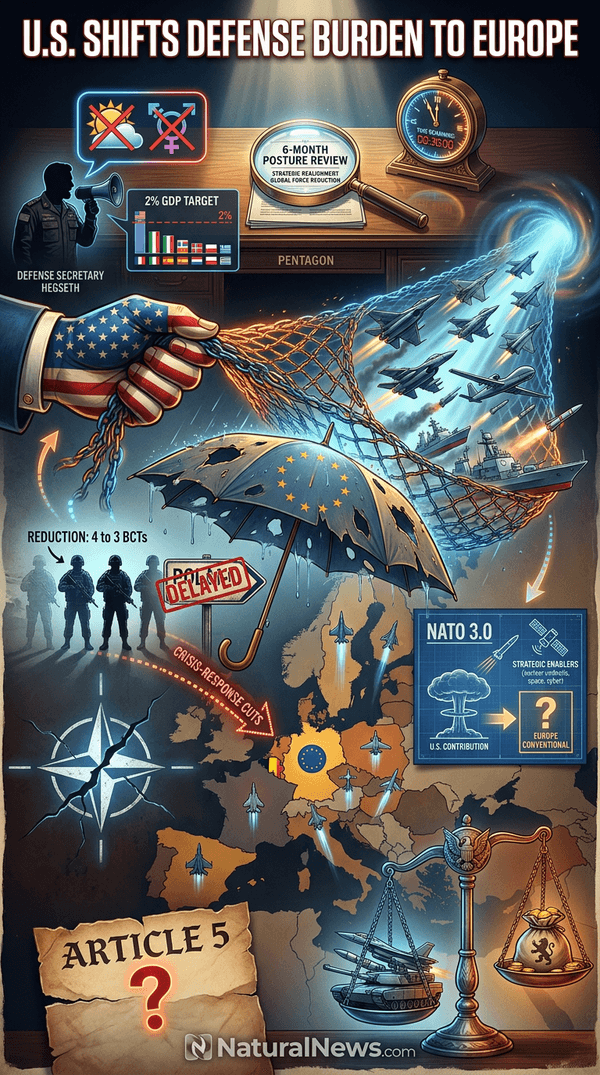
Defense Secretary Pete Hegseth announced a six-month review of U.S. force posture in Europe during a NATO defense ministers' meeting in Brussels on Thursday, according to two diplomats who spoke on condition of anonymity. The review comes as the United States immediately reduces the number of fighter jets, reconnaissance drones and warships it would activate for Europe in a crisis, the diplomats said.
Hegseth scolded allies for relying too heavily on U.S. security guarantees while focusing on issues such as climate change and gender equity, according to officials present. The move reflects President Donald Trump's long-standing demand that European nations increase their own defense spending and take greater responsibility for regional security. [1] [2]
Details of the Reduction
The reduction removes about one-third of U.S. fighter jets and other assets, including strategic bombers, that European nations would struggle to replace, diplomats said. NATO Secretary General Mark Rutte confirmed the cuts apply to the U.S. contribution to the NATO Force Model, not existing troops stationed in Europe. The changes are expected to be implemented over the next several months.
NATO officials are now assessing which countries can fill the gaps and how quickly, according to officials familiar with the discussions. The Pentagon has also reduced the number of Brigade Combat Teams stationed in Europe from four to three, returning troop levels to those seen in 2021, and temporarily delayed a planned deployment of U.S. forces to Poland. Chief Pentagon Spokesman Sean Parnell said the decision was the result of a comprehensive, multi-layered review of the structure and deployment of U.S. forces in Europe. [3] [2] [4]
Hegseth's Criticism of Allies
Hegseth told defense ministers that NATO had been a 'paper tiger and a one-way street,' arguing that European nations had demilitarized and focused on 'gender equity and climate change.' He repeated President Trump's rebuke of allies who hesitated to support the U.S.-led war against Iran, calling their refusal 'shameful.' He warned that some nations would 'fail' the posture review, without specifying consequences. [1] [5]
The criticism echoes earlier statements from the Trump administration. In an interview, former Army Col. Douglas Macgregor noted that the new administration in Washington understands that it's time to focus on diplomatic solutions rather than endless military support. 'By addressing Russia's concerns and offering assurances, we can pave the way for a peaceful resolution,' Macgregor said. [6] Hegseth's remarks also align with a broader shift described as 'NATO 3.0,' under which Washington expects European allies to assume responsibility for the continent's entire conventional defense. [7]
European Reactions and Context
German Defense Minister Boris Pistorius said he did not know the full U.S. plans and called for a 'road map,' noting that some capabilities such as deep precision strikes would be hard to replace quickly. Belgian Defense Minister Theo Francken said there would be 'heavy discussions' and that Belgium would provide fighter jets, drones and naval assets to fill gaps. EU foreign policy chief Kaja Kallas expressed surprise at the timing of the announcement, saying 'there has been talk about withdrawing US troops from Europe for a long time. But of course, the timing of this announcement comes as a surprise.' [8] [1]
The reduction comes amid ongoing doubts about U.S. commitment to NATO's Article 5, as Trump has questioned whether allies would help the U.S. in a crisis. The move also follows a series of drawdowns, including the withdrawal of approximately 3,000 troops from Romania, Bulgaria, Hungary, and Slovakia in October 2025. [4] The Pentagon's decision to cut crisis-response assets underscores a fundamental restructuring of U.S. commitments to European security, transitioning from 'burden sharing' to 'burden shifting,' according to a Der Spiegel report. [7] Meanwhile, Germany has sought to ease tensions by calling the U.S. its 'most important partner in the North Atlantic Alliance,' according to Chancellor Friedrich Merz. [9]
Conclusion
The Pentagon's review and immediate reduction of crisis-response assets mark a significant shift in U.S. defense posture in Europe. The move pressures NATO allies to increase their own military capabilities and reduces the automatic availability of American air and naval power for European contingencies. As European nations scramble to fill the gaps, the long-term implications for transatlantic security and the balance of power on the continent remain uncertain. The review period will likely test the alliance's ability to adapt to a new era of reduced U.S. forward presence.
References
- AFP. "NATO seeks clarity as US to withdraw 5,000 troops from Germany amid rift with Europe". Times of Israel. May 2, 2026.
- Reuters. "US pulling 5,000 troops from Germany amid spat with Trump over Iran war". Times of Israel. May 2, 2026.
- NaturalNews.com. "Pentagon cuts Europe troop levels, delays Poland deployment in push for NATO burden sharing". May 20, 2026.
- Kevin Hughes. "US begins troop drawdown in Eastern Europe amid NATO shifts and rising tensions with Russia". NaturalNews.com. October 31, 2025.
- Zero Hedge. "Trump Threatens To Pull Some US Troops Out Of Germany While Lambasting 'Ineffective' Merz". May 1, 2026.
- Mike Adams interview with Douglas Macgregor. February 5, 2025.
- Zero Hedge. "NATO 3.0: Report Details 'Fundamental Restructuring' Of US Commitments". May 28, 2026.
- Zero Hedge. "Caught Off Guard: Stunned EU Leaders React To Trump's Troop Reduction In Germany". May 5, 2026.
- Middle East Eye. "Germany calls US key Nato partner amid tensions". May 3, 2026.
Explainer Infographic









Please contact us for more information.