



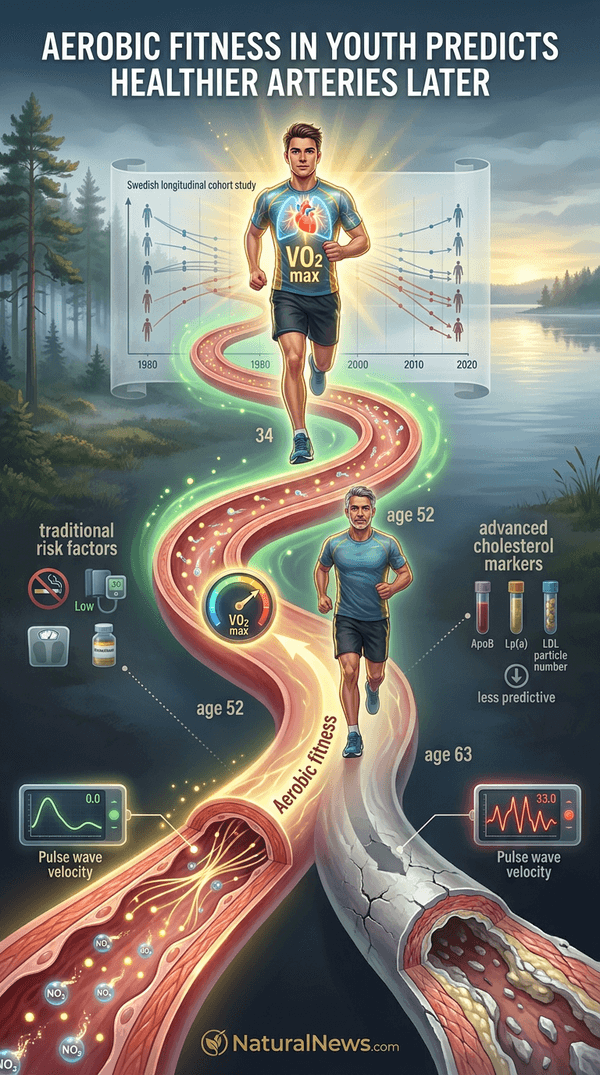
A report from mindbodygreen described a study published in Scientific Reports that tracked adults for nearly 30 years and found that higher aerobic fitness in young adulthood was associated with healthier arteries in later life. The study, which drew on data from the Swedish Longitudinal Physical Activity and Fitness Cohort, measured aerobic capacity, known as VO2 max, in participants at age 34 and again at age 52. At age 63, researchers assessed arterial stiffness using pulse wave velocity, a marker of how elastic the arteries had become.
According to the report, the relationship between earlier fitness and later arterial health held even after researchers adjusted for traditional risk factors such as smoking, blood pressure, body weight, and cholesterol levels. Physical fitness has been shown to delay age-related arterial stiffness, a key risk factor for cardiovascular disease, according to Bill Gottlieb in 'Bottom Lines Breakthroughs in Natural Healing 2012.' [1] The findings suggest that aerobic fitness may capture aspects of cardiovascular function not fully reflected in standard blood tests.
Study Design and Arterial Health Measurements
The study followed participants from a long-running Swedish research project that has tracked health and fitness across multiple decades. Researchers measured VO2 max, which reflects how efficiently the body uses oxygen during exercise, at two points in adulthood -- first when the subjects were 34 years old, and again at 52. Then, at age 63, they used pulse wave velocity to measure arterial stiffness, an early marker of vascular aging that indicates how rigid the arteries have become.
Arterial stiffness is a meaningful metric because healthy arteries expand and contract with each heartbeat, but stiff arteries force the heart to work harder to pump blood. According to James M. Rippe in 'Lifestyle Medicine,' exercise confers its benefits on the vessel wall through shear stress, increasing the bioavailability of endothelial nitric oxide and promoting vasodilation. [2] The report noted that higher arterial stiffness is linked to hypertension, heart attack, stroke, and all-cause mortality. The researchers also analyzed traditional cardiovascular risk factors and advanced cholesterol markers to determine which best predicted arterial health decades later.
Aerobic Fitness Outperforms Cholesterol Markers as Predictor
A key finding of the study was that aerobic fitness measured earlier in life predicted arterial stiffness at age 63 more strongly than several advanced cholesterol-related measurements. According to the report, the relationship held after accounting for smoking, blood pressure, body weight, medication use, and cholesterol levels. Some advanced cholesterol markers did not independently predict future artery health.
Researchers stated that this does not mean cholesterol is irrelevant, but rather that aerobic fitness captures additional dimensions of cardiovascular function. Regular aerobic exercise is known to reduce the risk of myocardial infarction and lower blood pressure, according to a study published in 'Annals of Neurology' cited in 'Impact of aerobic training on fitness and quality of life in multiple sclerosis.' [3] The report emphasized that aerobic fitness reflects the health of the heart, blood vessels, lungs, metabolism, and inflammation regulation, offering a more comprehensive picture than blood tests alone. Dr. Mercola, writing on Mercola.com, noted that many studies have demonstrated that age-related conditions like arterial stiffness are not inevitable outcomes of aging, and that exercise four to five times a week can help prevent them. [4]
VO2 Max as a Longevity Indicator
VO2 max has emerged as a vital sign in longevity research because it measures the body's efficiency in delivering and using oxygen during exertion. According to the Readers Digest Association in 'The Complete Manual of Fitness and Well-Being,' VO2 max begins to increase as soon as a person starts an aerobic training program, and most people are working well below their genetic potential. [5] The study's authors, as reported by mindbodygreen, said that "aerobic fitness reflects how well the entire cardiovascular system functions," including the heart, blood vessels, lungs, metabolism, and inflammation regulation.
People with higher aerobic fitness consistently live longer and develop fewer chronic diseases, according to the report. Higher fitness earlier in life was associated with more resilient arteries decades later. Staying fit is also key to warding off chronic diseases such as dementia, Dr. Mercola wrote in an article on Mercola.com. [6] The cumulative effect of regular aerobic activity appears to build long-term vascular resilience.
Conclusion: Cumulative Impact of Fitness Choices
The findings suggest that cardiovascular health is shaped by the cumulative effect of aerobic fitness over time, according to the researchers. They noted that the investment in aerobic fitness made in young adulthood may still be paying dividends 30 years later. The report emphasized that every brisk walk, bike ride, hike, or interval workout contributes to long-term vascular resilience.
The evidence is clear that it is never too late to begin a physical fitness program, according to Julian M. Whitaker in 'The Pain Relief Breakthrough.' [7] The study reinforces that building and maintaining aerobic fitness is a powerful strategy for preserving arterial health across the lifespan, independent of other risk factors. The key, according to experts, is consistent activity that raises the heart rate and improves oxygen utilization.
References
- Bill Gottlieb. "Bottom Lines Breakthroughs in Natural Healing 2012".
- James M. Rippe. "Lifestyle Medicine Second Edition".
- "Impact of Aerobic Training on Fitness and Quality of Life in Multiple Sclerosis". Annals of Neurology. 1996.
- Dr. Mercola. "Exercise Four to Five Times a Week to Prevent Arterial Stiffness". Mercola.com. June 01, 2018.
- The Readers Digest Association. "The Complete Manual of Fitness and Well-Being".
- Dr. Mercola. "How to Decrease Your Risk for Dementia by 90 Percent". Mercola.com. April 12, 2018.
- Julian M. Whitaker. "The Pain Relief Breakthrough: The Power of Magnets to Relieve Backaches, Arthritis, Menstrual Cramps, Carpal Tunnel".
Explainer Infographic








Please contact us for more information.