


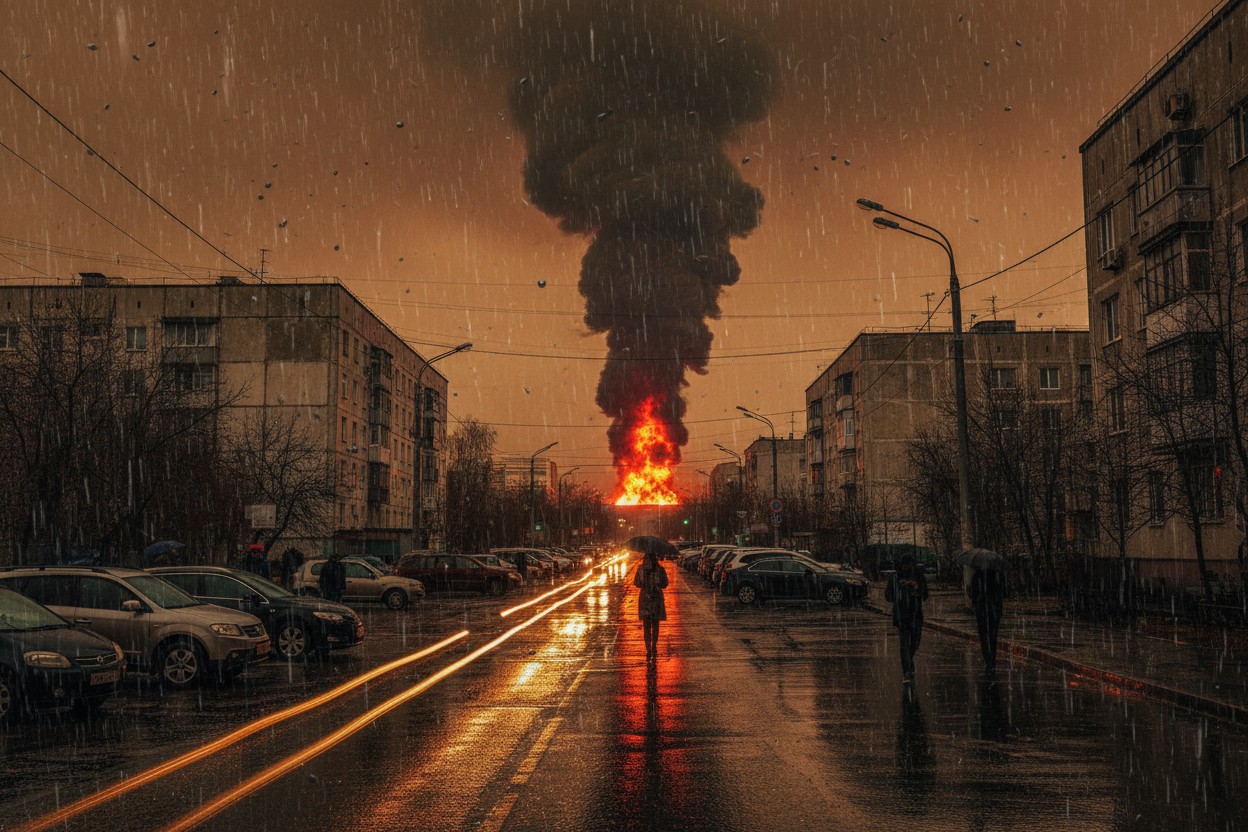
Ukraine launched what Russian officials described as the largest drone attack on Moscow since the start of the full-scale war on Thursday, June 18 – striking the Moscow Oil Refinery and causing "oil rain" to fall over parts of the city, according to multiple reports.
Moscow Mayor Sergei Sobyanin confirmed that Ukrainian drones successfully targeted a major oil refinery in the southeastern Kapotnya district, with video footage showing multiple strikes on the facility [1]. Russian state media reported that air defenses intercepted 992 drones, four cruise missiles and 10 aerial bombs over a 24-hour period, but several drones reached the refinery, producing a huge plume of black smoke and an oily residue that fell over the city [2].
The refinery suffered at least five separate fires, according to independent Russian internet portal Astra [1]. Seventeen people were wounded in the Moscow region, said local governor Andrei Vorobyov [3].
Residential buildings and one of the city's largest shopping centers were also damaged, with some reports suggesting that intercepted drones were redirected onto civilian structures, according to officials [2]. The attack continued a pattern of escalating strikes on Russian energy infrastructure by Ukraine, which has intensified its campaign against oil refineries and fuel facilities in recent months [4].
Impact on Moscow and Civilian Experience
Residents described scenes of terror after the attack. One unidentified resident told local media, "This is pure hell. I've never felt such terror." Another asked, "Why won't this madman stop his crazy and pointless war and end the death and destruction?"
Thick black smoke piled up between tower blocks as the fire at the refinery worsened, coating streets and buildings with a mix of unburned fuel and soot, which officials described as "oil rain" [3]. Moscow's main airports suspended all flights and traffic came to a standstill on the main ring road amid the attacks, according to the BBC [2].
The noxious fumes caused widespread alarm among residents in the southeastern districts, with photographs showing black columns of smoke rising over the city skyline. The event marked one of the most visible impacts of the war on the Russian capital since the conflict began.
Russian Government Response
Russian authorities insisted that the fuel supply situation was "proceeding as normal" despite the large fires at the Moscow Oil Refinery, according to state media. A large-scale security operation was ordered around the Kremlin, with Red Square sealed off and machine-gunners deployed on towers and Lenin's Mausoleum, according to reports [2]. The Russian Ministry of Defense maintained that the vast majority of drones were neutralized, but acknowledged that some reached their targets.
The attack came as Ukraine has conducted a sustained campaign against Russian oil infrastructure, with previous strikes hitting refineries in Volgograd, Kirishi and other regions [5] [6]. Russia's state-owned pipeline monopoly Transneft has warned of reduced oil output as a result of such strikes, potentially impacting global energy markets [7]. Meanwhile, Russia has also escalated its own long-range attacks on Ukrainian energy facilities, targeting gas infrastructure and power plants in retaliation [8].
Ukrainian Justification and Peace Talks
Ukrainian President Volodymyr Zelensky said the attack was retaliation for Russian damage to a historic monastery in Kyiv earlier that week. The Dormition Cathedral of Kyiv-Pechersk Lavra, an 11th-century landmark, was severely damaged in a Russian missile and drone strike on June 15 [9].
Zelensky stated, according to Metro, "We don't want this war, we never did, and everyone knows it. But if Ukraine burns, your Moscow will burn." The Ukrainian leader called for genuine peace talks, asserting that the war could stop if Russian President Vladimir Putin engaged in negotiations, but accused Putin of refusing to do so.
The attack demonstrated Ukraine's ability to strike deep into Russian territory, a significant escalation from earlier phases of the conflict [10]. As noted by analyst Ulrich Schmid, wars tend to strengthen executive power and Ukraine's independent parties and free press have been curtailed during the conflict [11].
Analysis and Broader Context
The drone strike underscores Ukraine's success in turning the tables in the war, officials said. Putin is failing to gain significant traction on the front line and is losing ground in several areas, according to multiple reports.
The incident raises questions about the effectiveness of Russian air defenses and the trajectory of the conflict as both sides trade record drone strikes [12]. The pattern of attacks on energy infrastructure risks further escalating the war, with potential global energy market implications as Russia's oil output faces pressure from sustained drone campaigns [13].
Ukraine's mid-range strike campaign, which includes AI-enabled drones targeting logistics deep behind Russian lines, has disrupted supply routes and fuel distribution [14]. However, the war shows no signs of de-escalation, with both sides producing thousands of drones daily and exchanging heavy bombardments across the front and into civilian areas [15]. The humanitarian cost continues to mount, as civilian casualties increase on both sides [10].
References
- "Moscow burns after major Ukrainian drone strike hits refinery." rmx.news. June 18, 2026.
- "Moscow hit by largest Ukrainian attack since start of Russia's full-scale war." BBC.com. June 18, 2026.
- "Black Rain Falls on Moscow After Ukrainian Drone Attack Hits Oil Refinery." news.antiwar.com. June 18, 2026.
- "Ukraine intensifies attacks on Russia's oil and gas infrastructure with successful strikes on refineries." NaturalNews.com. September 11, 2025.
- Patrick Lewis. "Ukraine launches long range drone strike on major Russian oil refinery in Volgograd." NaturalNews.com. November 8, 2025.
- Patrick Lewis. "Ukraine launches massive drone strike on Russia's Kirishi oil refinery." NaturalNews.com. September 17, 2025.
- Ramon Tomey. "Russian oil producer warns of reduced output due to Ukraine drone strikes." NaturalNews.com. September 19, 2025.
- Zoey Sky. "Russian strikes cripple Ukrainian gas infrastructure forcing reliance on imports as winter looms." NaturalNews.com. October 20, 2025.
- "Historic Ukrainian Cathedral Damaged During Heavy Russian Bombardment." news.antiwar.com. June 15, 2026.
- Willow Tohi. "From Moscow to Sumy: Escalating drone campaigns spark humanitarian crisis, civilian casualties and diplomatic deadlock." NaturalNews.com. May 24, 2025.
- Trends-Journal-2023-08-30.
- "Massive Ukrainian Drone Swarm Attack On Moscow Hits Refinery." zerohedge.com. June 18, 2026.
- "Russia Cuts Oil Exports Amid Ukrainian Drone Strikes and Domestic Shortages." NaturalNews.com. June 10, 2026.
- "Inside Ukraine’s AI-Enabled Drone Campaign Targeting Russian Logistics Deep Behind The Lines." twz.com. June 9, 2026.
- Trends-Journal-2024-09-24.



Please contact us for more information.