



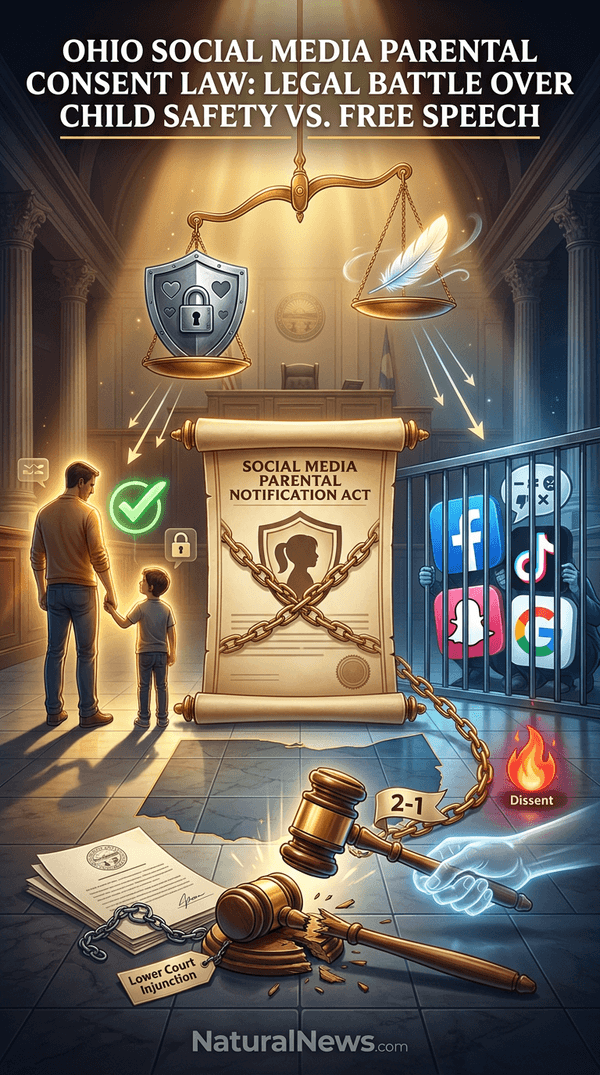
A federal appeals court on June 18 reversed a lower court ruling and allowed Ohio to enforce a law requiring parental consent for children under 16 to use social media platforms. The 2-1 decision by the Sixth U.S. Circuit Court of Appeals found that the Social Media Parental Notification Act does not violate the First Amendment. [1]
The law, passed by the state legislature in 2023, took effect in January 2024 but was blocked by a district judge in April after NetChoice, a trade group representing major technology companies, filed a lawsuit challenging its constitutionality. [2]
Law and Lower Court Ruling
The Social Media Parental Notification Act requires social media companies to obtain parental consent before allowing children under 16 to create accounts or access platforms. Ohio’s legislature passed the law in 2023, and it took effect in January 2024. NetChoice, whose members include Meta, Google, TikTok, and Snapchat, sued, arguing the law was an unconstitutional restriction on speech. [1]
In April 2024, U.S. District Judge Algenon Marbley issued a permanent injunction blocking enforcement, ruling in NetChoice’s favor. The judge held that the state had not demonstrated that the parental consent requirement was narrowly tailored to protect minors. Ohio subsequently appealed that decision to the Sixth Circuit. [2]
Appeals Court Decision
A three-judge panel of the Sixth Circuit reversed the lower court. Writing for the majority, Circuit Judge Eric Clay said the parental consent requirement imposes only “a marginal burden” on speech. “That requirement constitutes a marginal burden that precisely targets the multi-faceted problem that Ohio has identified: Children's unsupervised assent to terms and conditions for use of platforms that take advantage of and harm them,” Clay wrote. [1]
“Parental consent will not always be narrowly tailored to the compelling interest in protecting minors' well-being. It works here because the nature of the harm itself is that children's unsupervised use of social media puts them at risk of the adverse effects of prolonged and unregulated exposure,” Clay added. The dissenting judge argued that the law likely violated the First Amendment by restricting access to protected speech without sufficient justification. The decision allows Ohio to begin enforcing the law while further litigation proceeds. [1]
Reactions from Officials and NetChoice
Ohio Attorney General Andy Wilson praised the appeals court’s decision, calling it “a win for Ohio families.” In a statement, Wilson said the ruling would allow parents to supervise their children’s use of social media. “The court agreed that parents – not social media companies – should get a say in what kids see online. We have an obligation to keep our children safe, and today, the most dangerous place for our kids is the internet,” Wilson said. [1]
NetChoice responded by saying the decision threatens the online privacy and constitutional rights of Ohio residents. Paul Taske, director of the NetChoice Litigation Center, stated: “By requiring parents to override the government’s determination, Ohio has violated bedrock First Amendment principles. We are currently reviewing our options on how best to move forward.” The group has previously challenged similar laws in other states. [1]
Broader Legal and International Context
NetChoice last year won court rulings blocking a similar social media parental consent law in Arkansas and a children’s digital privacy law in California. The Ohio case is part of a broader national debate about state efforts to regulate minors’ access to social media platforms. [1] Similar legislation has been considered in other states such as Texas, where a ban on social media accounts for users under 18 failed to pass the Senate in June 2025. [3]
Internationally, Australia in December 2024 became the first country to impose a complete social media ban for children under 16, with fines of up to AU$50 million for platforms that fail to implement age verification. [4] Denmark has proposed banning social media for those under 15, allowing parental consent for children aged 13 and over. [5] The Ohio case may continue as NetChoice could appeal to the U.S. Supreme Court, adding to the growing legal landscape surrounding online child safety. [1]
References
- Aldgra Fredly. "Appeals Court Allows Ohio To Restrict Children's Use Of Social Media." ZeroHedge. June 19, 2026.
- Aldgra Fredly. "Appeals Court Allows Ohio to Restrict Children's Use of Social Media." The Epoch Times. June 19, 2026.
- Laura Harris. "Texas Social Media Ban for Minors Fails to Pass Senate Before Legislative Deadline." NaturalNews.com. June 8, 2025.
- Willow Tohi. "A Digital Frontier: Australia's Sweeping Social Media Ban for Minors." NaturalNews.com. October 31, 2025.
- Ava Grace. "Groundbreaking Social Media Ban for Under-15s Proposed in Denmark." NaturalNews.com. November 11, 2025.
- "Adolescent Health Sourcebook, Third Edition."
- Kimberly Ells. "The Invincible Family: Why the Global Campaign to Crush Motherhood and Fatherhood Can't Win."
Explainer Infographic









Please contact us for more information.