


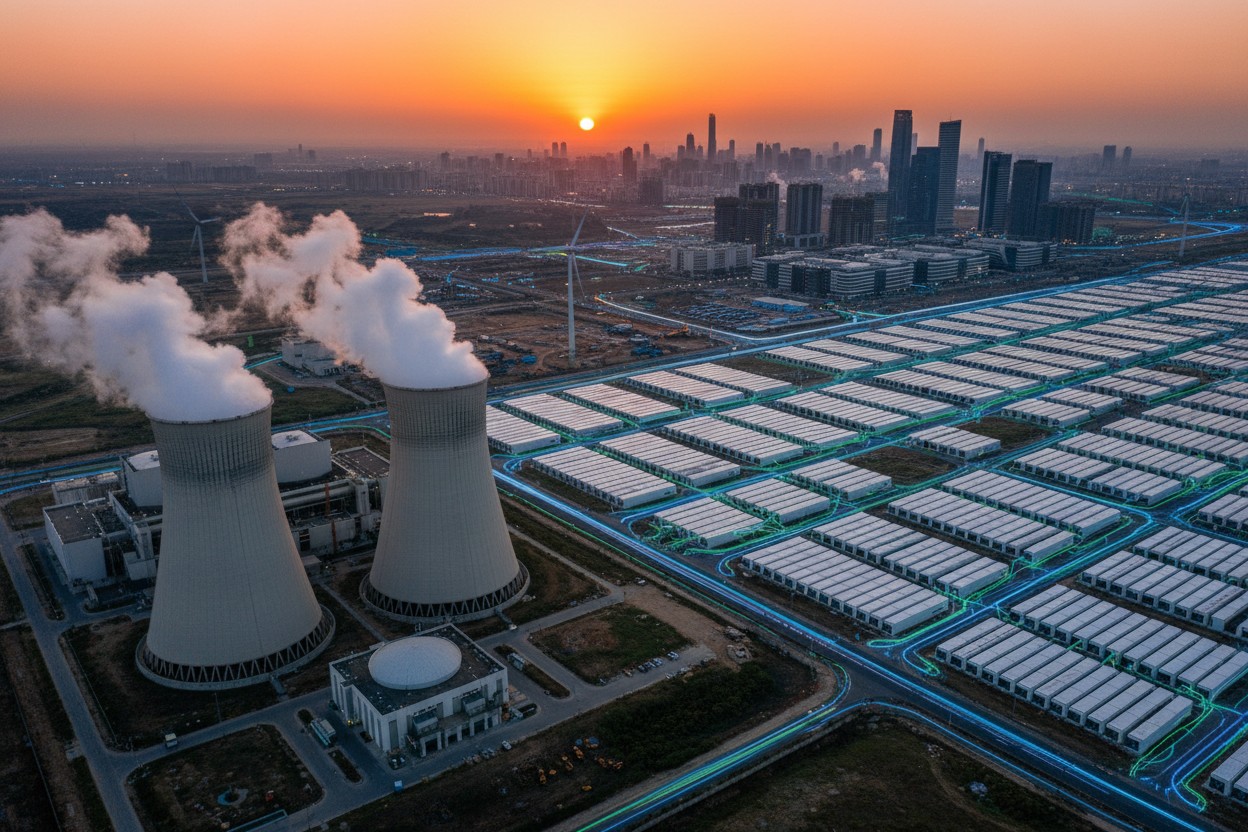
The narrative surrounding artificial intelligence has been dominated by one name for the past two years. NVIDIA, once a $300 billion gaming chip company, now stands as the most valuable corporation in history at over $4 trillion. A $10,000 investment in NVIDIA at the start of 2023 would be worth more than $130,000 today. The story sold to the public is one of technological revolution, of software breakthroughs, of algorithms that will transform human productivity. But beneath this surface-level narrative lies a far more uncomfortable truth. The AI arms race is not about technology at all. It is about electricity. And the companies that control power, not the companies that design chips, will ultimately determine who wins.
Key points:
- NVIDIA's chip shortage created a $4 trillion company, but the power shortage is a larger and longer-term problem.
- AI data centers require massive electricity, with a single ChatGPT query consuming 10 times the energy of a Google search.
- The U.S. electrical grid cannot accommodate the projected demand, with 70% of interconnection requests being withdrawn.
- Power infrastructure takes 10 to 15 years to build, creating a bottleneck far more severe than the chip shortage.
- Bitzero Holdings has secured low-cost power in Norway at 3 to 4 cents per kilowatt-hour, compared to the U.S. average of 12 cents.
- The company has signed a $2.6 billion lease with OneQode for AI computing capacity.
- Major tech companies are scrambling to secure nuclear power, including Microsoft's deal to restart Three Mile Island.
The electricity gap that nobody is talking about
The conventional wisdom holds that NVIDIA solved the chip shortage by ramping up production at TSMC's foundries. The company can now ship as many Blackwell chips as the manufacturing process allows. The supply problem, according to the official story, has been largely resolved. What this narrative conveniently ignores is that none of those chips can run without electricity. And the grid was never designed for what is coming.
A single ChatGPT query consumes roughly 10 times the energy of a Google search. Training the next generation of large language models requires the equivalent power draw of small cities. Industry forecasts now put AI data center capital expenditure at approximately $5.2 trillion between now and 2030. Goldman Sachs Research projects global data center power demand will surge up to 165% by 2030 compared to 2023 levels. The U.S. electrical grid was built for a world where electricity demand grew at 1 to 2 percent per year, predictably, with decades of warning. Now hyperscalers are showing up at utility offices asking for hundreds of megawatts on three-year timelines. The answer keeps coming back the same: we cannot deliver it.
Berkeley Lab recently found that more than 70 percent of grid interconnection requests in the United States are ultimately withdrawn because the grid simply cannot accommodate them. Kevin O'Leary, the Shark Tank investor and longtime infrastructure backer, has gone further. He believes 50 percent of the data centers currently planned across the United States will never get built. This is the new bottleneck. And it is a much bigger problem than the chip shortage ever was.
The 10-year infrastructure trap
The chip shortage was an 18 to 24 month manufacturing problem. It was painful while it lasted, but it proved solvable with more fab capacity. The power shortage is a 10-year infrastructure problem with no shortcut. New nuclear plants take 10 to 15 years from approval to operation. New transmission lines take 8 to 12 years to permit and build. Even adding renewable generation requires years of environmental review, grid interconnection studies and utility approvals. None of these timelines compress, regardless of how much capital gets thrown at them.
The hyperscalers know this, which is why they are already scrambling. Microsoft signed a 20-year deal to restart the Three Mile Island nuclear plant, a facility that has been offline since 2019, specifically to feed its AI ambitions. Amazon paid $650 million for a data center campus directly co-located with the Susquehanna nuclear station in Pennsylvania. Google announced agreements with Kairos Power for small modular reactors. Meta has been pursuing similar nuclear partnerships and recently issued a request for proposals seeking up to 4 gigawatts of new nuclear capacity. These are admissions that scarce, secured, low-carbon power is now the most important asset in the AI economy. The companies with the deepest pockets on earth are committing billions and waiting years to lock it in.
The chip shortage created the most valuable company in history because demand outran supply for less than two years. Imagine what happens when the same dynamic plays out with electricity over a decade. The companies that own that capacity get to set the price. Bitzero Holdings, Inc. (NASDAQ: AIBZ) locked in more than 1 gigawatt of secured, low-cost power capacity across four strategic sites in Norway, Finland and the United States, before the AI boom kicked into high gear. That capacity is permitted, contracted and in many cases already operational. The crown jewel is the company's Norwegian flagship at Namsskogan, where Bitzero operates as a licensed grid operator at the 132 KV level. Most data center operators connect at 22 KV through a utility, paying middleman fees and waiting on utility timelines, while Bitzero connects directly to the high-voltage grid and works directly with hydroelectric power plants.
The cost difference is dramatic. Bitzero's all-in power cost at its Norway facility, including grid fees, taxes and every other charge, currently sits at 3 to 4 cents per kilowatt-hour. The U.S. average is closer to 12 cents. American operators competing for AI workloads are paying three to four times what Bitzero pays for the same electron. Norway has effectively closed the door on new entrants, capping new operators at just 5 megawatts of initial allocation. Finland and Sweden are tightening as well. The companies that secured Nordic power before the surge are sitting on something that cannot be replicated, no matter how much capital is thrown at it. The window is closed.
Bitzero Holdings positions itself for energy security in the AI Arms race
Three months ago, Bitzero was an unusually well-positioned power infrastructure company without a major contracted tenant. On May 5, 2026, Bitzero signed a binding letter with OneQode Networks Pte. Ltd. for a 15-year lease of the entire 110 megawatts at its Namsskogan, Norway site. Total contracted revenue runs approximately $2.6 billion over the term, with implied annual revenue of $178 million at full capacity and a net operating margin of 85 percent. The tenant is deploying GPU clusters for enterprise AI, large language model training and sovereign AI workloads. Commissioning is targeted for the first half of 2027, with the lease then running through 2042 at minimum. This is the same kind of long-duration HPC contract that drove the multi-billion dollar valuations of TeraWulf, Hut 8 and Core Scientific. Bitzero's market cap, as of this writing, sits at roughly $130 million.
The company also acquired its first eight NVIDIA Blackwell B300 servers, representing 64 GPUs total, deployed at the Norway site as its first direct entry into AI compute revenue. Bitzero announced a partnership with Hydra Host, a top-10 NVIDIA Cloud Partner backed by Founders Fund, to distribute its compute capacity globally. The company also retained CBRE as the strategic broker for its 200-megawatt Finland site, with the explicit mandate of marketing that capacity to hyperscale customers seeking AI infrastructure. Most companies in the AI economy are either chip-heavy or power-heavy. NVIDIA owns the chips. Power producers own the electricity. Bitzero now owns secured low-cost power, has the latest NVIDIA Blackwell chips deployed on that power, has Hydra Host distributing the resulting compute to global customers, and has a $2.6 billion long-term tenant signed for its largest single block of capacity.
The formula that minted fortunes on NVIDIA could be repeating itself at a larger scale. The window to position before the institutional crowd catches on is open right now, and it won't stay open for long.
Sources include:






Please contact us for more information.