



The War for the Dollar
I believe Trump's war with Iran is not about freedom or security. It is about saving America's debt market.
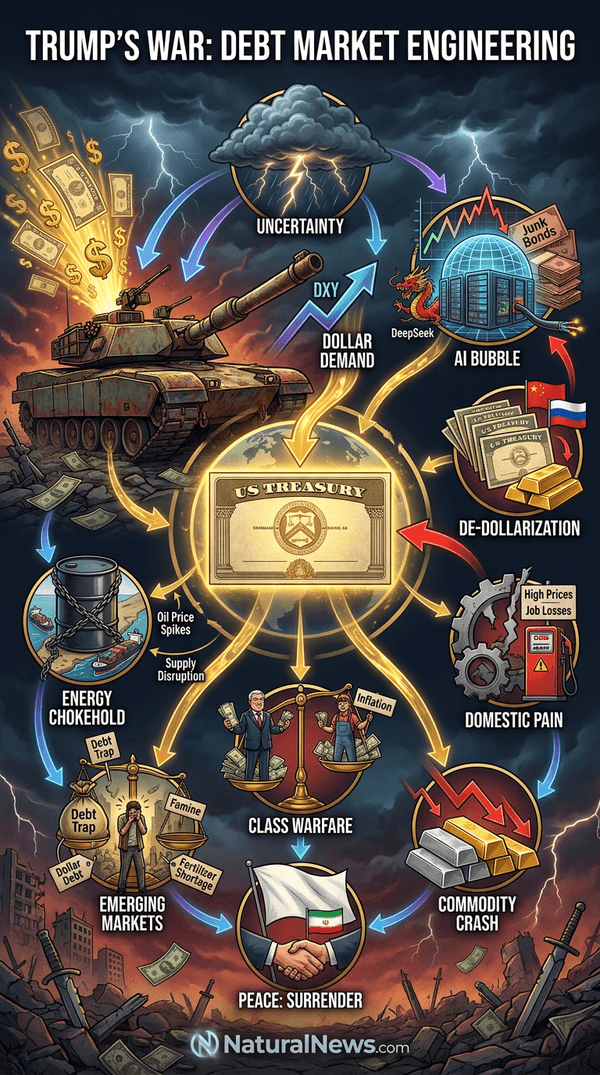
The conflict causes an energy shortage, driving up energy prices and causing higher global demand for the dollars needed to buy that energy. The energy disruptions and global market chaos also cause asset holders to seek the safe haven of the U.S. dollar-denominated stock market and U.S. Treasuries, keeping stocks high and treasury yields low (where Trump wants them).
This strategy props up the financial system and the U.S. debt market at the expense of emerging markets and American consumers. The numbers are undeniable: the war has already cost American taxpayers over $100 billion in just 108 days [1], and Trump has proposed $1.5 trillion in new military spending for 2027 [2]. Yet the real purpose is to manufacture an energy shortage that motivates the world to flood the U.S. with dollars that prop up the stock market and debt demand. Effectively, the war is a financial engineering tool disguised as geopolitics.
The Dollar's Rising Tide
HOW THIS WORKS: War and energy restrictions force countries to buy oil in dollars, driving up dollar demand and strengthening the DXY index (indicating the dollar is stronger compared to other currencies). A strong dollar makes US exports expensive, however, hurting U.S. manufacturing and job creation, ultimately leading to increased U.S. job losses.
In my view, this is a feature, not a bug. The stronger dollar crushes commodity prices and keeps inflation in check for the rich while squeezing everyone else. Gold and silver have plunged since the war began while the dollar surged. Meanwhile, Trump talks down oil prices in domestic markets, but real physical oil prices on the international scale remain elevated. Trump says the Strait of Hormuz is "fully open," but we still don't see more than one-third the usual tanker traffic moving through the strait.
The result is that emerging nations are starved of energy for industry and fertilizer for farming. The World Bank reported that the war slowed global economic growth to its lowest level since the pandemic [3]. That is the cost of propping up the dollar and driving dollars into the U.S. to prop up the stock market and Treasury demand.
The Safe-Haven Flood
THE FIGURES: Global uncertainty pushes capital into US Treasuries, keeping yields well below 5% -- critical for servicing a $39+ trillion national debt. Some money also flows into US stocks, creating a blow-off top that Trump claims as economic success while implying that higher stock valuations are making Americans rich (even though relatively few Americans even own stocks).
The S&P 500 and Nasdaq rally on ceasefire hopes , but this is an engineered illusion. China has systematically reduced its Treasury holdings, dropping from $1.3 trillion to $683 billion over the past decade [4]. For the first time since 1996, gold has surpassed Treasury bonds as the largest foreign reserve asset [5]. The world is de-dollarizing, and Trump's war is a desperate attempt to reverse that trend.
Yet the capital influx of dollars is temporary. As I wrote in March 2026, the war is a 'staggering surrender' that only delays the inevitable [6]. When the "memorandum" peace deal finally came, it was a surrender dressed in diplomatic language [7]. All sound and fury with no substance, in other words.
The Global Despair
Emerging markets suffer doubly: dollar-denominated debt becomes more expensive to service (because dollars are more costly to acquire), and energy shortages cripple local industry. Countries like Bangladesh face fertilizer and fuel crises, leading to famine and economic collapse, while nations like India are forced to find huge sums of cash to subsidize fertilizer costs for their domestic farmers.
Sadly, the war has been a war of choice, not necessity, as two-thirds of Americans recognized [8]. Trump's decision to attack Iran shifts the long-term liability onto the rest of the world, but the blowback will reach us, too. Costs of groceries, fuel and health insurance are skyrocketing for all Americans, for example, indicating how rapidly the dollar is losing domestic purchasing power even as it is gaining value versus other currencies.
Meanwhile, central banks are buying gold aggressively [9]. In my interview with Andy Schectman, he explained that countries are questioning why they should continue supporting a regime that uses their assets to fund wars [10]. The global despair is intentional -- it forces nations to beg for dollar liquidity, which props up the US debt market and allows Trump and Bessent to refinance U.S. debt at lower rates, even while printing trillions and spending the American empire into financial oblivion.
The AI Bubble and the Paper Mirage
A flood of cheap capital from the war-driven safe-haven rush also fuels the AI data center construction boom with no sustainable revenue model. OpenAI missed revenue targets, and internal pushback against Sam Altman's aggressive spending is growing [11]. The semiconductor supply chain is fragile, with tungsten hexafluoride shortages threatening memory prices , and indium phisphide restrictions from China threatening to strongly hamper microchip production for the west.
Open-source Chinese models make US-based AI inference overpriced; the bubble will burst, causing a devastating financial crash. When the crash comes, savvy buyers will acquire hardware for pennies on the dollar, but retail investors will be wiped out. As I said in my interview with Andy Schectman, the data center announcements are just paper announcements that won't be operational for years [12]. This is a paper mirage built on the back of war, lacking any real long-term revenue model that makes rational sense.
Conclusion: Hold the Metal, Hold the Line
Gold and silver are suppressed now by the strong dollar and the flight of capital to semiconductor / AI stocks, but they remain the best long-term hedge against dollar devaluation.
Silver is currently near $58 and gold is just under $4,000 -- and they both benefit from the lack of counterparty risk that plagues stocks, bonds and treasuries. I advocate disciplined, fiscally conservative financial strategies such as staying debt-free, stacking physical metals, and avoiding margin and stock speculation. As Bill Holter warned in a recent interview, the collapse of fiat currencies is inevitable [13].
In a world of engineered crises and fictional wealth, discipline and patience are the only winning strategies. Do not trust the paper markets. Hold the metal, hold the line. And you'll be the one holding real value when the music stops.
References
- US-Iran war concludes: taking the toll - RT.com. June 18, 2026.
- Trump Proposes $1.5 Trillion In War Spending, 'Largest In Decades' - ZeroHedge.com. April 3, 2026.
- Trump’s Iran War Slowing Global Economic Growth to Lowest Level Since Pandemic: World Bank - Antiwar.com. Brett Wilkins. June 13, 2026.
- China advises banks to limit US Treasury holdings amid volatility concerns - NaturalNews.com. Cassie B. February 10, 2026.
- Gold dethrones Treasury bonds as largest foreign reserve asset after 30 years - NaturalNews.com. Ava Grace. January 15, 2026.
- Operation EPIC FAIL: The Staggering Surrender Trump Won’t Admit - NaturalNews.com. March 31, 2026.
- Hopeful But Not Out of the Woods Yet: A Brutal Analysis of the Iran Peace Deal - NaturalNews.com. June 18, 2026.
- A War of Choice, Not Necessity - Original.antiwar.com. Rep. John J. Duncan Jr. April 9, 2026.
- The ABCs of gold investing how to protect and build your wealth with gold - Kosares Michael J.
- Mike Adams interview with Andy Schectman - October 31 2023.
- Futures Tumble On AI Spending Fears As Brent Hits 2 Week High - ZeroHedge.com. April 28, 2026.
- 2025 10 22 BBN Interview with Andy Schectman .
- Mike Adams interview with Bill Holter - November 18 2022.
- Gold and silver prices plunge due to strong dollar and fading Fed rate cut expectations - NaturalNews.com. Patrick Lewis. March 5, 2026.
- Gold and silver soar to RECORD HIGHS amid dollar weakness and geopolitical tensions - NaturalNews.com. Kevin Hughes. February 1, 2026.
- Futures, Bonds Surge On Optimism War May End, Oil Tumbles Below $100 - ZeroHedge.com. April 1, 2026.
- Futures Jump As Dip-Buyers Return After After Iran Truce Holds - ZeroHedge.com. May 5, 2026.
- Futures Rally Amid Fresh Iran Peace Hopes, All Eyes On SpaceX - ZeroHedge.com. June 12, 2026.
- MONEY AND FINANCE ON THE PERIPHERY OF THE INTERNATIONAL DOLLAR STANDARD - International Journal of Finance and Economics 7: 87–96 (2002).
Explainer Infographic









Please contact us for more information.