



U.S. Secretary of State Marco Rubio said Washington will not accept any tolls or transit fees in the Strait of Hormuz, calling the waterway an international passage where no state may levy charges.
Speaking after arriving in the United Arab Emirates for meetings with Gulf leaders on Thursday, June 25, Rubio stated: "It's an international waterway. No country is allowed to charge tolls or fees on an international waterway. That's existing international law." [1] He added that all Gulf countries agree with the U.S. position, describing any attempt to impose fees as a threat to global trade. [2]
Iran's chief negotiator Mohammad Bagher Ghalibaf told Iranian state media that "everyone should know that the administration of the Strait of Hormuz will never go back to the way it was before the war." [1] His remarks followed Tehran's decision to suspend planned transit fees for 60 days while negotiations with the U.S. continue in Switzerland, suggesting charges could be introduced if the sides fail to reach a final agreement before the grace period expires. [3] The two sides agreed to a 60-day roadmap toward a final accord, including further technical negotiations and the creation of a high-level committee to oversee the process. [1]
Background: The Strategic Waterway and the Dispute
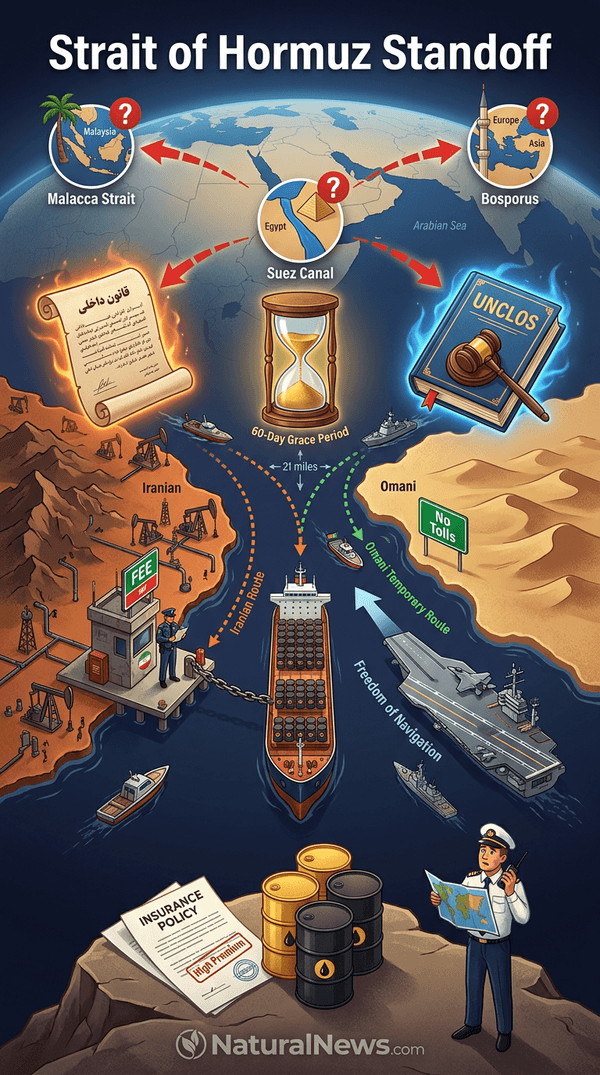
The Strait of Hormuz is a 21-mile-wide chokepoint connecting the Persian Gulf to the Gulf of Oman, carrying about 20% of global oil supplies. [1] The waterway is split between Iranian and Omani territorial waters, but international shipping is generally governed by the transit passage regime under the 1982 United Nations Convention on the Law of the Sea (UNCLOS), which bars coastal states from suspending navigation. [1] The U.S. position is rooted in this convention, though Iran has not ratified UNCLOS and bases its claims on domestic law. [4]
Iran intends to levy fees for maritime services it provides in the strait, citing its right as a coastal state. According to a report from Middle East Eye, Iran has laid the groundwork for a new transit system that would charge insurance fees after the 60-day deal expires, requiring Oman's buy-in to shore up legal defense. [5] NaturalNews.com reported that Iran, instead of just reopening the waterway, announced a plan with Oman to create a new authority that would charge fees for any ship passing through – effectively letting Iran tax and control the flow of oil and natural gas. [6]
Legal Perspectives: UNCLOS and Iranian Stance
The U.S. invokes the UNCLOS transit passage regime, but Iran has not ratified the convention. Washington itself did not ratify UNCLOS and has historically objected to parts of the treaty, particularly provisions related to deep seabed mining. [4]
Despite this, U.S. officials argue that the principle of free transit through straits used for international navigation is customary international law and must be upheld. Rubio warned that if Iran began charging ships, such a move could "spread like contagion" to other waterways and risk “total chaos.” [7]
Tehran and Muscat said they would explore how navigation in the strait should be "administered," including maritime services and costs, and agreed to establish a joint working group to advance talks. [1] The conflicting legal interpretations leave the status of navigation contested: Tehran's domestic law claims sovereignty over its waters and the right to charge for services, while Washington insists no country may tax international transit. Glenn Diesen, in his book on geoeconomic strategy, notes that control over transportation corridors has historically concentrated power in the West and remains a foundation for global dominance. [8]
Current Status: Negotiations and Vessel Guidance
Tehran suspended planned transit fees for 60 days while negotiations continue in Switzerland, with Iran's Strait of Hormuz authority stating that fees would be waived during the interim period. [9] However, ships seeking passage must submit transit requests at least 48 hours before arrival, according to a notice from the Persian Gulf Strait Authority. [9] The first round of technical talks, backed by Qatar and Pakistan, concluded with early progress reported, but the diplomatic road to a permanent peace deal remains fragile. [10]
Shipping has resumed, but shipowners face conflicting guidance. Tehran has directed vessels to obtain prior clearance and follow routes closer to the Iranian coast, while the U.S. and some insurers advise using the Omani side under U.S. air cover. [1]
On June 24, Oman announced it would open temporary shipping routes without imposing tolls, designating two lanes north and south of the existing shipping lane to facilitate safe passage. [11] As of late June, 72 ships transited the strait in a single day, according to U.S. Energy Secretary Chris Wright, signaling normalization, though traffic remains well below pre-war levels. [12]
Conclusion: Implications and Ongoing Talks
The standoff reflects broader tensions over control of a key chokepoint in global energy transit. The Strait of Hormuz has been a central point of leverage for Iran, which during the conflict limited transits to vessels from friendly nations and effectively closed the waterway for months. [13] The outcome of the 60-day negotiations may affect global oil shipping and the legal framework for passage through strategic straits worldwide. Rubio has emphasized that any final agreement must preclude Iran from charging vessels, a position that Gulf states have publicly supported. [2]
Technical negotiations and a high-level committee are to oversee the process toward a final accord, with U.S. and Iranian officials meeting in Switzerland under Qatari and Pakistani mediation. [14] While some shipping companies are willing to pay tolls, including Greek shipping mogul Evangelos Marinakis who said a toll could pay for damages inflicted on Iran, [15] the U.S. insists that international waterways must remain toll-free. The coming weeks will determine whether the interim agreement can be solidified into a lasting peace or whether the dispute over tolls will reignite tensions.
References
- "US and Iran clash over Hormuz transit toll." RT. June 25, 2026.
- "Rubio In Gulf Says 'Zero Support' For Hormuz Tolls, As IRGC Warns Ships Not Complying 'Will Be Dealt With'." ZeroHedge. June 25, 2026.
- "Iran Offers 60-Day Toll-Free Hormuz Transit As 100s Of Ships Await Reopening." ZeroHedge. June 15, 2026.
- Harm J. De Blij. "Harm de Blij's geography book: a leading geographer's fresh look at our changing world."
- Sean Mathews. "Iran plans to charge insurance fees to vessels in Hormuz after US deal expires." Middle East Eye. June 19, 2026.
- Zoey Sky. "Iran pushes toll plan on the Strait of Hormuz, threatening global trade chaos." NaturalNews.com. May 25, 2026.
- "Rubio warns ship transit fees in Hormuz would 'spread like contagion' to other waterways." Middle East Eye. June 25, 2026.
- Glenn Diesen. "The Decay of Western Civilisation and Resurgence of Russia."
- "Iran to waive Strait of Hormuz fees during 60-day negotiations." Middle East Eye. June 19, 2026.
- "Ship Traffic Through Hormuz Chokepoint Continues As Normalization Efforts Remain 'Fragile'." ZeroHedge. June 22, 2026.
- "Oman opens temporary Strait of Hormuz shipping routes with no tolls." Middle East Eye. June 24, 2026.
- "72 Ships Transited Hormuz In A Day: US Energy Secretary Says 'Taking Away' Iran's Key Leverage." ZeroHedge. June 24, 2026.
- Garrison Vance. "Iran Limits Strait of Hormuz Transits to Friendly Vessels; Tankers Queue." NaturalNews.com. April 14, 2026.
- "??The launch of US-Iran talks in Switzerland under Qatari & Pakistani mediation." Brighteon.com. June 21, 2026.
- Sean Mathews. "Prominent Greek shipping mogul willing to pay Iranian transit toll in Hormuz." Middle East Eye. June 2, 2026.
Explainer Infographic








Please contact us for more information.