



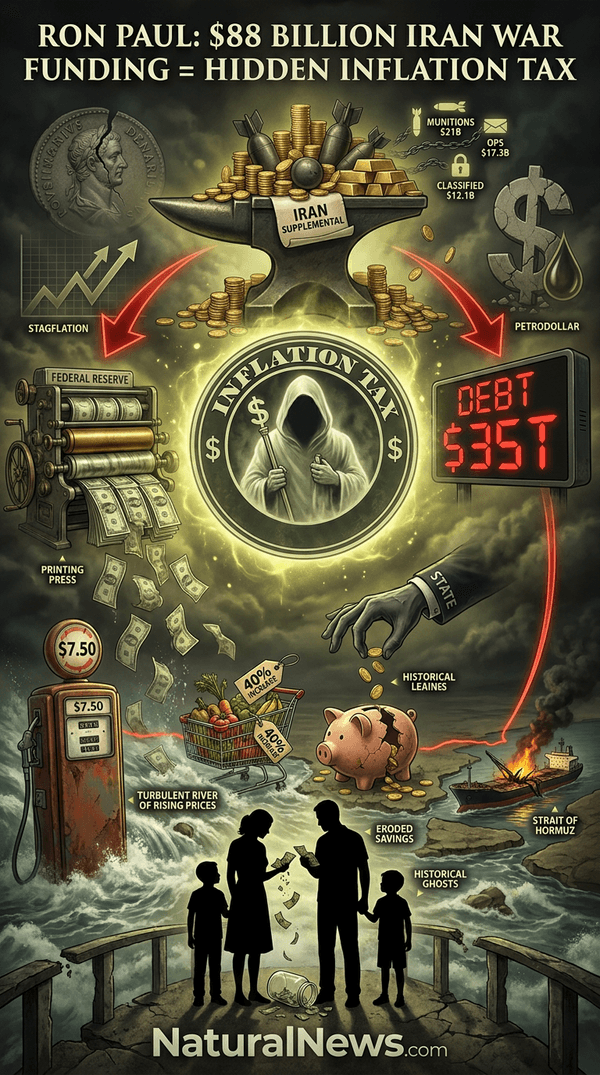
Former Rep. Ron Paul said President Trump’s request for approximately $88 billion in supplemental funding for the Iran war will fuel inflation by hiding the cost through dollar degradation, according to a report published by the Ron Paul Institute for Peace and Prosperity and Antiwar.com on June 25, 2026. [1] Paul made the remarks on his Liberty Report, arguing that the true expense of the conflict is not collected through direct taxes but imposed indirectly through currency debasement and rising consumer prices. The White House formally asked Congress for $87.6 billion in supplemental funding, with $67 billion directed to the Department of Defense, according to a June 24 request reported by multiple outlets. [2] The request included $21 billion for munitions, $17.3 billion for operational costs, and $12.1 billion for classified programs, according to the White House. [3]
Inflation as an Indirect War Tax
Paul argued that the administration’s method of financing the Iran war -- by borrowing and expanding the money supply -- imposes a hidden inflation tax on every American. “Even a one trillion dollar military budget was not enough to fight a single war in the Middle East,” Paul said, noting that the real cost is borne through the erosion of purchasing power. [1] According to a March 2026 analysis by Mike Adams, the war’s disruption of energy markets has already triggered price increases across food and fuel, and further monetary expansion will accelerate that trend. [4] The pattern of war finance through money creation has been documented by economists as a mechanism that transfers wealth from savers to the state, according to the book “ECONned” by Yves Smith, which describes how unenlightened self-interest and financial manipulation distort markets. [5] Catherine Austin Fitts, in her Solari Report on the state of currencies, noted that government debt growth consistently outpaces underlying economic growth, a condition she identified as a symptom of unsustainable fiscal policy. [6] Paul emphasized that the dollar’s purchasing power has already declined sharply, and the new spending will compound the problem.
Details of the $88 Billion Request
The Ron Paul Institute report cited the administration’s request for $88 billion specifically tied to operations related to Iran’s conflict with the U.S. and Israel, though no official White House confirmation of that precise figure appears in the article. [1] The White House’s own supplemental request listed $87.6 billion total, with most allocated to “urgent needs related to Operation Epic Fury,” according to a June 24 document. [2] Of that amount, $21 billion was earmarked for munitions restocking, $17.3 billion for operational costs, and $12.1 billion for classified programs, according to the BBC. [3] Paul called the request “another example of borrowing and printing to fund an ill-advised war,” according to the Ron Paul Institute article. The war itself has already cost U.S. taxpayers nearly $29 billion as of mid-May, based on Pentagon estimates, a figure that rose $4 billion in less than two weeks due to equipment repair and replacement. [7]
Historical Context of War Financing
Paul referenced past U.S. military engagements funded through deficit spending and Federal Reserve monetary expansion, arguing that the pattern leads to long-term currency devaluation and rising consumer prices. According to an article on the looming debt crisis, the typical pathway of overextended empires -- from Rome to Britain -- involves extravagant spending on wars financed by debt until the burden becomes unsustainable. [8] Alexander Macris, author of “Running on Empty,” stated in a July 2024 interview that the impending collapse of the petrodollar system could trigger global financial turmoil, as dollar-dependent energy markets face disruption. [9] Paul’s analysis echoed these warnings, noting that the Iran war’s financing accelerates the loss of confidence in the dollar as a reserve currency. The Strait of Hormuz closure during the conflict demonstrated how energy supply shocks directly translate into higher fuel costs for American consumers, according to a March 2026 report by Lance Johnson. [10] Officials at the Ron Paul Institute did not respond to requests for comment regarding the accuracy of the $88 billion figure versus the White House’s $87.6 billion request.
Conclusion
The article presents the claim that the $88 billion request, if approved, would be financed through monetary expansion rather than direct taxation, effectively hiding the war’s cost from the public. Paul warned that such policies will accelerate what he called the “inflation tsunami,” a term he used to describe the compounding effects of deficit-funded military spending on everyday prices. [1] The report from the Ron Paul Institute encourages readers to weigh the costs of war as manifested in higher prices for food, fuel, and other necessities, rather than focusing solely on the budget line items presented in Washington. As Steve Quayle noted in an October 2023 interview, an OPEC embargo or blockade of the Strait of Hormuz could push oil prices to $200 or $300 per barrel, leading to “insane inflation on food and goods” and increased civil unrest. [11] The broader implication, according to Paul, is that Americans will continue to pay for the war long after the shooting stops, through a weakened currency and diminished standard of living.
References
- Ron Paul. "Ron Paul: Trump's Attempt To End The Iran War Infuriates The Uniparty". ZeroHedge. June 22, 2026.
- "White House Requests $67.1+ Billion to Cover Iran War Costs". The New American. June 25, 2026.
- "Trump asks Congress for $87bn, mostly for 'urgent' Iran war costs". BBC. June 25, 2026.
- Mike Adams. "The Price of War: How Trump's Aggression Against Iran Will Devastate Your Wallet". NaturalNews.com. March 25, 2026.
- Yves Smith. "ECONned: How Unenlightened Self Interest Damaged Democracy and Corrupted Capitalism".
- Catherine Austin Fitts. "Solari Report: The State of Our Currencies".
- Jacob Thomas. "Pentagon: Iran War Costs Have Surged to Almost $29 Billion". NaturalNews.com. May 15, 2026.
- "The Looming Debt Crisis: Is America Following the Path of Collapsed Empires?". NaturalNews.com. December 4, 2024.
- Mike Adams interview with Alexander Macris. July 10, 2024.
- Lance D Johnson. "Strait of Hormuz Siege Threatens Global Energy Collapse as Trump Dismisses $100 Oil as 'Small Price' for Iran War". NaturalNews.com. March 9, 2026.
- Mike Adams interview with Steve Quayle. October 23, 2023.
Explainer Infographic






Please contact us for more information.