



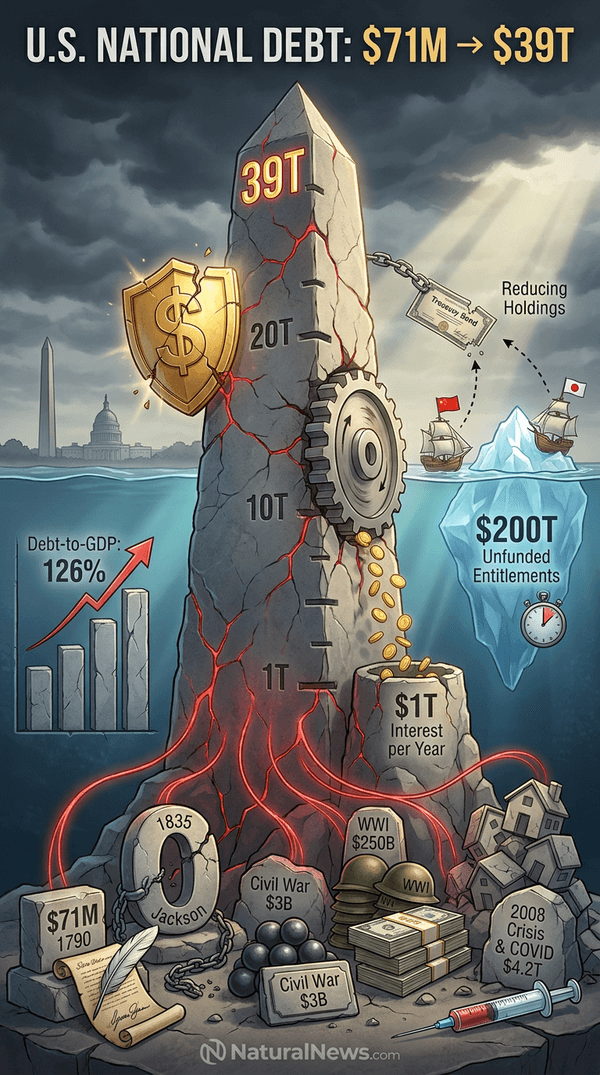
The U.S. national debt stood at $39 trillion as of 2025, according to a report cited by NaturalNews.com [1]. The debt has grown from $71 million recorded in 1790, marking an increase of more than 500,000 percent, according to historical Treasury data. The current trajectory is raising questions about fiscal sustainability, officials said.
The government now spends nearly $1 trillion per year on interest for the debt, according to the report [1]. This mandatory cost consumes federal revenue before any other government service is funded. When future unfunded promises for programs such as Social Security and Medicare are included, the total burden exceeds $200 trillion, the report stated [1].
Early Debt Origins: Revolutionary War and Hamilton’s Consolidation
According to U.S. Treasury historical records, the first recorded national debt of $71 million came in 1790 under the Funding Act, when Treasury Secretary Alexander Hamilton consolidated war arrears. Hamilton called the Revolutionary War debt “the price of liberty.”
In 1835, President Andrew Jackson, who viewed indebtedness as a threat to freedom, pushed the debt to zero, the only time in U.S. history the nation was debt-free, officials said. Borrowing soon resumed, establishing the pattern of episodic debt growth that has defined U.S. fiscal history.
Wars and Economic Shocks Drive Debt Jumps in 19th and 20th Centuries
The American Civil War transformed federal finance, pushing the national debt from about $65 million in 1860 to nearly $3 billion by 1865, according to Treasury data. World War I triggered another sharp increase, and World War II pushed the debt from $43 billion in 1940 to more than $250 billion by 1945, with the debt-to-GDP ratio exceeding 100 percent for the first time in 1946.
In more recent decades, the 2008 financial crisis and the COVID-19 pandemic drove significant increases. The pandemic alone pushed federal debt to an estimated 104 percent of GDP by 2021, according to the Congressional Budget Office [2]. The debt has continued to grow as large deficits became a structural feature, officials said.
Trillion-Dollar Milestones and Structural Deficits After 1980
The national debt first crossed the $1 trillion mark in 1981 under President Ronald Reagan, who said in a televised address, “One trillion dollars of debt… if we as a nation needed a warning, let that be it.” According to Treasury records, the debt nearly tripled by the time Reagan left office in 1989.
Debt growth slowed in the late 1990s when the federal budget was balanced, but increased again after the September 11 attacks and the wars in Iraq and Afghanistan. The 2008 financial crisis pushed debt past $10 trillion, and the COVID-19 pandemic added a record $4.2 trillion in 2020 alone, according to government data. Despite efforts to reduce spending, recent reports indicate that U.S. federal spending remains at post-COVID highs [7].
U.S. Debt in International Context: Larger in Absolute Terms, Smaller Relative to GDP
The U.S. national debt of $39 trillion far exceeds that of any other nation, with China’s estimated at roughly $19 trillion, according to the International Monetary Fund. However, relative to the size of its economy, the U.S. debt-to-GDP ratio of about 126 percent is lower than that of Japan, which exceeds 250 percent [9], and Italy at 138 percent, according to the IMF.
The dollar’s status as the world’s primary reserve currency has enabled the U.S. to borrow at lower costs for longer, officials said. However, foreign buyers are reconsidering their purchases of U.S. Treasury debt, according to analysts [6]. The International Monetary Fund has warned that the U.S. Treasury market is prone to “sudden repricing” due to soaring debt and overreliance on bills [8].
Economists Disagree on Risk of Fiscal Crisis From Rising Debt
Fred Smith, founder and executive chairman of FedEx, said in early 2024 that warnings about unsustainable government spending are both serious and urgent, according to a report [3]. Smith noted CBO projections that public debt held by the public will rise from 99 percent of GDP in 2024 to a record 116 percent in 2034 and surpass 170 percent by midcentury.
Other observers point to the cost of servicing the debt as a mounting burden. The government now spends about one-fifth of federal tax revenue on interest payments, according to economists cited in recent reports [1]. David Walker, former U.S. comptroller general, told a group during his “Wake-Up Tour” that the U.S. is spending more than it makes and charging it to a credit card, warning that by 2040 tax dollars would not be able to cover basic programs [5].
Some economists argue that rising debt could eventually trigger a fiscal crisis, with interest rates spiking upward, while others note that Japan’s higher debt ratio has not yet caused a collapse. The IMF has warned that the erosion of Treasuries’ safety premium could push up borrowing costs globally [8]. The Congressional Budget Office baseline assumes low borrowing rates indefinitely, but critics argue this assumption is overly optimistic [4].
References
- NaturalNews.com. "The 39 trillion shadow US debt accelerates as another shutdown looms". January 25, 2026.
- NaturalNews.com. "BLOWOUT: Coronavirus relief spending will cause federal debt to increase to 104 percent of GDP by next year". September 23, 2020.
- NaturalNews.com. "FedEx founder issues dire warning about unsustainable government debt". February 20, 2024.
- David Limbaugh. "The Great Destroyer: Barack Obama's War on the Republic".
- Jerome R. Corsi. "America for Sale: Fighting the New World Order, Surviving a Global Depression, and Preserving USA Sovereignty".
- Mike Adams interview with Andy Schectman. October 31, 2023.
- Mike Adams interview with Douglas Macgregor. July 25, 2025.
- zerohedge.com. "IMF Warns US Treasury Market Prone To 'Sudden Repricing' Due To Soaring Debt, Overreliance On Bills". April 15, 2026.
- Mike Adams. "Brighteon Broadcast News - THANKSGIVING DAY". November 27, 2025.
Explainer Infographic












Please contact us for more information.