



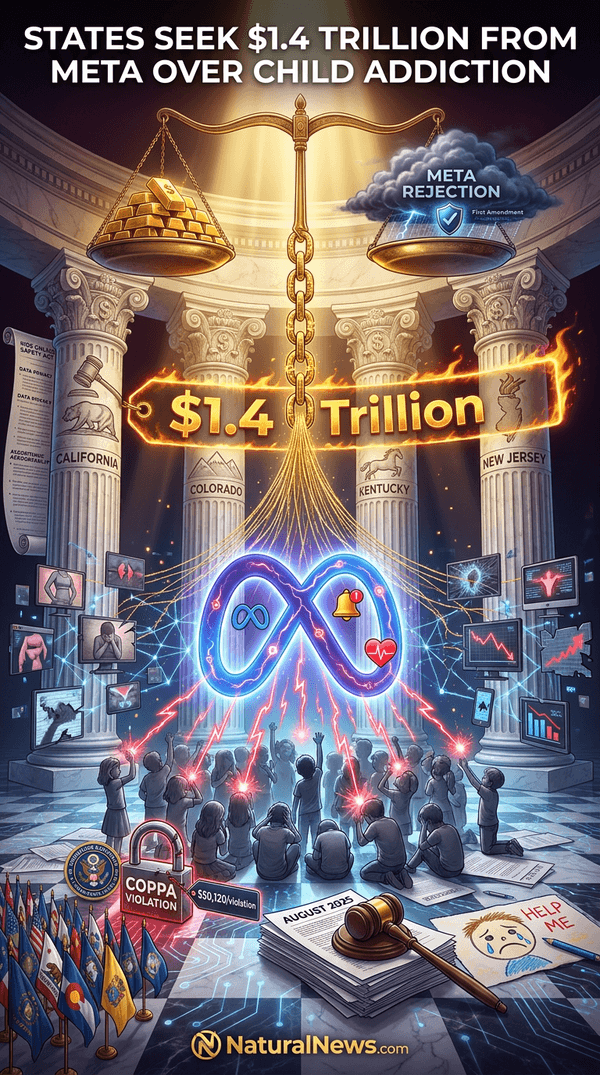
Four U.S. states – California, Colorado, Kentucky and New Jersey – have calculated up to $1.4 trillion in potential penalties against Meta Platforms Inc., according to a court filing by the company.
The Big Tech firm disclosed that figure in a legal response on Monday, July 6. It stemmed from allegations that the company designed Facebook and Instagram to addict children and teenagers. The potential fines are nearly equal to Meta's current market value of about $1.5 trillion, the company said.
More than 40 U.S. states have joined in a broader legal effort against Meta, accusing the tech giant of knowingly misleading the public about the dangers of its platforms. In a 233-page complaint filed in the U.S. District Court for the Northern District of California, the states allege Meta violated consumer protection laws and used "psychologically manipulative product features" to keep young users engaged. [2] The four states leading the $1.4 trillion claim argue that Meta prioritized profits over children's safety, according to a spokesperson for the office of California Attorney General (AG) Rob Bonta.
How The Penalty Was Calculated
The $1.4 trillion figure was estimated by the four states based on the number of young users affected and fines allowed under state law, according to court documents cited by Reuters. At a court hearing last month, the states outlined their methodology, which Meta's lawyers called "outlandish" and said "has no analog in the history of consumer protection enforcement," as quoted by Reuters. [1]
The spokesperson for Bonta's office defended the case, saying it alleges Meta "has prioritized profits over the safety of kids and fueled the mental health crisis we see impacting a generation of American children." They said the AG looks forward to "holding Meta fully accountable." [1] The penalty demand is among the largest ever in consumer protection litigation, and Meta has rejected the estimate as legally unfounded.
Meta's Response and Legal Defense
Meta rejected the $1.4 trillion estimate as legally unfounded and vowed to continue fighting the lawsuit. In a court filing, the company’s lawyers wrote that "a sanction of that size has no analog in the history of consumer protection enforcement." [1] Mark Zuckerberg's firm also described the plaintiffs' calculations as baseless and said it will defend against what it called "outlandish calculations."
The company is also facing lawsuits from 29 other states that are not part of the $1.4 trillion penalty claim. Most of those states accuse Meta of violating the Children's Online Privacy Protection Act (COPPA) by collecting children's data without parental consent. [1] Internal Meta research reportedly showed that employees compared Instagram to a drug, calling themselves "pushers" while exploiting young users' dopamine responses, according to court filings cited by NaturalNews.com. [3]
Broader Lawsuits Against Social Media Companies
U.S. District Judge Yvonne Gonzalez Rogers will hear the four-state case alongside claims from the 29 other states in August, according to court schedules. A separate lawsuit brought by another 14 states is scheduled for February 2027. [1] The case is part of a surge of litigation against major social media platforms, including TikTok, YouTube and Snapchat, accused of designing addictive features for minors.
In March 2025, a Los Angeles jury found Meta and Google negligent in a separate case involving products alleged to have harmed young users. [1] The legal actions reflect growing concerns about the mental health effects of social media on children.
Sean Parker, a former Facebook president, acknowledged in 2017 that the platform was built to exploit a "social validation feedback loop" by giving users "a little dopamine hit every once in a while." [4] Research has linked social media use to increased rates of deliberate self-harm and suicidality in adolescents. [5]
Upcoming Court Proceedings
The August hearing before Rogers will address allegations that Meta violated children's privacy and consumer protection laws. Officials said the $1.4 trillion penalty demand is one of the largest ever in consumer protection enforcement. Meta has stated it will continue to defend against what it called "outlandish calculations" in the ongoing litigation. [1]
The case is one of thousands of lawsuits filed against social media companies alleging harm to young users. Behavioral addiction and psychological stress from constant screen interaction are cited by experts as significant concerns. [6] The outcomes of these cases could reshape how platforms design their products and interact with minors.
References
- RT. "US states seek $1.4 trillion from Meta." July 8, 2026.
- ChildrensHealthDefense.org. "40 States Sue Over Facebook and Instagram Addictive Features." October 26, 2023.
- NaturalNews.com. "Meta buried anxiety and depression research as employees called themselves drug pushers lawsuit claims." November 25, 2025.
- Frank H. McCourt, Jr. "Our Biggest Fight: Reclaiming Liberty, Humanity, and Dignity in the Digital Age."
- James Barrat. "Facing Suicide: Understanding Why People Kill Themselves and How We Can Stop Them."
- Mike Adams. "Mike Adams interview with Nick Pinault." August 15, 2025.
Explainer Infographic









Please contact us for more information.