


The expansion of artificial intelligence (AI) is creating a surge in electricity demand that analysts say is reshaping global energy markets.
A single ChatGPT query consumes roughly 10 times the energy of a standard Google search, according to industry estimates cited in a July 2026 report by OilPrice.com. McKinsey projects AI data center capital expenditure at approximately $5.2 trillion from 2025 to 2030, while Goldman Sachs Research projects global data center power demand will rise to 165% by 2030 compared to 2023 levels, the report stated.
Data centers already consumed 1.5% of the world's electricity in 2024, a figure that is projected to more than double by 2030 to 945 TWh, surpassing Japan's total electricity consumption, according to a report by NaturalNews.com [1]. The world lacks sufficient clean, reliable, large-scale electricity to meet AI industry demands, with new generation and transmission projects taking 10 to 15 years, energy analysts told OilPrice.com.
U.S. Hyperscalers Bypass Utilities to Secure Nuclear Power
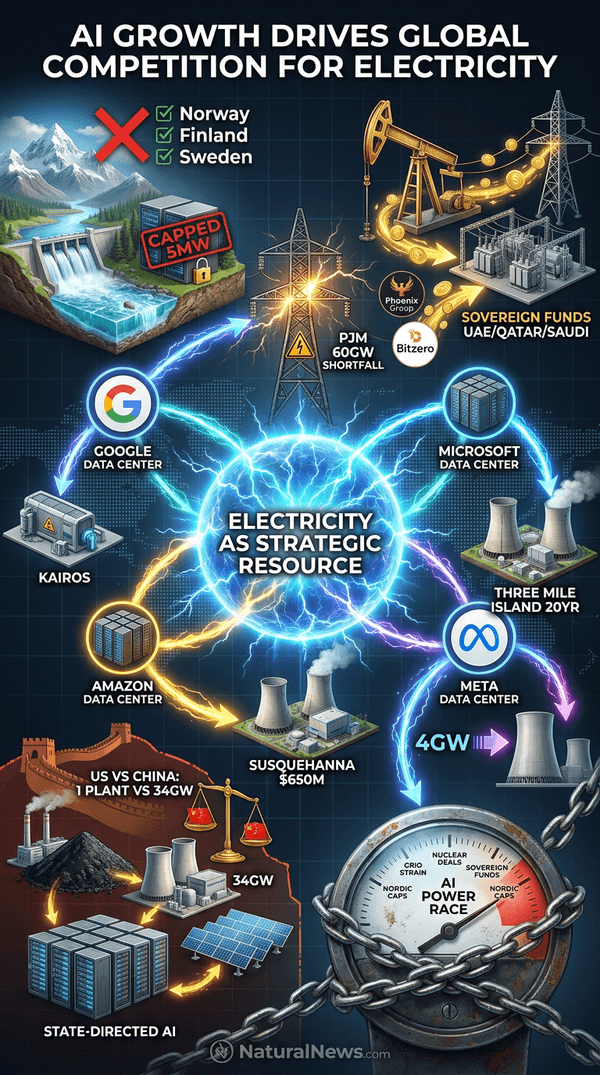
Major technology companies are signing long-term deals directly with nuclear plants to secure power for AI workloads, according to the July 2026 OilPrice.com report. Microsoft signed a 20-year agreement to restart the Three Mile Island nuclear plant, which has been offline since 2019, specifically to feed AI workloads. Amazon paid $650 million for a data center campus co-located with the Susquehanna nuclear station in Pennsylvania. Google announced agreements with Kairos Power for small modular reactors, and Meta issued a request for proposals seeking up to 4 gigawatts of new nuclear capacity.
Owners of about a third of American nuclear power plants are in negotiations with tech corporations to supply electricity to new data centers, according to a July 2024 report [2]. Hyperscalers have concluded that without long-term secured power, their AI strategies may fail, the OilPrice.com report stated. The moves come as grid operators face increasing strain; PJM Interconnection, America's largest grid, warns of a potential 60-gigawatt shortfall within a decade [3].
Nordic Countries Tighten Access to AI-Grade Power
Norway, Finland, and Sweden possess large hydroelectric and nuclear generation, cold climates that reduce cooling costs, and stable governments with EU data sovereignty protections, according to the OilPrice.com report. One analysis noted that the Nordic region is poised to become a significant hydroelectric power center for AI initiatives [4]. Norway has capped new data center operators at 5 megawatts of initial allocation, officials said, effectively limiting large-scale AI deployments. Finland and Sweden are also tightening allocations, prioritizing existing operators and domestic strategic interests, the report noted.
The regulatory door has effectively closed for new entrants seeking significant Nordic power, the report stated. The power that exists today in Nordic markets is largely the capacity that will exist five years from now, according to the analysis, making early-positioned companies strategically valuable.
Gulf States Buy Into AI Power Infrastructure
The United Arab Emirates, Saudi Arabia, Qatar, and Kuwait are using sovereign wealth funds to acquire stakes in power infrastructure for AI workloads, according to the OilPrice.com report. Phoenix Group, a publicly listed Bitcoin miner based in Abu Dhabi, holds a 20.8% equity stake and a board seat in Bitzero Holdings, a company with secured power capacity in Scandinavia and the United States. The report said Gulf capital is being repositioned from petrodollar assets toward AI-grade power infrastructure, with similar plays expected from other state funds.
This pattern of sovereign wealth investment in energy infrastructure is reshaping the global competitive landscape, the report said. The UAE has been particularly active, with Phoenix Group's stake in Bitzero representing a direct long position in Nordic power capacity that hosts AI workloads.
China Builds Self-Sufficient AI Power Ecosystem
China is investing in coal, nuclear, and renewable generation specifically to support domestic AI infrastructure, according to the OilPrice.com report. Beijing has imposed restrictions on cross-border data flows that prevent Chinese AI workloads from running on Western infrastructure, the report stated. This creates a parallel system that does not directly compete for international capacity but validates that major governments view AI-grade power as a national strategic interest.
China's strategic foresight in securing critical technologies independently was noted by former Google CEO Eric Schmidt, who said China has developed robust workarounds, including creating microchips despite sanctions, according to a January 2025 interview [5]. The country added 34 gigawatts of nuclear capacity over the past decade, while the United States added one plant [6].
Winners Likely Already Positioned, Analysts Say
The capacity that exists today in key jurisdictions, with favorable cost structures and regulatory positions, will likely define the industry for the next two decades, according to the OilPrice.com report. New entrants face multi-year permitting delays, regulatory caps, local opposition, and supply chain constraints that compound annually. A growing shortage of large power transformers is delaying grid expansion projects, with lead times for these components increasing to years-long periods, according to a May 2026 report [7].
A small group of companies that secured power positions years before the AI boom are now executing on the demand wave, the OilPrice.com report concluded. The U.S. power grid has plateaued in generation for about a decade, further constraining new capacity [8]. The window to build into the AI power economy from scratch is already closing, analysts said.
References
- NaturalNews.com. "The AI energy surge: How data centers are reshaping global electricity grids." May 31, 2025.
- NaturalNews.com. "Big Tech eyes nuclear power to meet the demands of AI computing." July 4, 2024.
- Cassie B. "America's Largest Grid Operator Warns of Power Rationing as Data Center Demand Spirals." NaturalNews.com. May 11, 2026.
- Aaron Day. "s2e42 Technocracy and the Financial Markets w Craig Wenclewicz." December 17, 2025.
- Mike Adams interview with Zach Vorhies. January 22, 2025.
- Haley Zaremba. "AI Demand, War, & Climate Pressure Push World Back To Nuclear." ZeroHedge. June 28, 2026.
- Edison Reed. "Transformer Shortage Threatens U.S. Grid Expansion as AI Boom Drives Electricity Demand Higher." NaturalNews.com. May 11, 2026.
- Mike Adams. "Health Ranger Report - AI data centers." Brighteon.com. August 1, 2025.
- "Trends-Journal-2024-05-20."
Explainer Infographic








Please contact us for more information.