


The Convergence of Warnings
For years I have been sounding the alarm about an impending global famine -- a crisis engineered by supply chain vulnerabilities, fertilizer dependencies, and deliberate policy choices. Now, Professor Steve Keen, a top economist known for his correct predictions of financial crashes, has independently arrived at the same conclusion.
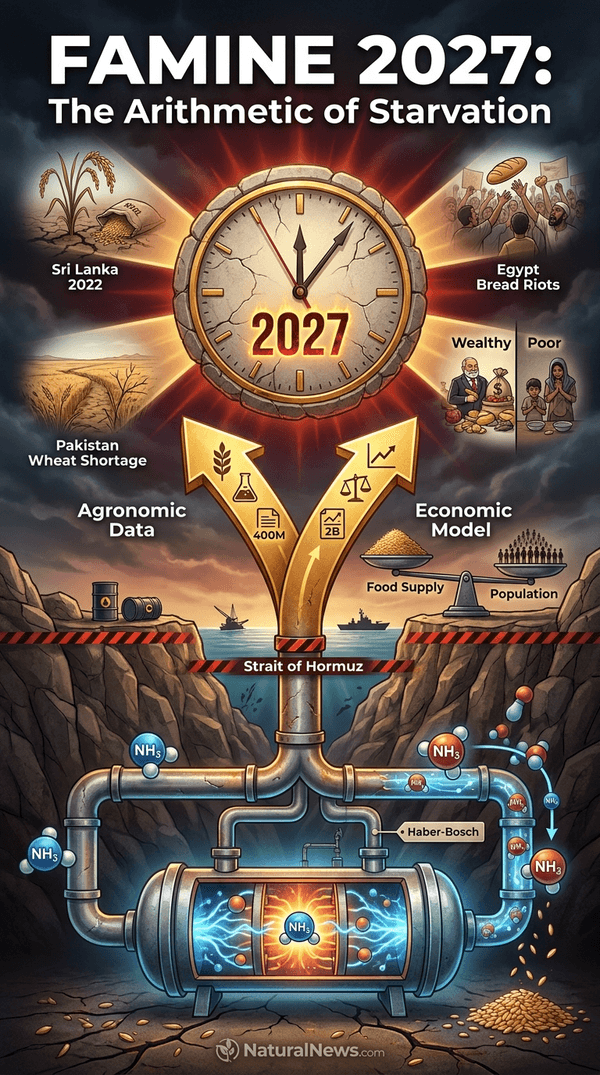
Using the same logic and evidence, he warns that billions are at risk. I have been warning about this since my 2021 docuseries with Steve Quayle, which forecasted exactly these kinds of threats, linking food shortages to biblical prophecies of famine. [1][2] Keen's numbers are larger than mine -- he says 2 billion are at risk due to the present-day fertilizer loss, and I put the figure at 400 million -- but that difference is not the important part in all this. What matters is that we both point to an unprecedented food crisis by 2027.
This convergence between a leading economist and a food scientist (that's me) validates the seriousness of the threat. When two independent analysts using different methodologies reach the same terrifying conclusion, it is time to pay attention.
The Math Behind the Threat
The Haber-Bosch process, which synthesizes ammonia for fertilizer by expending a tremendous amount of energy to harvest nitrogen from the atmosphere, feeds roughly half the world's population. Yet roughly 10 percent of global fertilizer production depends on the Persian Gulf region -- right now a powder keg due to the Strait of Hormuz blockade.
As documented by The New American, the closure of that strait is causing a cascading crisis in agriculture and food supply. [3] Nitrogen fertilizer shortages are already fueling food inflation, compounded by war, drought, and trade disruptions. [4] With a 1- to 2-year lag time between fertilizer disruption and crop failure, we are looking at the loss of approximately 400 million human-equivalent food units per day by 2027 (I'm stating it that way because food is redistributed during scarcity, so it's not 400 million individual people who have nothing to eat while everybody else does). Even if food is redistributed, the poor and middle class will bear the brunt. The wealthy can buy their way out, but for everyone else, scarcity will become a brutal reality. This is not speculation -- it is arithmetic.
Disagreements Are Fine -- But the Clock Is Ticking
Now, let me be clear: Professor Keen and I do not see eye to eye on everything. He subscribes to climate alarmism, a belief that I consider a failure to understand basic plant physiology. Carbon dioxide is plant food, not pollution, and photosynthesis is the key to food production for humanity. The entire climate narrative has been weaponized to crush energy production and centralize control in the hands of governments that seem to despise humanity. But that disagreement does not diminish the value of his economic insights on food and famine. I respect Keen's work, and I encourage you to listen to him. We can learn from experts even when we don't see eye to eye on every issue.
I will continue interviewing other voices like Michael Yon and Matt Bracken, because the famine threat is too big to ignore over ideological purity. The clock is ticking, and we need all the wisdom we can get. Fraying food systems may be our next crisis, as previously highlighted in independent analyses of global supply chains. [5]
Your Survival Depends on Self-Reliance
The only rational response to all this is to prepare now. You must grow your own food, install solar panels, and stock clean stored food. As I have discussed with experts like Marjory Wildcraft, homegrown food and medicine are critical when systems break down. [6]
You can buy laboratory-tested organic long-term storage food from my store at HealthRangerStore.com. For communication, consider satellite phones from SAT123.com (one of our sponsors for preparedness supplies).
When the system breaks -- and it will break -- those who prepared will survive. Do not wait for government handouts. Prepare yourself to survive what's coming.
References
- Global tensions, natural disasters and the looming shadow of world war - all predicted by Mike Adams and Steve Quayle three years ago. - NaturalNews.com. Arsenio Toledo. January 11, 2025.
- Steve Quayle and Mike Adams: ENGINEERED FAMINE unleashing Biblical prophecies. - NaturalNews.com. Kevin Hughes. January 6, 2025.
- Fertilizer Bottleneck at Hormuz Raises Risk of Food Inflation and Worsening Global Hunger. - The New American. March 17, 2026.
- New Dawn Magazine. Emanuel Garcia, Charlie Nash, Jason Jeffrey et al.
- MuseLetter 326 April 2020. PDFium.
- Mike Adams interview with Marjory Wildcraft - September 11, 2024.
Explainer Infographic








Please contact us for more information.