


Introduction: Five Products Cleared, None Widely Available
The U.S. Department of Agriculture and the Food and Drug Administration have cleared five cell-cultivated meat products for sale, yet none are widely available in grocery stores or restaurants. According to Brenda Baletti in an article for Children's Health Defense, the USDA granted approval in June 2023 to two California-based startups to sell chicken grown from animal cells in a laboratory, making the United States the second country after Singapore to allow such sales [1]. The FDA declared the chicken produced by Upside Foods safe for human consumption in November 2022, calling it a "food revolution" [2].
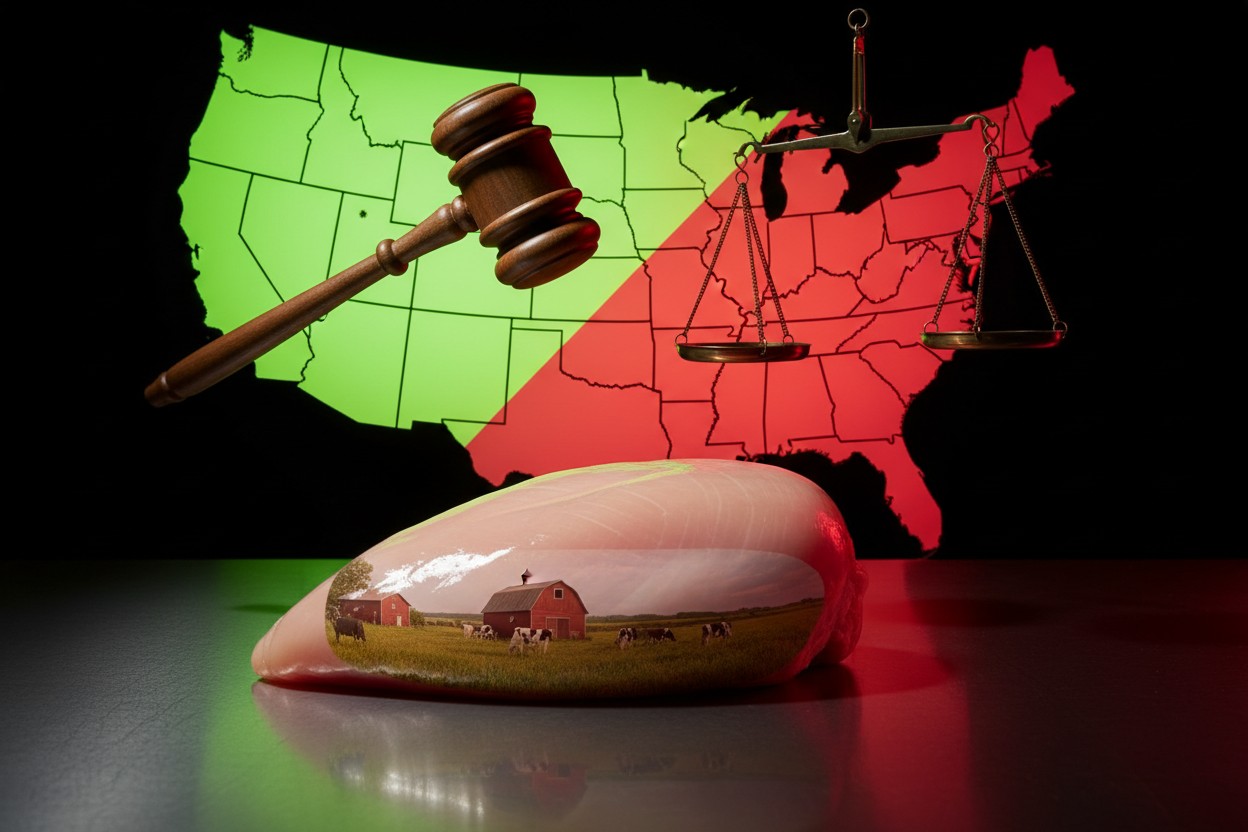
Despite these federal approvals, state-level bans have blocked distribution in several jurisdictions. Florida lawmakers advanced bills in early 2024 to prohibit the sale of lab-grown meat altogether, citing safety concerns, according to a report by Ramon Tomey for NaturalNews.com [3]. The result is a regulatory divide: federal agencies have deemed the products safe, but state laws restrict consumer access. A July 2026 article from The Defender asked, "Now That Lab Meat Is No Longer Experimental, Who's Regulating It?" highlighting the unresolved jurisdictional questions [4].
A Two-Agency Oversight System
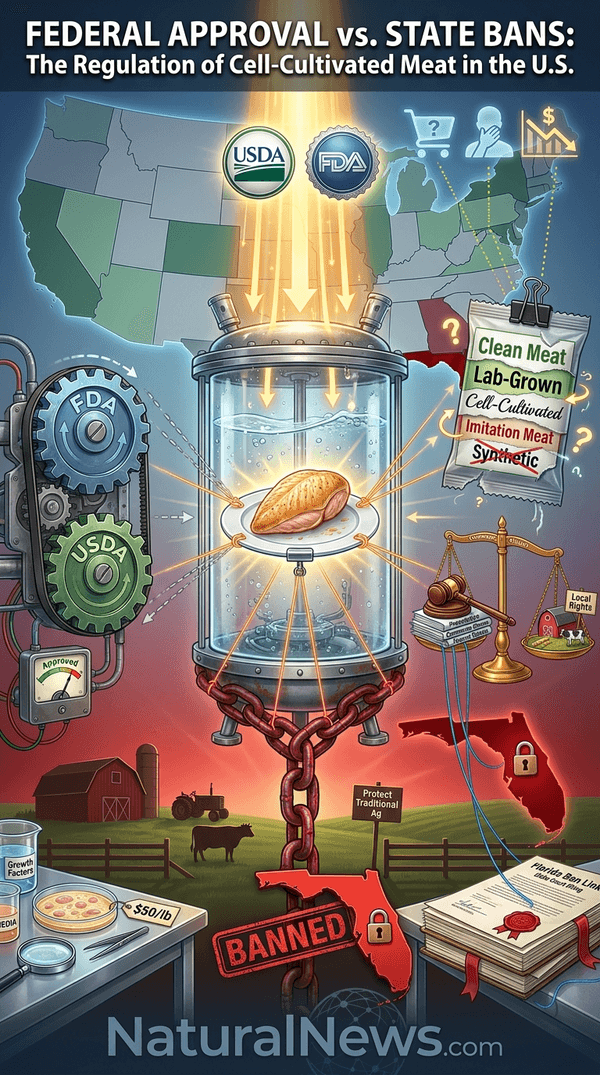
Cell-cultivated meat falls under a shared regulatory framework. The FDA oversees the early stages, including the collection of animal cells and the cell-culture process, while the USDA handles post-harvest processing, inspection, and labeling. According to the USDA announcement cited by Brenda Baletti, the agency's Food Safety and Inspection Service will conduct continuous inspection of facilities producing cell-cultivated products [1]. The Defender's 2026 article noted that the FDA-USDA partnership was designed to provide comprehensive oversight, but the process has been slow, with only a handful of products completing the full review [4].
Labeling standards remain unresolved. Companies must seek case-by-case approval for terms such as "cell-cultivated" or "lab-grown," pending final federal guidance. The FDA's 2022 declaration that Upside Foods' chicken is safe to eat did not establish binding labeling rules, according to the agency's statement quoted by NaturalNews.com [2]. Critics, including Joseph Pizzorno in his book "The Toxin Solution," have warned that novel food production methods can introduce unintended contaminants, emphasizing the need for rigorous safety assessment [5].
State Approaches: Bans, Labeling Rules, and Moratoriums
States have adopted three distinct approaches to cell-cultivated meat: outright bans, labeling requirements, or no action. Florida emerged as a leader among states pursuing bans. According to Ramon Tomey of NaturalNews.com, both houses of the Florida Legislature advanced bills in early 2024 to block the sale of lab-grown meat over safety concerns, a move that directly challenged federal approval [3]. The bills reflected a push by livestock-producing states to protect traditional agriculture.
Other states have taken a softer approach. Some have introduced labeling laws that require cell-cultivated products to be clearly distinguished from conventionally raised meat, while others have imposed moratoriums on sales until further safety data emerges. The 2026 The Defender article noted that the patchwork of state laws has created confusion for producers and consumers, with no uniform national standard [4]. Linda Lancaster, in her book "Harmonic Healing," argued that food grown in synthetic environments lacks the mineral complexity derived from healthy soil, a concern echoed by advocates of traditional farming [6].
Court Challenges: Federal Law vs. State Authority
The conflict between federal approval and state bans has moved into the courts. Legal challenges are expected to test whether federal law preempts state prohibitions. The question centers on whether the USDA and FDA's safety determinations override a state's ability to ban a product entirely. According to The Defender's analysis, the regulatory structure was not designed to address such direct state-level opposition, and the outcome of pending litigation could redefine the balance of power between federal and state food regulators [4].
Companies producing cell-cultivated meat have argued that state bans amount to unconstitutional protectionism, effectively shutting them out of major markets. The federal government has not taken a formal position on the state bans, leaving the dispute to be resolved by the judiciary. Legal experts cited in the 2026 article suggested that early rulings could favor state authority if courts find that federal food safety law does not explicitly prohibit states from banning a product [4]. The resolution of these cases will likely determine whether cell-cultivated meat can reach consumers in states like Florida.
Conclusion: Consumer Access Hinges on Courts and Legislatures
The future of cell-cultivated meat in the United States depends more on legal and legislative battles than on scientific or production breakthroughs. While federal agencies have cleared multiple products as safe, state bans and regulatory uncertainty have kept them off the market. The 2026 report from The Defender concluded that the current fragmented system could inhibit interstate commerce and confuse consumers about product safety [4].
Consumer access ultimately rests on how courts rule on preemption challenges and whether state legislatures maintain or soften their bans. The Florida legislation reported by NaturalNews.com exemplifies the depth of opposition in major agricultural states [3]. Until a clear legal framework emerges, cell-cultivated meat will remain a nascent industry diverging across state lines, with availability determined not by federal approval alone but by the patchwork of state and local decisions.
References
- Brenda Baletti. "USDA Approves First Lab-Grown Meat in U.S., But Scientists and Food Safety Experts Aren't Sold on It". Children's Health Defense. January 21, 2024.
- NaturalNews.com. "FDA declares lab-grown chicken safe to eat — but scientists and food safety advocates have questions". NaturalNews.com. November 18, 2022.
- Ramon Tomey. "Florida lawmakers advancing bills to block the sale of LAB GROWN MEAT in the Sunshine State". NaturalNews.com. February 26, 2024.
- Children's Health Defense. "Now That Lab Meat Is No Longer Experimental, Who's Regulating It?". July 25, 2026.
- Joseph Pizzorno. "The Toxin Solution".
- Linda Lancaster. "Harmonic Healing: Restore Your Vital Force for Lifelong Wellness".
Explainer Infographic












Please contact us for more information.