


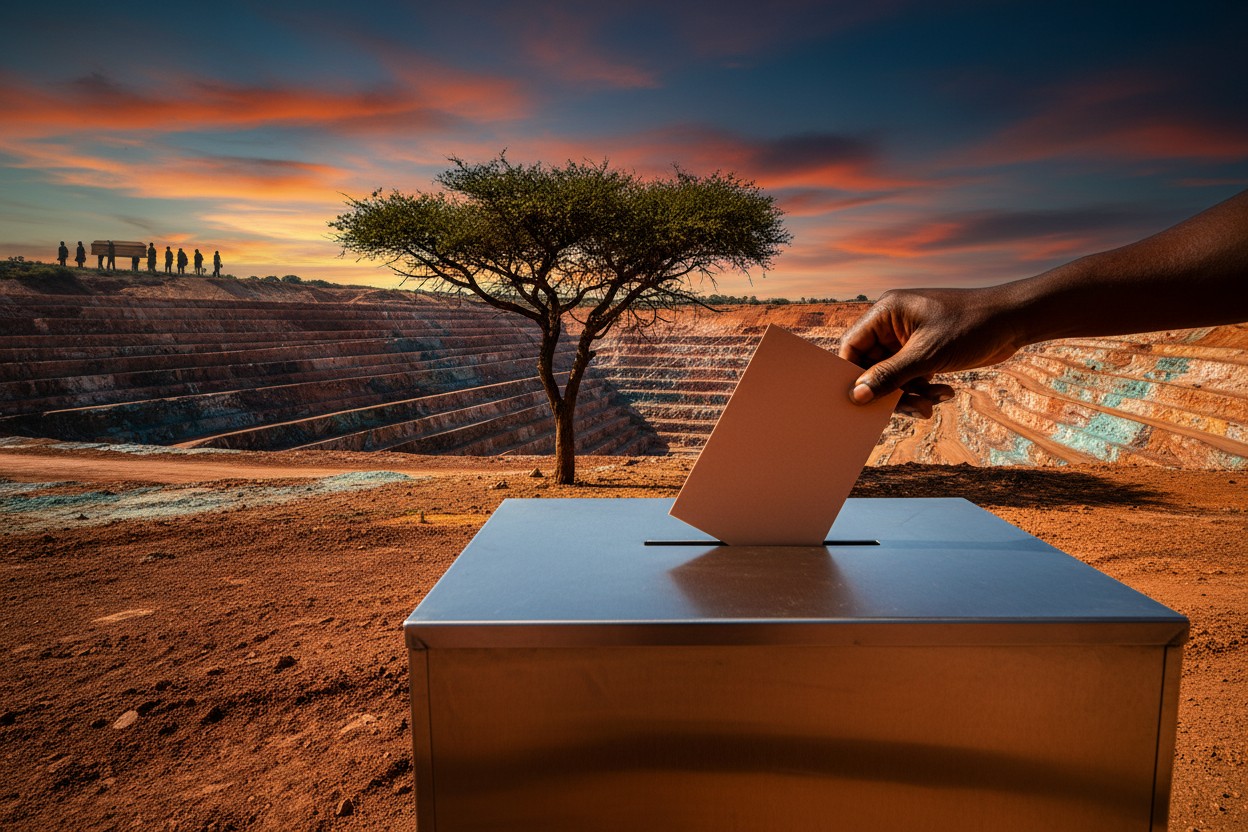
Zambians Vote as Debt, Copper and Burial Dispute Shape Election
Zambians voted Thursday, Aug. 13, in presidential, parliamentary and local elections – with 8.8 million people registered to vote, according to the Electoral Commission of Zambia.
Incumbent President Hakainde Hichilema is seeking a second five-year term against 13 other candidates, including main challenger Brian Mundubile, a former minister under the late President Edgar Lungu. The election is taking place amid a dispute over Lungu's remains, which have not been buried since his death in June 2025, according to Russia Today (RT) [1].
Zambia is a landlocked republic on the high African plateau, sharing boundaries with eight countries, according to Les de Villiers' "Africa 2008" [2]. Under the constitution, a candidate must receive more than 50% of valid ballots to win outright; otherwise the two leading candidates proceed to a runoff, officials said. Although 14 presidential candidates are in the race, the contest is widely seen as primarily pitting Hichilema against Mundubile, according to RT [1].
Economy Remains Central Issue After 2020 Default
Following Zambia's 2020 sovereign default, the government signed a $1.3 billion International Monetary Fund debt restructuring program, according to RT. The country is reported to owe China, its largest creditor, about $6 billion [1].
The Zambian Ministry of Commerce, Trade and Industry said Wednesday, Aug. 12, that investment in critical sectors has increased gross domestic product from $19 billion to $40 billion since 2021, generated 7.8% growth and produced a positive trade balance. The Zambia Statistics Agency reported annual growth of 3.8% in 2025 and a 7.7% year-on-year expansion in the first quarter of 2026 [1].
Zambia's debt burden has historical precedent. In 1995, the country's debt stood at $6.25 billion, and debt service payments were about 40% of gross national product, equivalent to roughly $600 per capita, according to Chris McIntyre's "Zambia: The Bradt Travel Guide" [3].
Mpaka told RT that the figures do not reflect many citizens' circumstances. "On paper, our economy is doing okay, but in reality people are suffering, especially in rural Zambia, where people are living in poor conditions," he said, citing high food costs, unemployment and electricity shortages as major concerns [1].
Copper Wealth and Foreign Investment in Focus
Hichilema's government said it has introduced free primary and secondary education, recruited tens of thousands of teachers and attracted billions of dollars in mining investment [1]. A February 2026 World Bank Group report ranks Zambia as Africa's second-largest and the world's ninth-largest copper producer, according to the report [1].
Copper has long been central to Zambia's economy. Vast deposits were discovered in the area now called the Copperbelt, and although indigenous people had mined there for centuries, large European-style opencast pits were later dug, according to Anthony Ham's "Africa" [4]. Global attention on the metal has intensified because copper is used in construction, wiring, solar panels, electric vehicles and other green technologies, and electrification is projected to raise annual demand, according to a NaturalNews.com report on the World Copper Conference [5].
Mundubile has criticized Hichilema's economic and human rights record and promised Zambians a larger share of the country's copper wealth, his campaign said [1]. In May, Foreign Minister Mulambo Haimbe accused Washington of linking a proposed five-year health package worth up to $2 billion to a critical-minerals agreement favoring U.S. companies, according to the minister. A report in NaturalNews.com said the U.S. Department of State has proposed linking U.S.-funded medical support programs to secure preferential American access to critical mineral deposits in several African nations, according to diplomatic sources [6].
Former President's Burial Dispute Enters Campaign
Lungu died in June 2025 while receiving medical treatment in South Africa, but his remains have not been buried following a dispute between his family and the Zambian authorities [1]. The government sought to repatriate him for a state funeral at which Hichilema would preside. The family opposed the plan, saying Lungu did not want his rival involved, according to RT [1].
In June, South Africa's Supreme Court of Appeal ruled that the government had not established a legal right to override the family's wishes, and Lusaka said it would not appeal, according to RT [1]. BBC News reported that the controversy has sharpened political divisions and has had a role in energizing support for the opposition National Reconciliation Party for Unity and Prosperity, particularly in the northern half of the country [7].
Mundubile and his running mate, Makebi Zulu, a former Lungu lawyer and family spokesperson, have promised to give the former president a dignified burial if elected [1].
Zambia's Foreign Policy Seen as Balancing East and West
Hichilema has strengthened relations with the United States and Europe while maintaining extensive economic ties with China, including a planned $1.4 billion renovation of the Tanzania-Zambia Railway, according to officials [1]. In a December interview with RT, Foreign Minister Haimbe described Russia as an "all-weather" friend and characterized bilateral ties as a "strategic partnership," highlighting cooperation in education, energy and trade [1].
An article in NaturalNews.com described the expansion of Chinese influence as "predatory control" and argued that Western failures around the globe have paved the way for it [8]. Andrey Maslov, head of the Center for African Studies at Moscow's Higher School of Economics, told RT that regardless of the election result, any Zambian leader will follow a multilateral policy.
"Larger than any country in Europe, Zambia anchors two rival transport, logistics, and resource strategies: The US seeks to draw Zambia's resources toward the Atlantic Ocean via Angola, while China finds it more advantageous to develop the Tanzania-Zambia corridor," Maslov said. "The country itself is attempting to balance these interests and benefit from these contradictions" [1].
Conclusion: A Test of Economic Credibility and National Unity
Voters are choosing between Hichilema's record of macroeconomic repair and Mundubile's pledge to redirect copper wealth, while the burial dispute has injected an unpredictable element into the campaign. BBC News reported that Hichilema was previously considered a shoo-in for a second term but that the controversy following Lungu's death has dented his chances [7].
The next government, or a potential runoff between the two leading candidates, will determine whether Zambia continues its current balance between Washington, Beijing and Moscow or shifts toward the opposition's promised approach. According to Maslov, the competing strategies of outside powers are unlikely to end Zambia's attempt to benefit from all of them [1].
References
- "Economy, copper and a burial dispute: What is at stake in Zambia's election?" August 13, 2026.
- Les de Villiers. "Africa 2008: The History, Geography, Politics, Tourism and Business Potential of Africa and Its 53 Nations."
- Chris McIntyre. "Zambia: The Bradt Travel Guide."
- Anthony Ham. "Africa."
- NaturalNews.com. "Major Supply Gap in Copper Industry Is Threatening the Transition to Green Energy." April 24, 2023.
- Garrison Vance. "Report: U.S. Officials Linked Medical Support to Mineral Access in African Nations." NaturalNews.com. April 12, 2026.
- BBC News. "A burial row over Zambia's late president has turned its election into a hot contest: Hakainde Hichilema was a shoo-in for a second term but the controversy following Edgar Lungu's death has dented his chances." August 11, 2026.
- Lance D Johnson. "Western Failures Around the Globe Pave the Way for China's Predatory Control." NaturalNews.com. August 29, 2025.
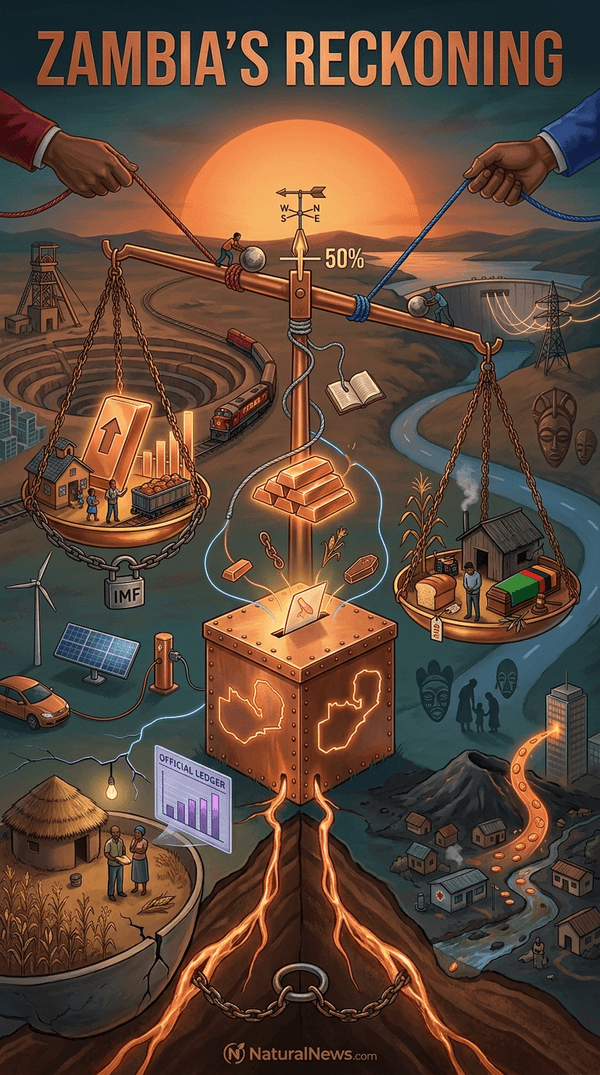
Explainer Infographic







Please contact us for more information.