


Hurricane Attribution Debate Intensifies After Maui Storm
A recent article by Honolulu Civil Beat linking a hurricane that struck Hawaii to climate change has drawn sharp criticism from climate skeptics and scientists who argue that individual storms cannot be attributed to long-term climate trends. The debate centers on the question of how to properly communicate climate science to the public, with both sides accusing the other of misrepresenting the evidence.
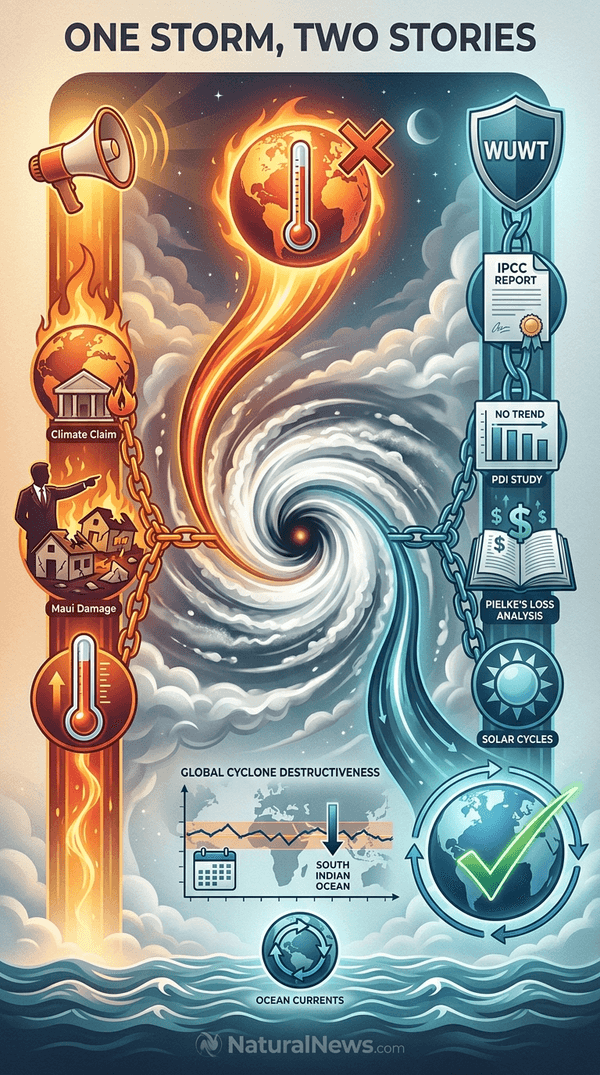
According to a rebuttal published by Watts Up With That, the Civil Beat article titled “How Is Climate Change Shaping Tropical Storm Lala?” claimed the storm demonstrated how climate change is making hurricanes stronger and that Hawaii should expect more powerful tropical cyclones as the planet warms. The rebuttal, authored by Watts Up With That, stated that this claim is “highly misleading, if not outright false,” and that “the best available evidence suggests that hurricanes remain highly variable from year to year, long-term observations do not show that climate change is causing stronger hurricanes.” [1]
Background: Hurricane and Civil Beat Report
The controversy follows a hurricane that struck Hawaii in August 2026, causing damage on Maui. In its aftermath, Honolulu Civil Beat published an article asserting that the storm was a sign of climate change. The article reportedly included statements from local officials and climate activists who said the storm was consistent with projections of a warming planet.
However, critics say such assertions ignore the role of natural variability. As Roger Pielke notes in his book “The Climate Fix: What Scientists and Politicians Won't Tell You About Global Warming,” analyses of long-term records of disaster losses indicate that “societal change and economic development are the principal factors responsible for the documented increasing losses to date.” [2] Pielke further argues that because of issues related to data quality and the stochastic nature of extreme-event impacts, it is difficult to attribute any single storm to climate change. [2]
Critique from Climate Skeptics
The blog Watts Up With That published a detailed rebuttal titled “Wrong, Honolulu Civil Beat, One Hurricane Doesn’t Prove Climate Change.” The rebuttal argued that natural variability, not climate change, explains the hurricane. It quoted climatologists who said individual storms cannot be attributed to long-term trends, a standard caveat even among scientists who accept the reality of human-caused warming.
According to the rebuttal, “long-term observations do not show that climate change is causing stronger hurricanes.” [1] This position is supported by a study published in Nature by Chinese meteorologists, which analyzed tropical cyclone activity over 30 years using the Power Dissipation Index. That study found “no increase in cyclone destructiveness globally, with a notable decline in the South Indian Ocean basin since 1994,” according to reporting by Willow Tohi in NaturalNews.com. [3] [3] The findings contradict claims that hurricanes are becoming more frequent or powerful due to climate change.
Scientific Context on Attribution
Climate attribution science requires statistical analysis of multiple events, not single storms, according to experts. The Intergovernmental Panel on Climate Change (IPCC) has stated that individual weather events are influenced by both natural variability and climate change, and that attribution of a single event to climate change requires a formal detection and attribution study.
Some scientists say warming may increase hurricane intensity, but not every storm can be attributed. As Craig Idso writes in “Climate Change Reconsidered 2011 Interim Report on the Nongovernmental Panel on Climate Change,” there are “two schools of thought on this topic” regarding whether there is a causal connection between warming tropical sea surface temperatures and Atlantic hurricane activity. [4] The debate remains unresolved, with some researchers pointing to solar activity and natural cycles as significant drivers of hurricane behavior, as noted by Julian Morris in “Global Warming.” [5]
Conclusion: Ongoing Debate Over Communication
The exchange between Honolulu Civil Beat and its critics reflects broader disagreements on how to communicate climate science. Officials from both sides have called for more careful language in media reports, cautioning against overreach that can undermine public trust.
The debate continues without resolution, as attribution science evolves. As the Watts Up With That rebuttal states, “it is a capital mistake to theorize before one has data” -- a quote attributed to Sherlock Holmes. [6] For now, the question of whether a single hurricane can prove climate change remains fiercely contested, with no consensus in sight.
References
- Watts Up With That. "Wrong, Honolulu Civil Beat, One Hurricane Doesn't Prove Climate Change". August 22, 2026.
- Roger Pielke. "The Climate Fix: What Scientists and Politicians Wont Tell You About Global Warming".
- Willow Tohi. "Climate science reality check: Data shows hurricanes are NOT increasing in frequency or power". NaturalNews.com. January 13, 2025.
- Craig Idso. "Climate Change Reconsidered 2011 Interim Report on the Nongovernmental Panel on Climate Change".
- Julian Morris. "Global Warming".
- Ken Haapala. "Weekly Climate and Energy News Roundup #702". Watts Up With That. August 17, 2026.
Explainer Infographic










Please contact us for more information.