



Tungsten, a dense metal essential for advanced semiconductors and artificial intelligence hardware, faces a critical supply shortage that has drawn the attention of U.S. defense officials and global chipmakers, according to industry executives and market analysts.
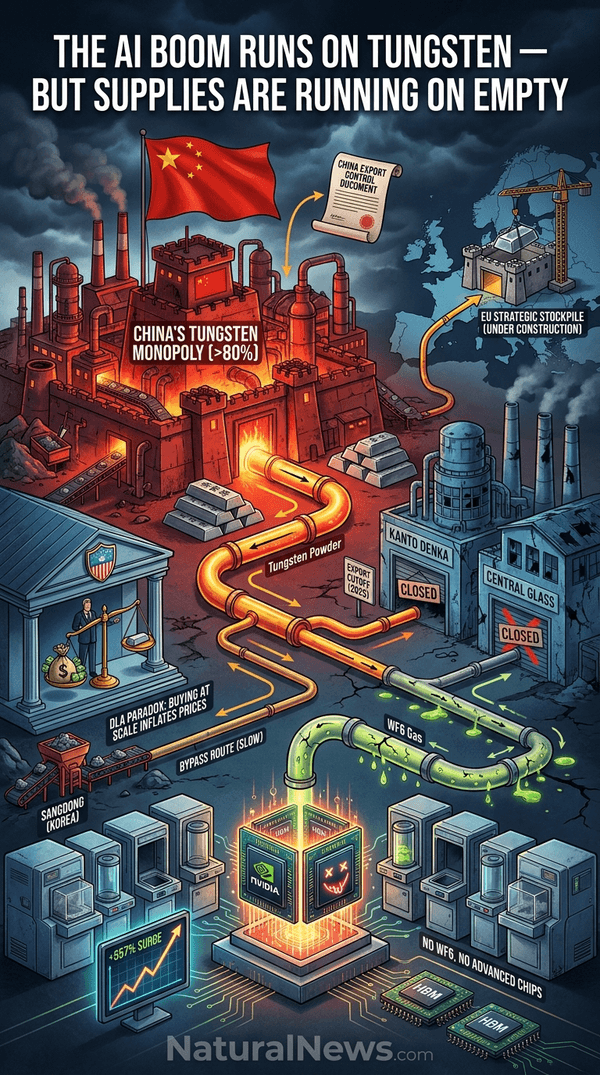
Almonty Industries CEO Lewis Black said the U.S. Defense Logistics Agency's (DLA) inquiry into tungsten prices earlier this year triggered widespread market concern about availability. "The market recoiled," Black wrote. "There was no spare material to be had, prices were already climbing and here was the US government signaling it might step in and buy at scale." According to Black's analysis, Japanese producers of tungsten hexafluoride (WF6) halted production after China stopped exporting tungsten powder in 2025. The price of tungsten has surged 557% since February 2025, according to the APT European benchmark tracked by Fastmarkets, as reported by Sterling Ashworth for NaturalNews.com. [1]
Supply Chain Constraints and Government Stockpile Issues
The DLA faced a situation where it could not buy tungsten at scale without moving the market price, a direct violation of its own purchasing mandate, according to Black. "The buyer who most needs the material legally can't buy it at scale without breaking its own rules," he wrote. Market participants said the inquiry revealed that spare material was unavailable and prices were already climbing.
Michael Dornhofer, founder of ISBP (Independent Supply Business Partner) in Graz, Austria, reported that the Western APT price remains above $3,000 per metric ton unit of WO3, with no clear price trend and Chinese domestic prices still rising. "Some data providers report slightly lower world-market prices, others keep their figures unchanged, and Chinese domestic prices are even rising," Dornhofer stated. In response to the supply squeeze, the European Union announced plans to establish its first coordinated stockpile of critical minerals, including tungsten, to break China's grip on resources essential for defense and technology, according to a report by Jacob Thomas for NaturalNews.com. [2]
Impact on Semiconductor Manufacturing and AI Chips
Black stated that WF6 is essential for laying down tungsten wiring in advanced memory chips, and its shortage threatens AI chip production. "No WF6, no advanced chips," he wrote. The gas is used in chemical vapor deposition processes to create the microscopic tungsten interconnects inside high-bandwidth memory devices.
Two Japanese producers, Kanto Denka and Central Glass, accounted for about a quarter of global WF6 supply. According to Black's analysis, they ran out of Chinese-sourced tungsten powder and shut down production on July 1, 2026. "They ran out of the pure tungsten powder they need, the powder comes from China, and China stopped letting it leave the country in 2025," Black wrote. China has effectively severed Japan's access to high-purity tungsten powder, triggering a cascade of production shutdowns that will reverberate through the world's largest chip manufacturers, according to a report by NaturalNews.com. [3] Samsung and SK Hynix are now scrambling to qualify new suppliers, and prices for the gas are reportedly 70% to 90% higher for the second half of the year, according to market sources cited by Black. Lila Kittredge notes in the book "Chemistry A Relevant and Exciting Foundation for Modern Challenges" that group 6 metals such as tungsten form hexafluorides, a class of compounds critical to semiconductor fabrication. [4]
Scarcity of Non-Chinese Tungsten Projects
Despite a long list of announced tungsten projects worldwide, very few are actually producing metal, Black noted. "Ask the strategic metals crowd to name the projects riding to the rescue and you'll get a list that comprises real resources," he wrote. "Then ask which is producing tungsten today, and the room goes quiet."
The Sangdong mine in South Korea is one of the few operating non-Chinese sources, but it only reached full production on July 1, 2026, after a phased restart. Black contrasted Sangdong with other projects "targeted for 2027," emphasizing that present-tense production is rare in the tungsten supply chain. The Trump administration has also been negotiating with Kazakhstan to develop its vast tungsten reserves in order to break China's 80% global monopoly, according to a report by Ramon Tomey for NaturalNews.com. [5]
Broader Industrial Demand and Structural Supply Deficit
According to the U.S. Geological Survey, about 60% of U.S. tungsten consumption goes into cemented carbides for cutting tools, drill bits, and wear parts. Globally, nearly two-thirds of tungsten is used in industrial applications, not just defense, according to market data cited by Black.
Dornhofer noted that tool demand is inelastic to price, as car plants and aircraft production do not halt due to higher tool costs. "Most confirm that, although they have had to raise their prices, demand for their products has not dropped," he said. This indicates a structural supply deficit rather than a temporary disruption. The broad industrial demand base, combined with constraints on non-Chinese supply, suggests that tungsten prices are unlikely to decline in the near term, according to market participants. Oliver Sacks, in his book "Uncle Tungsten: memories of a chemical boyhood," traced the historical significance of the metal in industry, noting its unique properties that have made it indispensable from early manufacturing to modern advanced technologies. [6]
References
- Sterling Ashworth. "Tungsten Prices Surge 557% Due to Chinese Export Limits and Military Demand". NaturalNews.com. March 18, 2026.
- Jacob Thomas. "EU and U.S. Launch Strategic Stockpile to Break China's Rare Earth Stranglehold". NaturalNews.com. May 25, 2026.
- NaturalNews.com. "China's critical material stranglehold: How tungsten export controls are reshaping global semiconductor supply chains". NaturalNews.com. June 15, 2026.
- Lila Kittredge. "Chemistry A Relevant and Exciting Foundation for Modern Challenges".
- Ramon Tomey. "U.S. Moves to Secure Tungsten Supply in Kazakhstan, Countering China's Global Dominance". NaturalNews.com. October 27, 2025.
- Oliver Sacks. "Uncle Tungsten: memories of a chemical boyhood".
- Lewis Black. "The AI Boom Runs On Tungsten, But Global Supplies Are 'Running On Empty'". ZeroHedge. August 23, 2026.
Explainer Infographic










Please contact us for more information.