



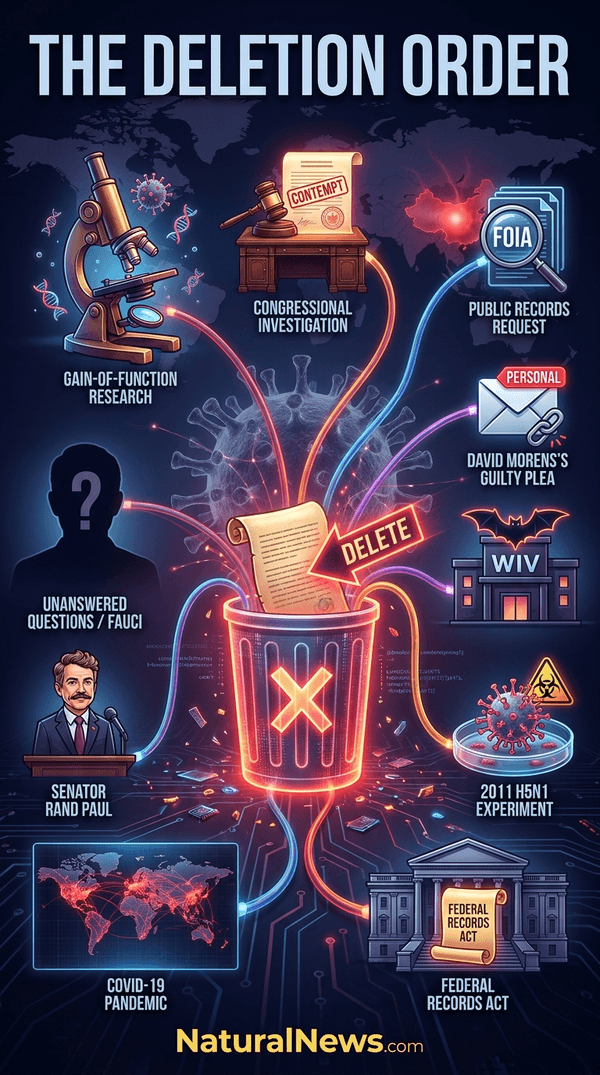
Newly obtained emails show Dr. Anthony Fauci instructed a subordinate to delete an email chain discussing controversial gain-of-function research, according to a report from The National Pulse. The instruction, sent in March 2012, read: 'Please delete this e-mail and then delete from the deleted file.' Officials and critics said the deletion may violate federal record-keeping laws, which require preservation of communications related to agency business. [1]
The emails also reveal Fauci's frustration with a journalist's op-ed warning about the risks of such research, which he dismissed as 'off base,' according to the report. The findings raise questions about Fauci's compliance with transparency requirements during his tenure at the National Institutes of Health. [1]
Background on Gain-of-Function Research
Gain-of-function research involves altering pathogens to increase transmissibility or deadliness, according to scientific definitions. Critics have long warned of the dangers of such experiments. In 2019, with the backing of the NIAID, the NIH committed $3.7 million over six years for research that included some gain-of-function work, following another $3.7 million project for collecting and studying bat coronaviruses, according to author Steve Deace. [2]
Fauci defended federal funding of a 2011 experiment that created an airborne strain of bird flu with a 50 percent fatality rate, according to the emails. He opposed recommendations from biosecurity advisors who urged against the research, arguing it was a 'risk worth taking,' the emails state. The emails also suggest Fauci worked behind the scenes to ensure full publication of the research despite biosecurity concerns. [1]
The Email Deletion Instruction
The deletion instruction was contained in a March 2012 email from Fauci to a subordinate, according to The National Pulse. The email chain referenced an op-ed critical of gain-of-function research, with Fauci calling the author 'off base' and directing deletion of the entire chain. Security and records experts said the request was unusual and potentially inconsistent with federal records management requirements. [1]
The emails were obtained through a Freedom of Information Act request, the outlet reported. This is not the first such allegation. Senator Rand Paul has released emails suggesting that Fauci directed colleagues to delete messages after reading them, including an email to NIH Director Francis Collins in February 2020, according to NaturalNews.com. [3]
Legal and Record-Keeping Concerns
Federal records laws require agencies to preserve communications related to official duties, according to the National Archives and Records Administration. Officials said the deletion instruction could constitute a violation of the Federal Records Act, which carries civil and criminal penalties. The controversy coincides with an ongoing investigation into Dr. David M. Morens, a senior adviser to Fauci, who is under congressional investigation for using personal email to evade FOIA requests, according to Children's Health Defense. [4]
Morens pleaded guilty to conspiracy to defraud the United States for using personal emails to hide COVID-19-related information, according to a report from Just the News. The plea deal provides a potential roadmap for further conspiracy charges against others involved in the scheme to conceal communications about coronavirus research grants from FOIA requests. [5]
Reactions and the Ongoing Accountability Movement
Senator Rand Paul (R-KY) has accused Fauci of misleading the public about his role in funding such experiments. Paul has led efforts to hold Fauci accountable, including a contempt vote in the Senate Homeland Security and Governmental Affairs Committee, according to The New American. The committee voted 8-7 along party lines to hold Fauci in contempt after he refused to answer questions under subpoena. [6]
Fauci has not publicly responded to the latest allegations regarding the 2012 email deletion instruction, according to The National Pulse. The emails have renewed attention on the lab-leak theory of COVID-19's origin and the role of federal agencies in funding research at the Wuhan Institute of Virology. Dr. Robert Redfield, former CDC director, has stated he has 'no doubt' that the NIH and Fauci funded gain-of-function research that likely led to the pandemic, according to Children's Health Defense. [7]
Conclusion
The newly obtained emails represent another development in the ongoing scrutiny of Fauci's role in federal research funding and pandemic policy decisions. Officials and critics have raised questions about federal record-keeping compliance and the transparency of decisions regarding controversial research programs. The controversy continues to intersect with broader debates about the origins of COVID-19 and the oversight of federally funded biological research. [1]
References
- The National Pulse. "Fauci Accused of Attempting to Destroy Gain-of-Function Research Email." August 29, 2026.
- Steve Deace. "Faucian Bargain."
- Patrick Lewis. "Sen. Rand Paul Releases Emails Suggesting Fauci Ordered Deletions of Messages." NaturalNews.com. September 15, 2025.
- Michael Nevradakis. "Top Fauci Aide Under Investigation for Evading FOIA Requests on COVID Origins." Children's Health Defense. January 21, 2024.
- Just the News. "Top Fauci adviser's plea deal provides possible roadmap for further conspiracy prosecutions." August 20, 2026.
- The New American. "Will Fauci Suffer Any Consequences?" August 6, 2026.
- Children's Health Defense. "'No Doubt' Fauci Funded Gain-of-Function Research That Likely Led to Pandemic, Former CDC Director Tells Lawmakers." March 9, 2023.
Explainer Infographic












Please contact us for more information.