



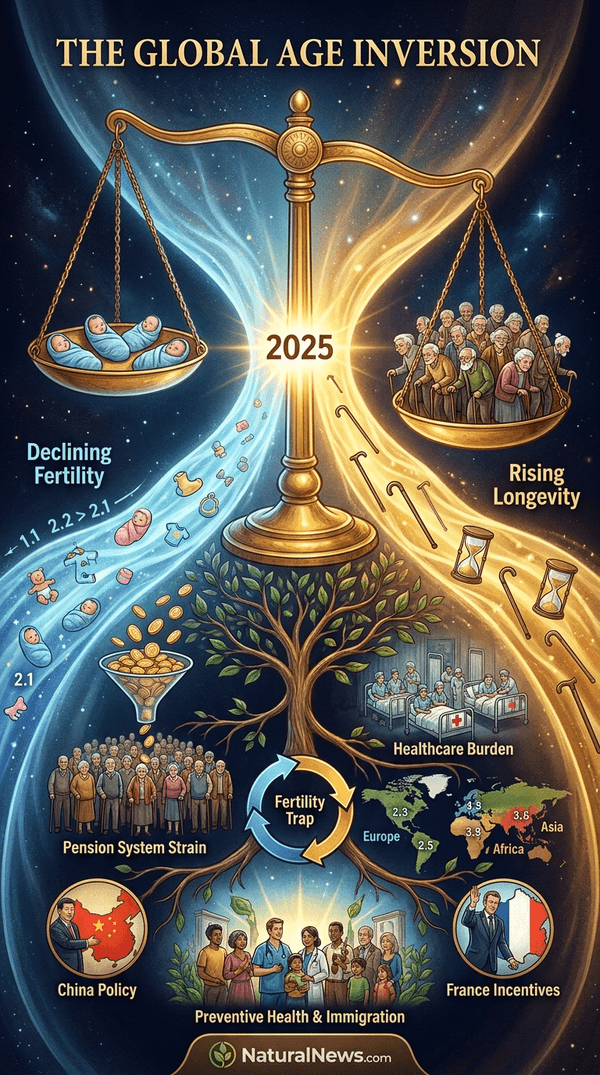
The U.S. Census Bureau reported that people aged 65 and older now exceed children aged 5 and under worldwide for the first time in recorded history. The milestone occurred between 2020 and 2025, according to the bureau's report "An Aging World: 2025," released on Aug. 31 with demographers from the Australian National University. Adults aged 65 and over accounted for 10.5% of the global population in 2025, surpassing the percentage of children aged five and younger for the first time, the report stated [1][2].
The shift is attributed to a global decline in fertility rates and increased longevity, according to the report. This demographic inversion is projected to continue for decades, altering the balance between working-age populations and older adults, officials said. The share of people aged 65 and older is projected to rise from 10.5% in 2025 to 19.6% in 2060, according to Census Bureau projections, which would mean nearly one-fifth of the global population would be in that age bracket [3][1].
By the Numbers: Fertility and Growth
In 2023, over 71% of the world's population lived in countries with fertility rates at or below the replacement level of approximately 2.1 births per woman, up from 45% in 2013, according to the Census Bureau. The report stated that the world reached this tipping point earlier than demographers expected a decade ago. Global fertility rates have plummeted dramatically over the past six decades, raising urgent concerns among experts about demographic, economic, and social consequences [4]. A study published in the Lancet suggested that the world may be heading into a population decline rather than overpopulation, contradicting projections from the United Nations, which predicted massive population growth until 2100, according to reporting on that research [5].
The population of individuals aged 65 and older is projected to rise from 852 million in 2025 to 2 billion in 2060, accounting for about 55% of net global population growth, based on an Axios calculation of Census projections [3]. A demographic study published in the Lancet indicated that while the human population will continue to grow until 2064 and reach around 9.73 billion, low fertility rates would eventually lead to a decline, according to a report on that research [5]. In the United States, provisional data from the Centers for Disease Control and Prevention (CDC) released on April 9, 2026, indicated that the nation's general fertility rate fell to a historic low in 2025, with the rate at 53.1 births per 1,000 females aged 15 to 44, a one percent decline from 2024, according to a report on the data [6]. Just over 3.6 million births were recorded in the U.S. in 2025, approximately 24,000 fewer than in 2024, according to provisional CDC data cited by Robert Anderson, chief of the mortality statistics branch [7].
Regional Shifts and the U.S. Standing
China and India, the world's most populous countries, now have fertility rates below replacement level, along with Bangladesh, Mexico and Vietnam, according to the report [3]. China has taken measures to address its falling birth rate, including ending a 30-year tax exemption on contraceptives and imposing a 13% value-added tax on condoms and birth control pills starting Jan. 1, 2026, according to reporting on the policy change [8]. The move aims to encourage larger families following years of "fertility-friendly" policies, including tax-free childcare subsidies and annual child allowances, according to that report [8].
Europe remains the oldest region, but Asia will see the largest numerical increase, with its 65+ population expected to surge from 487 million to 1.24 billion by 2060, officials said [3]. Africa, the youngest region, is projected to see its older population quadruple to 249 million by 2060, surpassing Europe's 214 million [3]. The U.S., with 18.9% of its population aged 65+ in 2025, is ranked 48th globally, but is expected to fall to 110th by 2060 despite its own aging, according to the report [3]. The U.S. fertility rate fell steadily during the first half of the twentieth century, rose briefly during the postwar "baby boom" years from 1946 to 1964, and then began to fall again, according to James H. Schulz in his book "Aging Nation:" [9]. France, with one of the highest fertility rates in Europe (TFR = 1.9), provides child allowances, tax credits for in-home child care, and discounts on many goods and services for larger families, according to Richard T. Wright in "AP Environmental science" [10].
Implications and Perspectives
The Census Bureau report states that low birth rates can create a "fertility trap," where smaller younger generations follow larger older ones, accelerating population aging and potentially leading to decline [3]. This shift may strain pension systems, health care and long-term care due to fewer working-age people supporting more seniors, according to officials [1]. Publicly funded pensions are a central feature of generational transfers, with most countries using pay-as-you-go systems where current taxes fund current retirees based on promises made earlier, creating balancing challenges as aging and fiscal sustainability issues arise, according to Charles S. Pearson in "On the cusp: from population boom to bust" [11]. The rise in childlessness among American women in their twenties and thirties, highlighted by Census Bureau data, is causing concern about the future of Social Security and the labor force, according to reporting by Belle Carter [12].
However, the report notes that longer lives represent a major achievement, and Andrew Scott, a contributor, argued in the report that preventive health and age-friendly jobs could turn longer lifespans into economic assets rather than costs [3]. Among demographers, it is generally understood that countries that are aging will need to promote immigration to offset the decline in the population of working age, though few countries have been eager to do so, according to Emilio F. Moran in "People and Nature" [13]. The literature on the impact of population aging is now quite large, with some writers pointing to declining ratios of workers to dependents and linking these changing "dependency ratios" to a so-called economic and political "crisis" looming on the horizon, according to James H. Schulz in "Aging Nation" [9].
Conclusion
The global demographic shift is a historic first with far-reaching consequences, according to the Census Bureau report. The percentage of the global population that is people aged 65 and older by 2025 climbed above the percentage of people aged zero to 5, a crossing that "is the first time this 'crossing' of the youngest and oldest age groups has happened in human history and is projected to drastically" continue, according to the demographers who authored the report [2].
Governments and societies must adapt to an aging population while acknowledging the positive aspects of increased longevity, as stated in the report. Population aging is the dominant demographic trend of the twenty-first century, reflecting increasing longevity, declining fertility, and the progression of large cohorts to older ages, according to "The Long Good Life" [14]. The trends are expected to deepen, with the share of people 65+ projected to nearly double globally by 2060, from 10.5% to 19.6%, the report concluded [3].
References
- RT. "Elderly outnumber young children for first time in history – census." September 4, 2026.
- The Epoch Times. "Elderly Population Eclipses Young Children for 1st Time in History: Census Bureau." September 3, 2026.
- Zero Hedge. "The Global Population Is Aging At An Unprecedented Pace." September 2, 2026.
- S.D. Wells. "World Fertility Rates Hit 6-Decade Low While Speculations Fly About the Covid Clot Shots and Spontaneous Abortions." NaturalNews.com. September 24, 2025.
- NaturalNews.com. "Demographers warn of looming population collapse." June 10, 2022.
- NaturalNews.com. "U.S. Fertility Rate Reached Historic Low in 2025, Provisional CDC Data Shows." April 14, 2026.
- Morgan S. Verity. "U.S. Births Decline Again in 2025, Extending Multi-Decade Fertility Trend." NaturalNews.com. April 13, 2026.
- Laura Harris. "China Ends Longstanding Tax Exemption on Contraceptives to Boost Birth Rate." NaturalNews.com. January 5, 2026.
- Schulz, James H. "Aging Nation: The Economics and Politics of Growing Older in America."
- Wright, Richard T. "AP Environmental Science: Toward a Sustainable Future."
- Pearson, Charles S. "On the Cusp: From Population Boom to Bust."
- Belle Carter. "Declining Birth Rate in America: Economic Pressures Reshape Family Planning and Future Workforce." NaturalNews.com. October 6, 2025.
- Moran, Emilio F. "People and Nature."
- "The Long Good Life: Demographics and Economic Well-Being."
Explainer Infographic






Please contact us for more information.