



Two U.S. House members introduced legislation on Sept. 11, 2026, that would prohibit social media accounts for users under 16 and require covered platforms to terminate accounts identified as belonging to minors, according to the bill text and a report by Reclaim The Net [1].
The measure, dubbed the 16 & Up Social Media Act, was introduced by Rep. Erin Houchin (R-Ind.) and Rep. Jake Auchincloss (D-Mass.), the report stated [1]. Psychologist Jonathan Haidt, who supports the proposal, said the goal is "to stop addictive design entirely," according to Reclaim The Net [1].
The bill has not become law. It would need to pass both chambers of Congress and be signed by the president before any provisions take effect [1]. Similar age-verification and minor-restriction proposals have advanced in other jurisdictions, including Australia, the United Kingdom, and the European Union, according to previous reporting [2][3][4].
Bill Targets Specific Platform Features and Account Removal Timelines
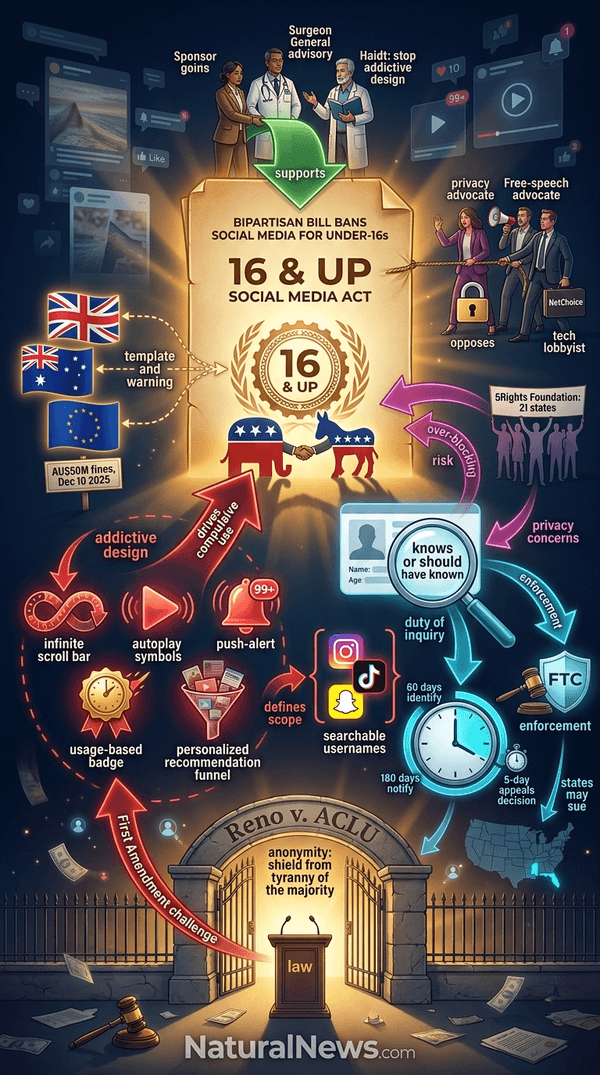
The bill would cover services available to the general public that have searchable and followable usernames, where user-generated content is the primary purpose, and that allow sharing, use engagement features, and use personal information for advertising, marketing, or recommendations, according to the text [1]. Features named in the bill include infinite scroll, autoplay, push alerts, usage-based badges, and personalized recommendations [1].
Enforcement would hinge on whether a company "knows" a user is under 16. Page 11 of the bill states that "knows" means "to know or should have known," according to Reclaim The Net [1]. That language could pressure companies to investigate users' ages or block them when doubt exists, the report stated [1].
The bill sets timelines for compliance. Existing accounts would have to be identified within 60 days of enactment, users notified within 180 days, and accounts removed within 30 days after notification, according to the text [1]. Appeals processes would have to be established within 60 days and before removals begin, the report stated [1]. Other provisions would take effect one year after the bill becomes law [1].
Age Verification and Appeals Provisions Draw Debate
The bill does not explicitly require government ID uploads for every user and does not prescribe a specific age-checking technology, according to the text [1]. Under the appeals process, companies may ask for evidence "strictly necessary to verify the age of the user," must decide within five days, and cannot retain, sell, or transfer the evidence, the report stated [1].
Adults mistakenly flagged as minors would have to contest the decision and provide personal information to the company to continue using the service, according to the bill [1]. Reclaim The Net reported that the legislation's incentives point toward more intrusive age verification, while supporters said the measure aims to protect minors from addictive platform design [1].
Comparable debates have played out in other countries. The United Kingdom's Online Safety Act, fully operational since July 2025, mandates age verification and broad content restrictions, igniting a global debate over free speech, according to reporting by Willow Tohi [3]. Australia's Senate rejected mandatory age verification for search engine users in August 2025, citing privacy concerns, with rare bipartisan support for the motion, according to Laura Harris [5]. In the European Union, the Digital Services Act has driven formal requests to tech companies about how they prevent minors from accessing harmful content, according to Kevin Hughes [4].
Enforcement Would Fall to FTC; States Could Sue
The Federal Trade Commission would enforce the bill and treat violations as unfair or deceptive practices, according to the proposal [1]. States would also be able to sue companies for violations, the bill states [1].
Some provisions would come into force one year after the bill becomes law, while account identification, notification, removal, and appeals provisions would follow the earlier timelines [1]. The bill would need to pass both chambers of Congress and be signed into law before any provisions take effect [1].
Federal courts have recently addressed related questions about government influence over social media content moderation. The 5th U.S. Circuit Court of Appeals found that Biden administration officials likely violated the First Amendment by pressuring tech firms to censor posts, according to Children's Health Defense [6]. A separate ruling held that the Cybersecurity and Infrastructure Security Agency likely violated the First Amendment by influencing platforms' moderation practices on topics such as COVID-19 and the 2020 elections [7].
Supporters Cite Youth Safety; Critics Cite Privacy and Speech Concerns
Haidt said the goal is "to stop addictive design entirely," according to Reclaim The Net [1]. The bill's sponsors described it as a bipartisan effort to address under-16 social media use, the report stated [1]. U.S. Surgeon General Vivek Murthy issued a public advisory warning that social media can pose a "profound risk of harm to the mental health and well-being of children and adolescents" [8].
Critics cited privacy and free speech concerns, saying age verification requirements could expand surveillance and restrict access to online speech [1]. The report stated that the bill stops short of mandatory ID checks for every user but that its incentives point toward more intrusive age verification [1]. A report by Reclaim The Net found that British groups, including 5Rights Foundation, have pushed age verification bills in 21 U.S. states [9].
The proposal follows a patchwork of state and international actions. Florida's HB 3 took effect on Jan. 1, 2025, addressing online safety for minors, according to Willow Tohi [10]. Australia passed a law banning children under 16 from having social media accounts, effective Dec. 10, 2025, with fines up to AU$50 million for platforms that fail to implement age verification, according to Willow Tohi [2]. NetChoice, a trade group representing major tech companies, asked the U.S. Supreme Court to halt Mississippi's HB 1126, a law restricting minors' access to social media, according to Laura Harris [11].
Legal scholars and civil-liberties advocates have long raised concerns about government mandates that affect anonymous speech and online access. The Supreme Court has held that anonymous pamphleteering is an "honorable tradition of advocacy and of dissent" and that "anonymity is a shield from the tyranny of the majority," as noted in James D. Torr's examination of civil liberties [12]. In Reno v. ACLU, the Court struck down the Communications Decency Act, granting cyberspace the highest level of First Amendment protection and warning that vague terms like "indecent" and "patently offensive" threaten serious discussion of topics including birth control and homosexuality [12]. Marty Klein, writing on America's war on sex, criticized 2257 regulations as "guilty until proven innocent" intrusions into legal businesses [13].
Conclusion
The 16 & Up Social Media Act represents the latest federal attempt to regulate minors' access to social media. It would prohibit accounts for users under 16, require termination of accounts identified as belonging to minors, and establish appeals processes with age-verification elements [1].
The bill's path to becoming law remains uncertain. It must pass both the House and Senate and be signed by the president before any provisions take effect [1]. If enacted, the FTC would enforce the measure, and states could sue for violations [1].
The debate over age verification and minors' online access continues to evolve across the United States and internationally. Similar measures in Australia, the United Kingdom, and the European Union have generated both support for child safety and opposition over privacy and free expression, according to multiple reports [2][3][4]. The outcome of this bill will shape the legal landscape for years to come.
References
- Cindy Harper. "Bipartisan House Bill Would Ban Social Media Accounts For Under 16s". Reclaim The Net. September 14, 2026.
- Reclaim The Net. "Report: British Groups Push Age Verification Bills in 21 US States". Reclaim The Net. August 14, 2026.
- Children's Health Defense. "Appeals Court Rules Biden Administration Likely Violated First Amendment by Pressuring Tech Firms to Censor Social Media Posts". Children's Health Defense.
- Children's Health Defense. "Social Media Poses 'Profound Risk' to Kids' Mental Health, Surgeon General Warns". Children's Health Defense.
- Children's Health Defense. "Federal Court Bars 'Nerve Center of Government Censorship' From Influencing Social Media Platforms". Children's Health Defense.
- Laura Harris. "Australian Senate rejects age verification for search engine users in surprise bipartisan push". NaturalNews.com. August 3, 2025.
- Kevin Hughes. "EU tightens grip on digital age verification sparking privacy and free speech concerns". NaturalNews.com. October 21, 2025.
- Willow Tohi. "Florida's Social Media Laws Spark Debate Over Minors' Privacy and Digital Safety". NaturalNews.com. April 15, 2025.
- Willow Tohi. "A Digital Frontier: Australia's Sweeping Social Media Ban for Minors". NaturalNews.com. October 31, 2025.
- Willow Tohi. "Global Firestorm Erupts Over U.K.'s Online Safety Act: Free Speech Under Siege as Democracy Faces Digital Downing Street". NaturalNews.com. August 8, 2025.
- Laura Harris. "NetChoice Asks Supreme Court to Halt Mississippi Law Limiting Minors' Access to Social Media". NaturalNews.com. July 30, 2025.
- Marty Klein. "America's War on Sex".
- James D. Torr. "Civil Liberties". 1974.
Explainer Infographic









Please contact us for more information.