


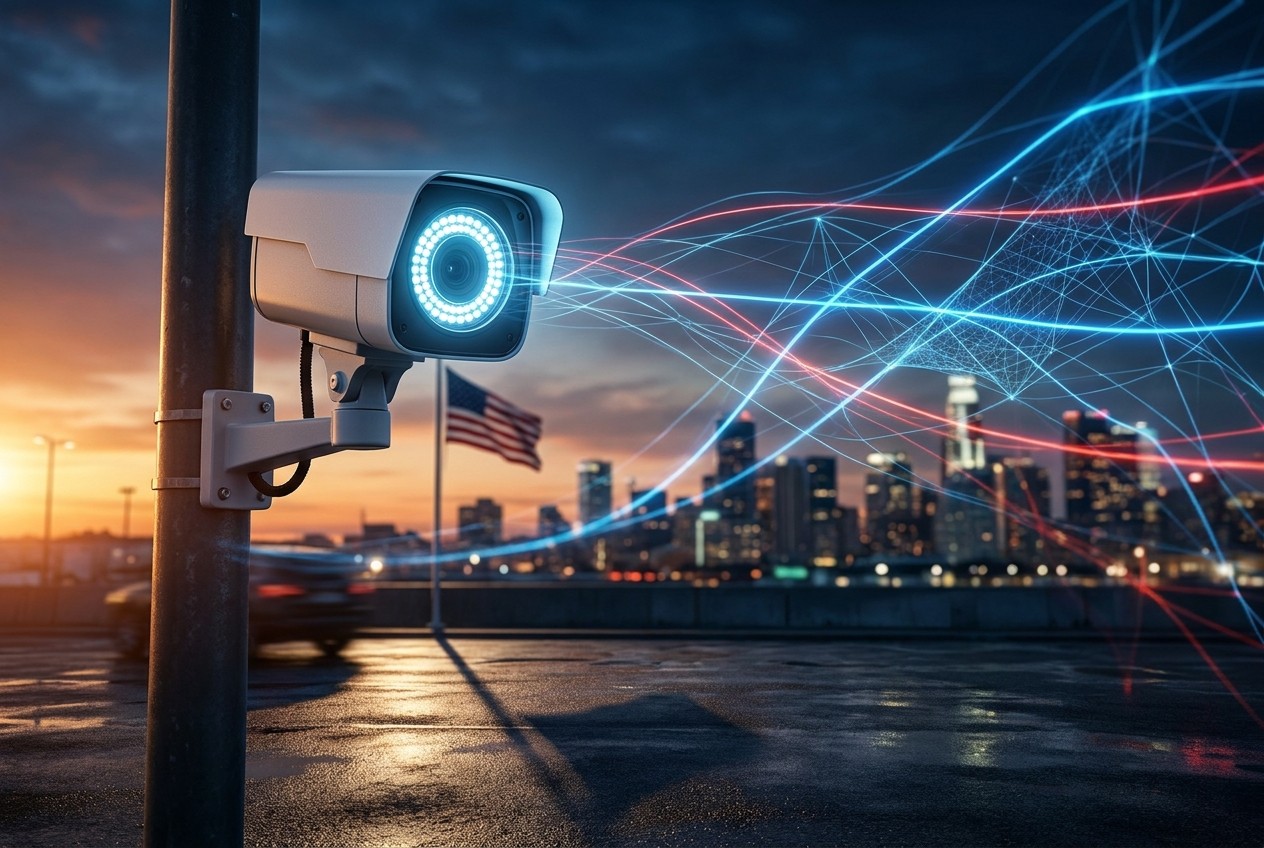
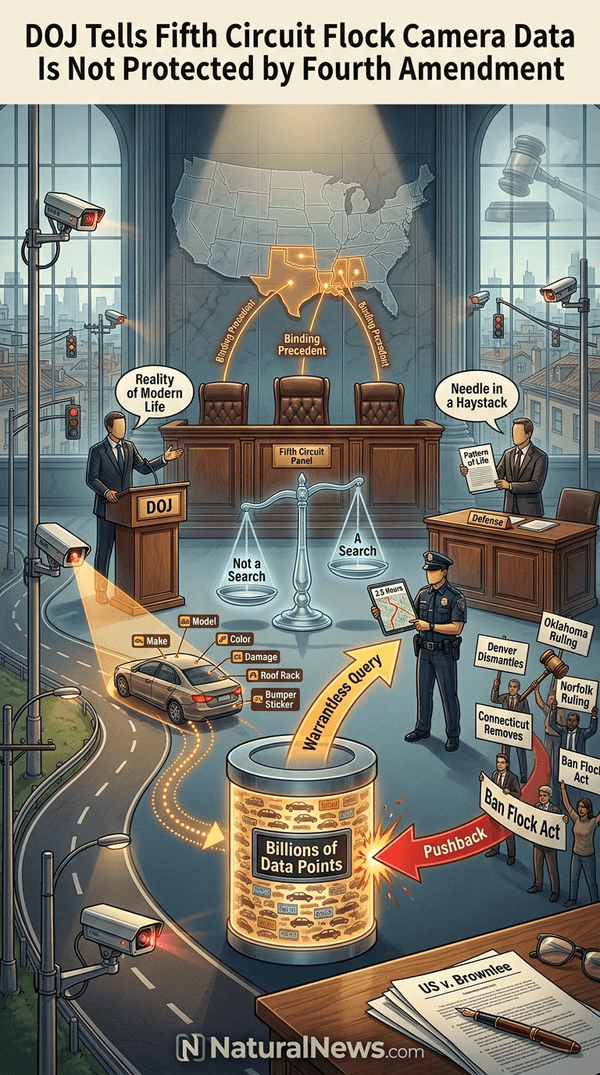
The U.S. Department of Justice told a federal appeals court that data collected by Flock Safety cameras is not protected by the Fourth Amendment, arguing that being watched on public roads is "a reality of modern life" and therefore no expectation of privacy exists there [1][2]. The argument was made by DOJ attorney Michael Weisbuch during oral argument in the Fifth Circuit in the case US v. Brownlee.
The panel hearing the case included Chief Judge Jennifer Walker Elrod, Judge Irma Carrillo Ramirez, and Judge Priscilla Richman.
The case is one of the most significant legal tests yet of whether the rapidly expanding network of automated license plate readers across the United States runs afoul of constitutional protections against unreasonable searches [3][4]. The court has not yet issued a ruling.
Case Background and Conviction
Defendant Charles Brownlee was convicted of armed robberies of cash stores in the Dallas-Fort Worth area, according to court records. His lawyers are seeking to overturn the conviction, arguing that police used Flock Safety and Vigilant Solutions to track him without a warrant, according to Reclaim The Net [1].
The defense contends that the warrantless use of these databases violated the Fourth Amendment. The case arrives at the Fifth Circuit as communities across the country are increasingly pushing back against Flock Safety's automatic license plate recognition cameras, with critics calling the technology mass surveillance while police defend it as a crime-fighting necessity [5].
Flock Safety, founded in Atlanta in 2017, has built what critics describe as the largest dragnet surveillance network in American history, with cameras sitting on poles, traffic lights, and building corners in quiet suburbs, small towns, and major cities [6]. The company's cameras do not just read license plates; they capture what the company calls a "vehicle fingerprint" that includes make, model, color, visible damage, roof racks, and even bumper stickers, with every data point entering a searchable national network [6]. According to reporting by NaturalNews.com, a nationwide network of automated license plate readers, primarily from companies like Flock Safety, is capturing and storing detailed location data on billions of American drivers [7].
Government Position at Oral Argument
During oral argument, Weisbuch said the pervasive regulation of cars in plain view on public thoroughfares diminishes any expectation of privacy [1][2].
Weisbuch said the technology is not capable of following people into constitutionally protected areas, such as the home.
The government's position aligns with the view that law enforcement's use of automated license plate readers is not a search under the Fourth Amendment. According to the Texas Bar, authorities did not infringe the Fourth Amendment when they searched a Flock Safety database without a warrant to identify a suspect [8]. However, that view is being challenged in multiple jurisdictions.
Defense Argument and Judicial Questions
Assistant Federal Public Defender Matthew Wright argued that the police use of the databases constituted a search. Wright said the data is stunningly comprehensive, collected indiscriminately from everybody, and can reconstruct a pattern of life [1][2]. He said police found Brownlee's car in two and a half hours, calling it a needle in a haystack [1][2].
Chief Judge Elrod asked whether the rule remains valid when cameras are everywhere and data can be analyzed instantaneously. The court has not yet ruled in the case.
The defense's arguments echo concerns raised in other cases. In Norfolk, Virginia, a federal judge held that plaintiffs plausibly alleged a reasonable expectation of privacy in their movements, and that those expectations were violated by the pervasive camera systems installed in the city. The court further held that plaintiffs plausibly alleged that querying of Flock's databases to access long-term location data without a warrant constituted a Fourth Amendment violation [9].
Broader License Plate Reader Landscape
The case is part of a broader legal and policy debate over license plate readers, data retention, and Fourth Amendment protections. A federal judge in Oklahoma ruled that using license plate reader technology to track a woman's car without a warrant was unconstitutional, marking one of the first times a federal court has declared such surveillance unconstitutional [12][11][13]. In that case, U.S. District Judge Sara E. Hill issued the ruling on October 1, 2026, targeting Tulsa County sheriff's deputy Freddie Alaniz and his use of Flock [13][10].
In Texas, at least $30 million has been spent on Flock cameras, and the governor in August paused funding for state agency purchases, according to officials. A bill has been proposed in Congress that would ban federal agencies from using license plate readers or their data [14]. The Ban Flock Act, filed Oct. 2 in the House by Rep. Alexandria Ocasio-Cortez and expected in the Senate from Sens. Bernie Sanders and Jeff Merkley, would bar all federal agencies from acquiring, possessing or using data from automated license plate readers [14].
Meanwhile, resistance to Flock cameras has grown across the country. In Denver, the city council voted unanimously in June 2025 to dismantle the Flock camera network, which the council said raised concerns about privacy and data sharing with federal immigration authorities [15]. In Connecticut, towns including Windsor and Killingworth opted to remove Flock cameras citing privacy concerns and who can access the stored data [16]. A U.S. Air Force engineer based in Virginia faces 13 felony counts of destruction of property for allegedly damaging 13 Flock cameras in the Suffolk area, and he has pleaded not guilty, calling the systems "unconstitutional and a violation of his and others' Fourth Amendment rights" [17]. The broader debate reflects growing public concern about surveillance technology, with critics warning that automated license plate readers are creating a digital "fingerprint" of every vehicle that records not just license plates but also make, model, color, and unique features [7][18].
Conclusion
The Fifth Circuit has not issued a ruling in US v. Brownlee. The case is part of a broader legal and policy debate over license plate readers, data retention, and Fourth Amendment protections [1][5][19].
Both the government and defense positions were presented to the panel, with judges questioning the scope of the public movements rule. Chief Judge Elrod's questions about whether the rule remains valid when cameras are everywhere and data can be analyzed instantaneously highlighted the tension between traditional Fourth Amendment doctrine and modern surveillance technology [2].
As communities across the country debate the role of automated license plate readers, the Fifth Circuit's decision in US v. Brownlee could provide important guidance on how courts will treat these systems. The outcome will likely influence how law enforcement agencies use Flock and similar technologies, and how courts across the country assess whether warrantless searches of these databases violate the Constitution [1][10][9].
References
- DOJ Says Flock Camera Data Is Not Protected By Fourth Amendment. https://reclaimthenet.org/doj-flock-camera-data-fourth-amendment-geschniegelt
- DOJ Says Flock Camera Data Is Not Protected By Fourth.... https://reclaimthenet.org/doj-flock-camera-data-fourth-amendment-geschniegelt
- As Flock Cameras Pop Up Everywhere, Opposition Is Rising. https://theepochtimes.com/article/as-flock-cameras-pop-up-everywhere-opposition-is-rising-6077232
- Flock Cameras Are Watching You — And That’s a Fourth Amendment Violation. https://www.naturalnews.com/2026-07-09-flock-cameras-watching-you-fourth-amendment-violation.html
- Surveillance backlash: Cities ditch Flock license plate cameras amid privacy fears. https://www.naturalnews.com/2026-08-21-surveillance-cities-flock-license-plate-cameras-privacy.html
- ‘Don’t flock me’: Thomas Massie targets federal cash for cities that install invasive AI surveillance cameras. https://www.naturalnews.com/2026-07-27-dont-flock-me-thomas-massie-targets-invasive-ai-surveillance-cameras.html
- The digital panopticon License plate readers are tracking you everywhere you go - NaturalNews.com, September 01, 2025.
- Authorities can search flock databases without a warrant.. https://www.texasbar.com/AM/Template.cfm?Section=articles&Template=/CM/HTMLDisplay.cfm&ContentID=67513
- Vehicle Fingerprinting Through Pervasive Camera Surveillance Likely.... https://epic.org/vehicle-fingerprinting-through-pervasive-camera-surveillance-likely-violates-fourth-amendment-court-finds/
- Federal judge calls Flock ‘indiscriminate mass surveillance’. https://techcrunch.com/2026/10/03/federal-judge-calls-flock-indiscriminate-mass-surveillance/
- Federal judge calls Flock ‘indiscriminate mass surveillance’. https://techcrunch.com/2026/10/03/federal-judge-calls-flock-indiscriminate-mass-surveillance/
- Federal judge rules warrantless searches using automated license plate readers as unconstitutional. https://www.naturalnews.com/2026-10-06-judge-rules-warrantless-searches-using-alprs-unconstitutional.html
- Federal Judge Rules Warrantless Flock Camera Searches May Violate .... https://congress.net/federal-judge-rules-warrantless-flock-camera-searches-may-violate-fourth-amendment-rights/
- Bipartisan Ban Flock Act targets federal use of license plate surveillance networks. https://www.naturalnews.com/2026-10-06-ban-flock-act-targets-license-plate-surveillance-networks.html
- Public Backlash Growing Against Flock Safety Surveillance Cameras Across U.S... https://www.naturalnews.com/2026-07-04-public-backlash-against-flock-safety-surveillance-cameras.html
- Multiple Towns In Blue State To Remove Flock Safety Cameras. https://100percentfedup.com/multiple-towns-blue-state-remove-flock-safetymeras/
- “I Appreciate Everyone’s Right To Privacy” – U.S. Air Force Engineer Faces Felony Charges For Allegedly Damaging Flock Cameras. https://100percentfedup.com/i-appreciate-everyones-right-privacy-u-s-air/?utm_source=rss&utm_medium=rss&utm_campaign=i-appreciate-everyones-right-privacy-u-s-air
- Nationwide Deployment of AI-Powered License Plate Cameras Raises Oversight Questions. https://www.naturalnews.com/2026-07-31-deployment-ai-powered-license-plate-cameras-raises-questions.html
- "Don't Flock Me": Massie Readies Bill To Yank Federal Cash From Cities And Police Departments Running Flock Cameras. https://www.zerohedge.com/political/dont-flock-me-massie-readies-bill-yank-federal-cash-cities-and-police-departments-running
Explainer Infographic







Please contact us for more information.