


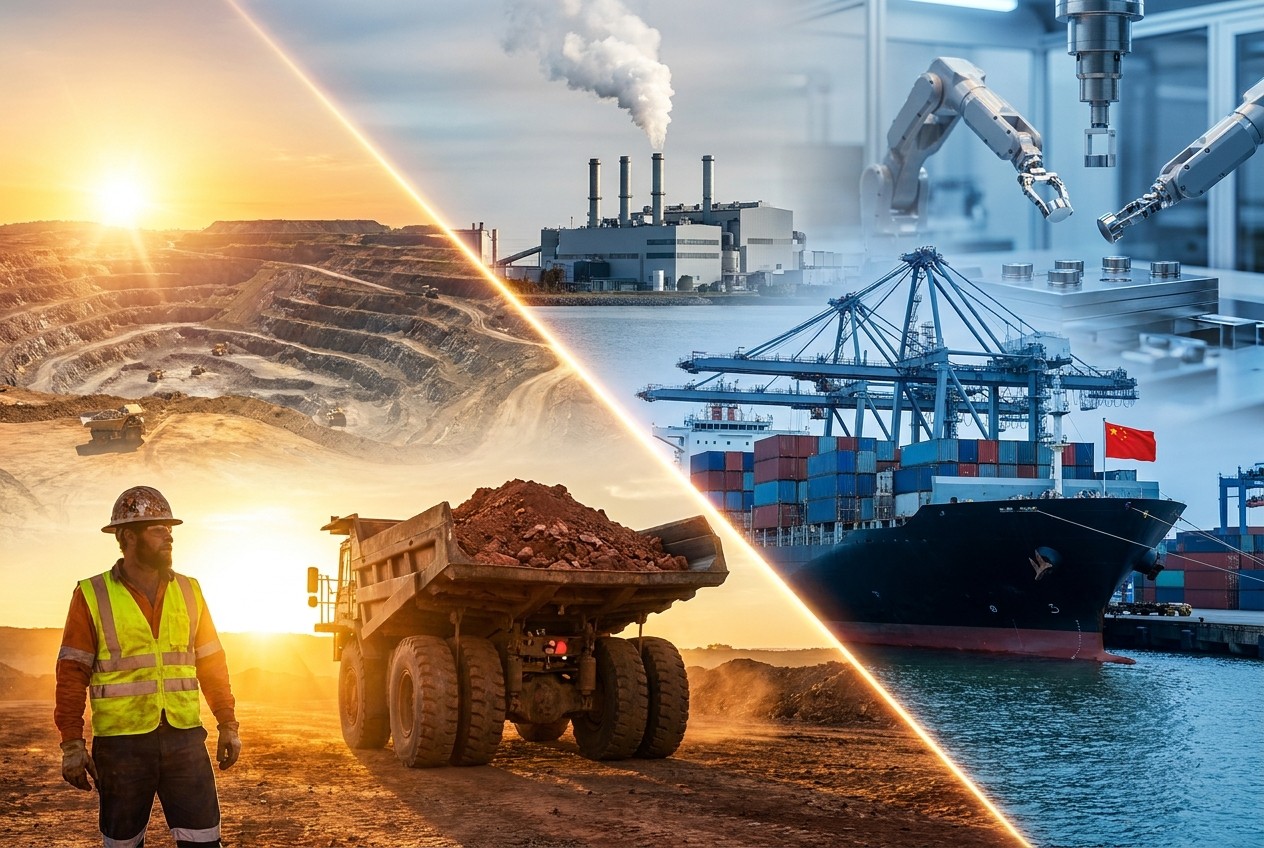
The U.S. will not break China's grip on rare earth elements this decade, according to ING analysts Ewa Manthey and Coco Zhang, who published a note on Monday titled "The US rare earth push: what comes next?" [1].
She characterized the U.S. challenge as industrial rather than geological, stating that vulnerability lies in the difficult stages between the mine and the finished component [1].
China's Role in Rare Earth Supply Chain
China accounts for about 60% of mined magnet rare earths, 91% of refined output, and 94% of permanent magnet production, Manthey said, citing the International Energy Agency [1]. The geographic concentration of processing capacity means that even if the U.S. expands mining operations, the material must still be shipped to China for refinement. Industry estimates indicate China holds a near-total monopoly on separation and refining, with analysis showing a share of around nine-tenths of all global processing [2].
Robert Bryce, author of "Power Hungry," noted that China has a de facto monopoly on the global trade in lanthanides, controlling about 90% of the market [3].
MP Materials Shows Progress and Constraints
MP Materials represents both America's progress in rebuilding domestic supply chains and its continuing constraints. The company produced 50,692 tons of rare-earth oxide in concentrate in 2025 and began manufacturing neodymium-iron-boron magnets in Texas that December, according to the ING report [1].
The biggest gap is heavy rare earths, particularly dysprosium and terbium. Key gaps exist in heavy rare earth separation and magnet production, particularly for materials vital to high-temperature performance [4]. MP Materials is developing a separation line designed to produce about 200 tons of dysprosium and terbium annually, but securing feedstock remains a challenge because production is concentrated in China and Myanmar [1].
Federal Support and Project Pipeline
The federal government has committed significant resources to bridge these gaps. Manthey cited a June agreement with USA Rare Earth involving $277 million in grants, a $1.3 billion senior secured loan, and a 16% government equity stake [1]. She also highlighted ING analysts Ewa Manthey and Coco Zhang's assessment that the U.S. rare earth push won't break China's chokehold this decade [5].
MP Materials, Vulcan Elements, and USA Rare Earth have each outlined plans for facilities capable of producing 10,000 tons of magnets annually. However, the report stated these targets represent planned capacity rather than current output, highlighting the difference between announcements and operational reality [1].
The Trump administration has signaled it will prioritize domestic production. In June 2025, President Trump announced plans to invoke emergency powers to bypass regulatory hurdles and fast-track domestic mining, processing, and refining of critical minerals, according to reports [6].
Conclusion: Outlook and Alternative Supplies
Alternative supplies are unlikely to eliminate the dependency this decade. The IEA estimates that announced magnet projects outside China would meet well below 20% of demand outside China in 2035, according to the note [1]. Breaking China's "quasi-monopolistic position" in critical materials is unlikely to be a this-decade story [7]. Breaking China's "quasi-monopolistic position" in critical materials is unlikely to be a this-decade story [7].
Jonathan Siegmann, a Stifel aerospace and defense analyst, wrote that owning the bottlenecks, or investing in producers within conflict-free supply chains, was the best way to gain exposure as China chokes off access to critical materials [1]. The Commerce Department's recent move to squeeze jet parts supplies to China followed Beijing's use of critical material exports, officials said [8].
As the U.S. seeks to build domestic capacity, the physical reality of mining and processing infrastructure remains a limiting factor. China's state-backed rare earths groups now benefit from immense scale and a technological lead in stages such as rare earth processing, which Beijing has banned from being shared abroad [9].
References
- An Uncomfortable Reality: China's Rare Earth Chokehold May Outlast This Decade. https://www.zerohedge.com/commodities/uncomfortable-reality-chinas-rare-earth-chokehold-may-outlast-decade
- How China leveraged its rare earths dominance over the US. https://www.france24.com/en/live-news/20251126-how-china-leveraged-its-rare-earths-dominance-over-the-us
- Power Hungry The Myths of Green Energy and the Real Fuels of the Future by Robert Bryce
- An Uncomfortable Reality: China's Rare Earth Chokehold May Outlast This .... https://thenote.app/post/en/an-uncomfortable-reality-chinas-rare-earth-chokehold-may-outlast-this-decade-iaqukfryhg
- China's Rare Earth Chokehold May Outlast This Decade. https://www.zerohedge.com/commodities/uncomfortable-reality-chinas-rare-earth-chokehold-may-outlast-decade
- Trump to invoke emergency powers to boost domestic production of CRITICAL MINERALS - NaturalNews.com, June 07, 2025
- The $40 Billion Minerals Gamble: Can Trump Break .... 2026-10-01T17:10:13Z. https://www.zerohedge.com/commodities/40-billion-minerals-gamble-can-trump-break-chinas-chokehold-wests-rearmament-hits-wall
- US Squeezes China's Jet Parts Supply As Rare Earth Showdown Escalates. 2026-10-03T00:30:00.000Z. https://www.zerohedge.com/geopolitical/us-squeezes-chinas-jet-parts-supply-rare-earth-showdown-escalates
- China won the rare earths race. Can it stay on top?. 2025-08-28T04:00:58Z. https://www.ft.com/content/045bf600-a89d-4dda-b63b-0a88024b80a4?syn-25a6b1a6=1
Explainer Infographic







Please contact us for more information.