



A review by neuroscientists at the University of Cambridge has linked regular reading to a lower risk of dementia and Alzheimer's disease, according to findings published in September 2026 in the journal Psychological Medicine.
The review was led by Barbara Sahakian, a neuroscientist at Cambridge, and colleagues, who gathered evidence on reading and brain health across the human lifespan. The central finding, attributed to the review and university sources, is that people who read regularly appear to develop dementia less often than those who do not, a pattern the researchers described as consistent across multiple study populations.
According to the review, the association held in studies of older adults in several countries and did not depend on a reader's level of formal education. Researchers said the review synthesized observational data rather than running a new clinical trial, a design that limits what can be concluded about cause and effect.
Study Findings on Older Adults
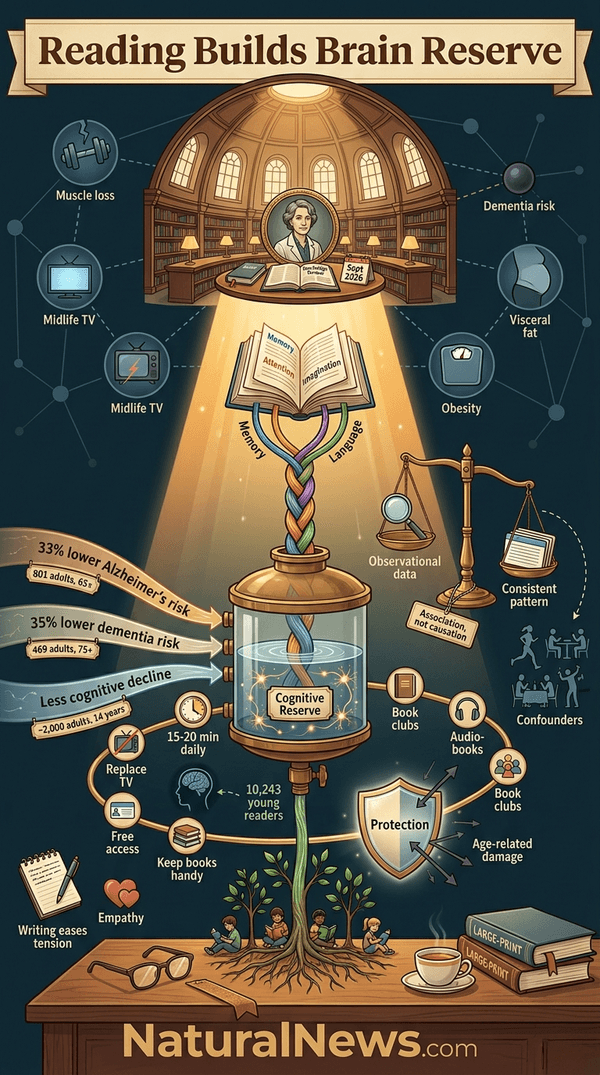
The review cited a study of 801 adults aged 65 and older in which each step up in mentally stimulating activities such as reading was tied to a 33% lower risk of Alzheimer's disease, according to the review. In a separate group of 469 adults aged 75 and older, regular readers had a 35% lower risk of dementia over roughly five years, researchers said.
Another study described in the review followed nearly 2,000 older adults for 14 years and tied weekly reading to less cognitive decline, the report stated. The benefit held across education levels, so researchers said a college degree was not required to see the association. Officials involved in the review said the pattern appeared in populations with different socioeconomic profiles.
The findings arrive alongside other recent dementia research. A 2026 analysis linked muscle loss to a 42% higher dementia risk, while obesity showed an age-dependent association, according to NaturalNews.com [1]. Separate research has tied midlife television watching to brain shrinkage and visceral fat to higher dementia risk [2][3]. The Cambridge review focused specifically on reading and other mentally stimulating activities.
Cognitive Reserve and Lifelong Effects
Reading engages memory, attention, imagination, and language simultaneously, according to researchers. Following a story requires holding names and events in mind while picturing scenes, a combination the review described as a steady mental challenge that may help build cognitive reserve. That reserve functions as a backup supply of brain connections that can help the mind cope with age-related changes.
The concept has drawn attention from other researchers. Yaakov Stern, a neurologist quoted by Richard Restak, observed that cognitive reserve is not fixed at birth. "It's something that changes and can be increased over time," Stern said. "Even something as simple as keeping up a regular reading schedule can increase cognitive reserve and reduce your chances of getting Alzheimer's disease" [4]. Sanjay Gupta has noted that the idea of cognitive reserve remains somewhat controversial because researchers are not certain exactly how it works [5].
The review also highlighted a study of 10,243 young people, about half of whom started reading for pleasure early. Early readers tended to score better on memory and language tests, show fewer attention and behavior problems, and do better in school, the review said. Brain scans showed larger volumes in regions tied to language, thinking, and emotional balance, researchers said.
Mood, Stress, and Limitations
The review points to mood and well-being benefits beyond memory. Researchers found that even a few minutes of fiction can ease stress, and reading appears to strengthen empathy by helping people understand how others think and feel. Connie Hatzikalimnios has written that expressing thoughts in writing releases tension, and that monitoring the quality of one's information intake supports mental health [6].
A key limitation is that much of the research shows strong links rather than proof that reading alone protects the brain, according to the review. The findings rest largely on observational studies, which cannot establish causation. Experts told Healthline that reading may help build cognitive reserve, though they cautioned that more research is needed to determine whether the activity changes the underlying biology of Alzheimer's disease [7].
The review offered practical steps: read 15 to 20 minutes daily, replace some television time, keep books accessible, and choose enjoyable material. Large-print books and audiobooks count, and libraries offer free access. Book clubs and reading aloud add social connection, which itself supports brain health.
Conclusion
The Cambridge review ties regular reading to a 35% lower risk of dementia over roughly five years in one study of adults aged 75 and older, according to the review. Sleep, food, movement, stress, and social connection also shape the aging brain, researchers said.
The review suggests that an ordinary habit may support brain health, while more research is needed to establish causation. A 2026 report from the Alzheimer's Association, which surveyed 3,800 adults aged 40 and older, found that nearly 9 in 10 Americans consider maintaining brain health to be very important, yet only 9% of those surveyed reported knowing how to achieve it [8].
References
- Analysis Links Muscle Loss to 42% Higher Dementia Risk; Obesity Association Varies by Age. https://www.naturalnews.com/2026-09-24-analysis-links-muscle-loss-higher-dementia-risk.html
- Study Links Midlife TV Watching to Brain Shrinkage. https://www.naturalnews.com/2026-09-28-study-links-midlife-tv-watching-to-brain-shrinkage.html
- Visceral Fat Linked to Higher Dementia Risk, Study Finds. https://www.naturalnews.com/2026-05-31-study-visceral-fat-linked-higher-dementia-risk.html
- Think Smart A Neuroscientists Prescription for Improving Your Brains Performance by Richard Restak
- Keep Sharp Build a Better Brain at Any Age by Sanjay Gupta
- Alzheimer's reduce your risk revitalise by Hatzikalimnios Connie author_1
- Reading Linked to Lower Dementia Risk, Review Finds. https://www.naturalnews.com/2026-09-30-reading-linked-lower-dementia-risk-review-finds.html
- Seven Daily Habits Linked to Long-Term Memory Preservation, According to Research. https://www.naturalnews.com/2026-09-03-daily-habits-linked-to-long-term-memory-preservation.html
Explainer Infographic












Please contact us for more information.