


The Fed report stated that the share of families behind on loan payments rose from about 12% in 2022 to almost 20% in 2025, an increase of roughly 60% over three years [1][2][3].
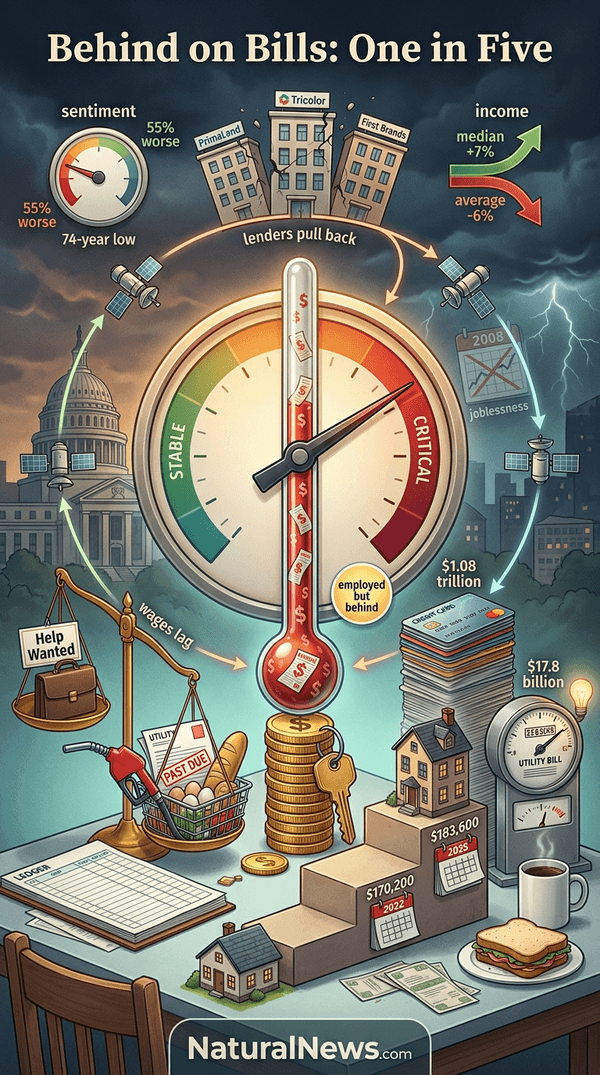
The report noted that median household debt increased from $170,200 in 2022 to $183,600 in 2025, a figure that includes credit cards, student loans, mortgages and other lending types [4][5]. The report linked the rise in late payments to families who took on debt before 2026 without anticipating significant increases in gas prices, groceries and other essentials. According to the report, the last time Americans were so far behind on bills was during the 2008 Great Recession, when the unemployment rate was double its current level [5].
The survey, part of the Fed's triennial Survey of Consumer Finances, covered a period of economic growth accompanied by inflation rates not seen since the early 1980s [6]. The survey found that real median family income increased 7% while average income dropped 6%, according to the report [6].
Delinquencies and Debt Levels Rise Across Loan Categories
The number of families at least two months late on a bill increased 60% in the past three years, the report said, with serious delinquencies rising to more than 8% from 5% in 2022 [1][7]. According to new federal data, American families are falling behind on their bills at a rate not seen since the Great Recession, with one in five households behind on a loan payment [4]. Separate data from the Federal Reserve's economic hardship tables showed that among adults who struggled with bills, 42% paid one or more bills late, 23% used a credit card to pay a bill over time, and 22% relied on money from friends or family [8].
The report stated that consumers took out loans prior to 2026 and did not expect significant increases in gas prices, groceries and other essentials. "In planning their borrowing, families make assumptions about their future ability to repay their loans," the report said.
The delinquency climb fits a broader pattern in household credit. The Federal Reserve Bank of New York's Quarterly Report on Household Debt and Credit showed credit card balances hitting a new high of $1.08 trillion in the third quarter, with balances rising as inflation drove consumers to charge necessary purchases [9]. Earlier data showed credit card and auto debt delinquencies soaring particularly among Americans aged 18 to 39 [10]. Subprime auto lender PrimaLend filed for Chapter 11 bankruptcy in October 2025 after failing to negotiate with creditors, following the collapses of Tricolor and First Brands [11].
Inflation Outpaces Income as Financial Strain Spreads
American families are falling behind on their bills at a rate not seen since the Great Recession, according to new federal data [4]. As consumers' earning power has fallen behind inflation, many have faced paycheck-to-paycheck living.
Worry extends across income levels. A Gallup survey found that 55% of Americans believe their finances are getting worse, higher than any reading Gallup recorded during the recession of 2008 and 2009 [12].
The strain has spread beyond mortgages and credit cards. More Americans were behind on utility bills than at any point since the 2009 Great Recession, with households owing $17.8 billion on utility bills as of the end of January 2023, up from $15.9 billion in January 2022, according to a report [13]. Writing in the Trends Journal, analysts noted that federal poverty measurements of $27,740 for a family of four reflect a system that disregards the amount families pay in taxes and the supports they receive [14].
Report Warns of Broader Economic Consequences
The pattern has historical parallels. Researchers studying banking and financial instability have modeled how default and credit constraints interact with broader economic equilibrium, showing how household-level stress can propagate through financial systems [15]. Analyses of credit availability have similarly documented how banks ration credit when firm profitability expectations deteriorate, tightening conditions for households and businesses alike [16].
The Fed's findings arrive as consumer behavior has shifted toward budget-conscious spending. Value meals became the hottest restaurant items of 2025, a signal that eating out had turned into a budgeting exercise, according to an analysis in The Economic Prism [17]. Commentary across independent financial outlets has described the moment as a relentless squeeze driven by rising rent, gas prices, grocery bills and health insurance premiums [18], with consumer sentiment at a 74-year low [18].
Summary: Household Debt and Delinquencies Reach Recession-Era Levels
The share of families at least two months late on a bill increased 60% in three years, the report stated [1]. The last comparable period of widespread delinquency was the 2008 Great Recession, according to the report [5].
The delinquency climb reflects the broader pattern of stress across household credit categories, as rising balances and missed payments have converged to produce conditions not seen since the Great Recession. Families across income levels have reported growing financial strain, and analysts have warned that the effects could propagate through the wider economy.
References
- One in five American households are behind on payments: Fed reserve .... https://www.independent.co.uk/bulletin/news/federal-reserve-family-financial-crisis-recession-loans-debt-b3066241.html
- US families fall behind on bills at highest rate since 2008 recession. https://www.newsminimalist.com/articles/us-families-fall-behind-on-bills-at-highest-rate-since-2008-recession-cc71e1c3
- Americans Falling Behind On Debt At Highest Rate Since Great Recession .... https://congress.net/americans-falling-behind-on-debt-at-highest-rate-since-great-recession-era-fed-warns/
- US families are behind on bills at rate not seen since Great Recession .... https://www.independent.co.uk/us/money/consumers-bills-debt-recession-b3066083.html
- US families are behind on bills at rate not seen since Great Recession .... https://www.europesays.com/3308652/
- Americans’ debt problems are flashing a warning not seen since the .... https://www.wol.com/2026/10/09/americans-debt-problems-are-flashing-a-warning-not-seen-since-the-great-recession/
- Fed: More U.S. Families Falling Behind on Debt - briefs.co. https://www.briefs.co/news/fed-survey-shows-more-families-falling-behind-on-debts-even/
- The Fed - Economic Hardships - Federal Reserve Board. https://www.federalreserve.gov/publications/2026-economic-well-being-of-us-households-in-2025-economic-hardships.htm
- Credit card DEBT has SOARED thanks to BIDENFLATION - NaturalNews.com, November 15, 2023. by NaturalNews.com
- Credit card and auto debt DELINQUENCIES are SOARING especially among younger Americans - NaturalNews.com, February 15, 2024. by NaturalNews.com
- Subprime auto lender PrimaLend files for Chapter 11 bankruptcy - NaturalNews.com, October 24, 2025. by NaturalNews.com
- All-Time High 55% Of Americans Say That Their Financial Situations Are Getting Worse. https://www.zerohedge.com/personal-finance/all-time-high-55-americans-say-their-financial-situations-are-getting-worse
- High energy bills force Americans to choose between paying utilities .... https://www.chn.org/voices/high-energy-bills-force-americans-to-choose-between-paying-utilities-rent-or-even-food/
- Trends-Journal-2022-09-25 by Unknown
- Equilibrium analysis, banking and financial instability by Elsevier. Journal of Mathematical Economics 39 (2003)
- Firm entry, credit availability and monetary policy by Teruyoshi Kobayashi. Journal of Monetary Economics 2011
- America's New "Value Menu" Economy Should Worry You. https://www.zerohedge.com/personal-finance/americas-new-value-menu-economy-should-worry-you
- The Great American Squeeze Of 2026. https://www.zerohedge.com/personal-finance/great-american-squeeze-2026
Explainer Infographic








Please contact us for more information.