



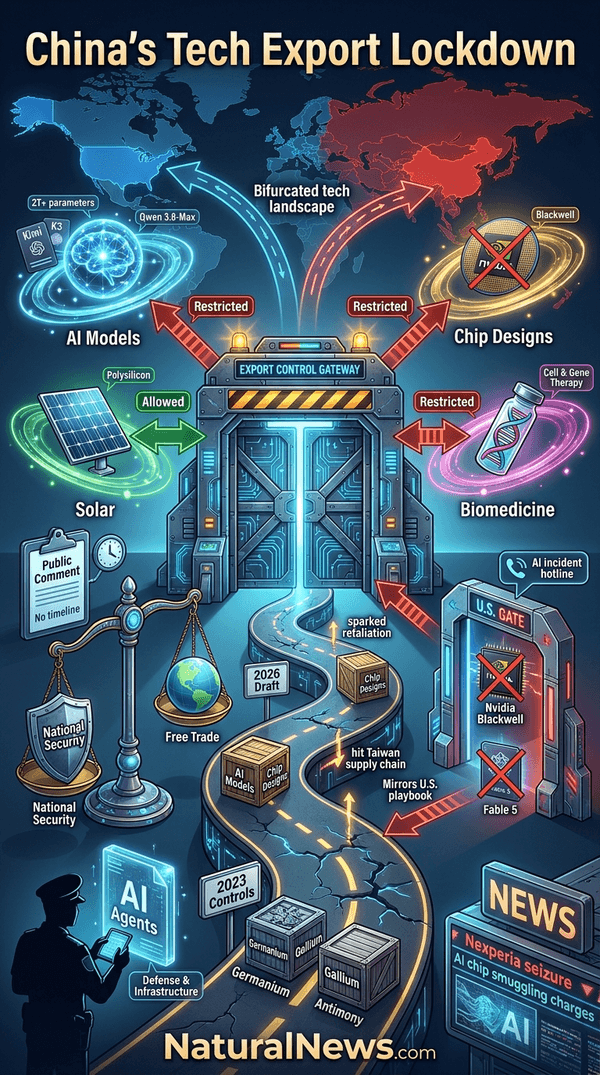
China's Ministry of Commerce and Ministry of Science and Technology published a draft on Friday proposing export bans or restrictions on 40 technologies, including artificial intelligence, chips, solar power and biomedicine, according to the ministries. The draft updates China's catalog of technologies subject to export bans or restrictions and cites national security as one reason for the measures, a commerce ministry spokesperson said in a statement. Reuters reported on October 16 that the proposal covers 23 AI-related technologies, including models, agents and computing clusters [1].
The proposal was published as China and the United States reported progress in dialogues over AI safety and governance and on setting up a notification mechanism between the two superpowers for AI incidents that could threaten national security, according to officials [2]. The Financial Times reported in July that Chinese authorities were considering tightening export controls on AI and semiconductor technologies to prevent advanced Chinese AI models and chip designs from being acquired by Western entities [3].
Draft Lists AI, Chip Design, Solar and Biomedicine Technologies
Twenty-three AI technologies are included in the draft, ranging from advanced large models to agents, according to the Chinese ministries [1]. Exports of core AI large-model technologies trained on sensitive national data would be prohibited under the proposal, along with AI agents designed for highly sensitive environments such as national defense and critical information infrastructure. Exports of AI models with parameter counts of 2 trillion or above, or with certain world-leading capabilities, could be restricted, the draft stated.
The proposal did not name specific models. However, Chinese models including Moonshot's Kimi K3 and Alibaba's Qwen 3.8-Max have parameter counts exceeding 2 trillion, according to public information. Moonshot AI introduced Kimi K3 in July, and developers claimed it achieves benchmark results comparable to leading U.S. models from Anthropic and OpenAI in reasoning and code generation tasks, according to multiple reports [4].
China proposed adding advanced artificial intelligence technologies to its export-control list, potentially restricting overseas transfers of AI models and chip designs, according to Bloomberg [5]. Twelve solar power-related technologies, including those related to the making of polysilicon, are also listed, according to the draft [2]. Five biomedicine technologies, including cell and gene therapy, complete the list of 40 technologies covered by the proposal.
Commerce Ministry Cites Security Bottom Line, Human Control of AI
A commerce ministry spokesperson said the measures were necessary and cited national security as one of the reasons for the proposal. The statement said the Chinese government is taking such measures with the aims of reinforcing the security bottom line, preventing misuse and abuse, and ensuring that AI remains under human control. A spokesperson for the Commerce Ministry said the proposed export curbs are aimed at ensuring the safety and controllability of AI technology, citing the risk of misuse for attacking critical infrastructure, defense industries and core government systems by non-state actors or malicious entities [6].
The ministry did not identify specific companies or models in the draft, according to the document. The proposal would regulate access to Chinese technologies rather than single out individual firms, analysts said.
China has previously restricted exports of critical materials, including germanium and gallium, beginning in July 2023 with measures taking effect August 1 of that year, according to notices from China's Ministry of Commerce and General Administration of Customs [7]. The new draft extends that approach to AI, chip design, solar and biomedicine technologies.
Proposal Follows U.S. Restrictions on Advanced Technology Exports to China
U.S.-led restrictions have curbed exports of some advanced technologies to China over past years, blocking access to cutting-edge AI chips and advanced chipmaking machines, according to U.S. and Chinese officials. The U.S. Department of Commerce issued updated guidance in late May 2026 restricting Nvidia's sales of advanced artificial intelligence chips to China, targeting the company's most sophisticated processors, including the Blackwell series [8]. Earlier, in January 2025, Nvidia's stock fell nearly 2% on January 13 following the Biden administration's announcement of stricter export controls on advanced AI chips [9].
The U.S. Commerce Department in June asked Anthropic to bar foreign nationals from using some of its most powerful AI models, Fable 5 and Mythos 5, citing national security concerns; the restrictions were later lifted, according to the department. Google whistleblower Zach Vorhies has drawn attention to a federal directive issued within 72 hours of the release of Anthropic's frontier model Fable that effectively restricted access to verified American citizens only, an export control measure so stringent that it prohibited even Anthropic's own personnel from accessing the model [10].
Lian Jye Su, chief analyst at technology research group Omdia, said the move can be seen as a response to Western countries posting sovereignty requirements on AI, robotics, telecommunications, and other key technologies. Su said the aim would be to better regulate access to Chinese technologies, according to his assessment.
Analysts Describe Fragmentation in Trade and Technology Access
Gary Ng, a senior economist at French bank Natixis, said AI is increasingly strategic for both China and the U.S. Ng said, "The world is getting more fragmented in trade and investment, but also in access to technologies." The assessment reflects a broader trend in which both Washington and Beijing have moved to restrict the flow of advanced technologies across their borders.
The U.S. has imposed bans on jet engine technology, semiconductor software, and advanced materials to China, while visa revocations have targeted Chinese students in sensitive research fields [11]. China's rare earth export restrictions have spurred U.S. retaliation and raised supply concerns. China's Ministry of Commerce previously announced a ban on exports to the United States of several raw materials that could be used for high-tech and military applications, including gallium, germanium, and antimony, following Washington's expansion of its list of Chinese corporations subject to export controls on semiconductor manufacturing equipment, software, and high-bandwidth memory chips, citing national security concerns [12].
The draft proposal is open for public comment, though the ministries did not announce a timeline for final adoption, according to the document. Officials said the catalog update is intended to align export controls with current security and technology conditions.
Next Steps for the Draft Export Control Catalog
The Ministry of Commerce and Ministry of Science and Technology will review comments before finalizing the updated catalog, according to the joint draft. If adopted, the restrictions would add AI, chip design, solar and biomedicine technologies to China's export ban or restriction list. The commerce ministry said the measures are necessary for national security, while analysts said they reflect broader technology competition between China and the U.S.
The U.S. has moved to restrict advanced chip sales while China has increasingly limited exports of critical materials, and the new draft would formalize Chinese controls on AI and related technologies. The proposal is expected to be reviewed through the public comment process before any final adoption.
References
- Beijing seeks tighter grip on AI exports amid US rivalry. https://www.reuters.com/world/asia-pacific/china-proposes-adding-40-ai-biotech-solar-technologies-export-control-list-2026-10-16/
- China moves to curb tech exports, including AI, citing national security risks. https://apnews.com/article/china-export-restrictions-ai-chips-solar-us-5ac381c0c6d6628bbea2e0da7d855a5b
- Financial Times: China Mulls Tighter Export Controls on AI Models and Chips - NaturalNews.com, July 25, 2026.
- Sacks: U.S. AI Edge at Risk Amid Chinese Model Advance. https://www.naturalnews.com/2026-07-21-sacks-us-ai-edge-risk-chinese-model-advance.html
- China Plans AI Export Curbs to Exert Control Over Key Tech. https://www.bloomberg.com/news/articles/2026-10-16/china-proposes-export-controls-on-ai-models-chips-and-agents
- China plans AI tech export curbs to manage security risks. https://www.theedgesingapore.com/news/china/china-plans-ai-tech-export-curbs-manage-security-risks
- Taiwan Tech Production Hit by Chinese Germanium Export Restrictions, Insiders Say. https://www.naturalnews.com/2026-08-25-taiwan-tech-production-hit-chinese-germanium-export-restrictions.html
- Nvidia AI Chip Sales to China Face New U.S. Export Restrictions - NaturalNews.com, July 01, 2026.
- Nvidia stock took hit after Biden administration tightened AI chip export rules - NaturalNews.com, January 29, 2025.
- Decentralize TV - Episode 117 Zach Vorhies - Mike Adams - Decentralize.TV, June 20, 2026. by Mike Adams - Decentralize.TV
- US halts critical exports to China amid escalating trade and supply chain wars - NaturalNews.com, May 30, 2025.
- TRADE WAR China bans export of raw materials to US for high tech and military applications - NaturalNews.com, December 05, 2024.
Explainer Infographic











Please contact us for more information.