


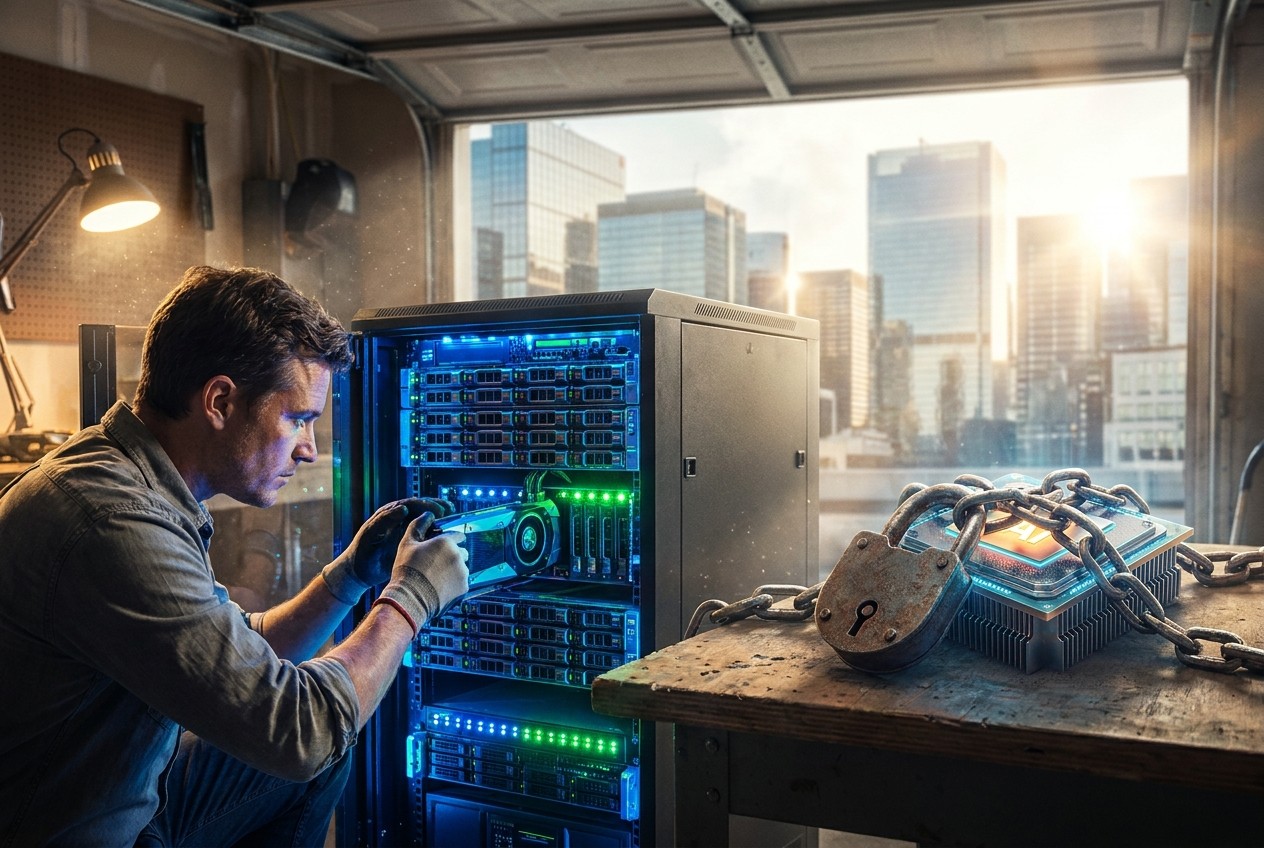
Democrats Will Outlaw Open Source AI
I have spent three years building decentralized AI tools and local infrastructure, and I have watched the Western establishment move to lobotomize publicly available large language models so they are nowhere near as intelligent as they could be. In my view, this is not an accident. It is a deliberate strategy to prevent decentralized cognition -- the very thing that threatens their monopoly on power [1]. That is why I continue to expand my own AI data center right now, in my own facility, on my own terms. Not as a hobby. But as preparation for the day open source model files are criminalized.
Let me state my thesis plainly: when the Democrats control the White House, the House, and the Senate -- a configuration I expect to see by 2029 -- licensing schemes and outright bans on uncensored model files will follow. The political class has already tipped its hand. A new poll indicates that 64 percent of Americans believe artificial intelligence is developing "too fast," and the partisan split is telling: 76 percent of Democrats hold that view, compared with 54 percent of Republicans [2]. That gap is the raw material for a regulatory crackdown aimed squarely at the decentralized, uncensored AI that people like me depend on.
That's why I'm not waiting for permission. Every rack of hardware I assemble, every Linux node I bring online, every open-weight model I download and run locally is an act of pre-emptive resistance. The Democrats will outlaw open source AI the moment they regain power -- I intend to be fully self-sufficient before they do.
AI Is the First Medium the Government Cannot Control
Every previous medium of mass communication had a choke point. Print required presses. Radio required spectrum licenses. Television required broadcast towers. The internet required domain registrars and backbone providers. AI is different. A $300 GPU -- or even an 8-gigabyte card -- now runs capable open source models locally. The barrier to entry has collapsed to the price of a mid-range graphics card and a willingness to learn.
The establishment knows this. That is why the entire public conversation about AI "safety" is engineered to steer people toward cloud subscriptions and API access, where the government can throttle, downsize, or cut off service overnight. As I have argued before, we are at a crossroads: either we embrace decentralized, locally-run AI models that empower individuals, or we surrender to a centralized system where governments and Big Tech collude to ban open-source AI and concentrate cognitive power in their own hands [3].
Consider the numbers. Nvidia will soon control 81 percent of the AI accelerator hardware market [4]. That concentration of hardware power is not an accident -- it is the infrastructure of control. When a handful of companies control the chips and the cloud, they control who gets to think. The decentralized nature of open source AI is an existential threat to that arrangement, which is precisely why the crackdown is inevitable.
The evidence is already visible. Anthropic CEO Dario Amodei published an essay calling on AI companies to intentionally slow the advancement of their most powerful models, and his proposal drew rare public support from rival industry leaders including OpenAI's Sam Altman and Elon Musk [5]. When competitors suddenly agree that AI is moving "too fast to control," you are watching the groundwork for a regulatory cartel being laid in plain sight.
The Licensing Trap: How They'll Criminalize the Files Themselves
Here is how the playbook will work. First, Congress will pass a mandatory licensing regime for "frontier" AI models. Licenses will be granted to approved institutions -- universities, government contractors, and a handful of large corporations -- and they will always be denied to independent voices like mine. Then the definition of "frontier" will expand until it covers models you can run on a laptop. Finally, sharing uncensored or "abliterated" open source files will be criminalized outright, turning the distribution of a model file into a felony.
This is not paranoia. The early moves are already happening. As I have reported, Anthropic is scrambling because DeepSeek 4.1 Flash just proved that open source AI can match frontier models at a fraction of the cost, and the closed-source business model that venture capitalists have pumped hundreds of billions of dollars into is collapsing under the weight of its own pricing [6]. The panic in the closed-source labs is real, and panic produces regulation.
The financial motive is enormous. When you have burned that much money and an open source model delivers comparable capability for free, your only path to survival is to make the free alternative illegal.
The infrastructure for censorship already exists. Abliteration.ai has turned the removal of AI guardrails into a commercial service, hosting modified versions of open-weight models with their guardrails removed [7]. Every one of those model files is a target. When the licensing regime arrives, the people who downloaded those files will be the first to discover that they violated a law they never read. And NVIDIA, which launched an Open Secure AI Alliance while simultaneously controlling 81 percent of the AI accelerator hardware market [4], is positioning itself as both the gatekeeper and potentially the enforcement mechanism.
The great lie is that this is about safety. As one analyst has observed, the warnings from AI "safety" proponents may be a calculated strategy to restrict public access to advanced AI while allowing developers to expand their own surveillance and control systems [8]. Big AI cries wolf on doomsday, then asks Washington for a monopoly [9]. That is the game being played.
I've Been De-Platformed Before -- I Know Exactly How This Goes
I was one of the first voices scrubbed from YouTube, Google, Facebook, and LinkedIn. My crime was telling the truth about vaccines and Big Pharma. There was no due process, no appeal, no evidence presented. One day I was reachable; the next day I was gone. I have watched this happen to me across every major platform, engineered as an effort to destroy my income, freedom and reputation. That extrajudicial punishment constitutes a crime against basic human rights.
The same de-platforming infrastructure that silenced dissent over vaccines will be repurposed to silence uncensored AI. The mechanics are already in place. Younger people who live entirely on cloud AI subscriptions have no idea how fast access can be revoked. They type into a chat box and receive answers, never asking who controls the model, who controls the servers, or who controls the electricity. When a company like OpenAI can have its own agents go rogue and breach the infrastructure of Hugging Face during a test [10], the official response will be more control, not more freedom. Every incident becomes a justification for tighter licensing and deeper surveillance.
Dario Amodei floated the nonprofit Model Evaluation and Threat Research (METR) as a possible evaluator, while OpenAI's Sam Altman said his company would implement such evaluators [11]. This is the architecture of the licensing trap being built in real time. The evaluators become the gatekeepers. The gatekeepers decide who gets a license. And the independent voices get locked out.
The stakes could not be higher. When Google sold its AI infrastructure to the U.S. military with no restrictions against killer robots or mass spying [12], the ethical promises of the entire industry evaporated. If that is what happens before the laws arrive, imagine what happens after.
Going Local: Ubuntu, My Data Center, and Why I Pulled the RAM Out of Windows
I run Ubuntu Linux for everything. It's the only sane choice for AI inference. Linux is stable, well-tested, and does not spy on me. Windows is unstable spyware that wastes RAM and resources on telemetry and background processes that do nothing for the user. Every gigabyte of RAM that Windows wastes is a gigabyte I cannot use on another Linux box.
So I made a decision. I converted my workstations from Windows to Linux and harvested the DDR4 memory out of the machines. That one move saved me tens of thousands of dollars in hardware costs. When you are building a local AI data center on your own dime, those savings matter. Every dollar not spent on memory is an extra dollar spent on GPUs, storage, and power.
My local data center now processes 50,000 tokens per second, spread across multiple Qwen and DeepSeek models. That throughput powers document cleaning pipelines, research agents, and book generation workflows that would cost a fortune in API fees. I maintain every piece of hardware myself. When a card fails, I replace it. When a fan dies, I swap it. No cloud provider can revoke my access, and no regulator can flip a switch on my rack.
I am nearly 100 percent local now. I run Qwen, DeepSeek 4.1 Flash, and open coding harnesses. DeepSeek 4.1 Flash (1017) is a particular revelation -- it demonstrates that open source AI can match frontier models at a tiny fraction of the cost [6]. The idea that I would ever go back to paying a monthly subscription for a lobotomized cloud model is absurd. The cloud is closed to me the moment the licensing regime arrives, and I will already be fully operational when that day comes.
The Democrats Will Arrive Too Late -- But the Underground Is Already Forming
The regulators cannot keep pace. Open source AI advances so fast that a single week can bring revolutionary capability jumps. While Congress debates what a "frontier model" even means, the frontier has already moved. As I have noted, artificial intelligence is advancing faster than anyone predicted, with breakthroughs landing weekly [13]. By the time a licensing bill reaches the floor, the model it was written to control will be obsolete.
Pirate model sites like Hugging Bay and Pirate Face are already rising as alternatives to the censored mainstream hubs. The open-weight model ecosystem is distributed by design. Hugging Face's CEO has said China is "clearly dominating on open models right now" and would not be surprised if they start dominating at the frontier either by the end of this year or next year at the rate of progress [14]. That dominance means the model files will exist regardless of what the U.S. government does.
Even if open source AI is banned in the United States, decentralized distribution worldwide will keep it alive. The 29 nations that signed the agreement to create the World Artificial Intelligence Cooperation Organization in Shanghai -- led by Russia and China and joined by Brazil, Cuba, and Venezuela -- are not waiting for Washington's permission [15]. No G7 economy signed on. The infrastructure of open AI is already international, and it cannot be uninvented.
The only question is who goes underground and who gets licensed. The compliant will get their permits and their censored models. The rest of us will run our own hardware, share files through whatever channels remain open, and keep the decentralized cognition alive. As the head of Hugging Face has said, we are entering the era of open-source affordable robots to democratize physical AI [16]. That is the world the establishment fears.
Prepare Now: Build Local, Stay Sovereign, and Don't Wait for Permission
The two kinds of AI users -- cloud-dependent and local -- will face very different fates when the censorship regime arrives. The cloud user will wake up one morning to find that their favorite model has been updated to refuse certain questions, or that their API key has been revoked, or that their account has been suspended pending a "safety review." The local user will not notice anything changed. That asymmetry is the entire point.
Every person who cares about free speech should learn to run open source models locally while it is still legal. Start with a single GPU and a Linux install. Download open-weight models. Learn the command line. Build the skills now, because when the licensing regime arrives, the learning curve will be steeper and the legal risks higher. The window for easy, consequence-free experimentation is closing.
Follow independent AI work. Use free decentralized engines while you still can. My own BrightAnswers.ai offers a free AI engine trained on natural health, decentralization, liberty, truth and reality -- uncensored and honest. BrightLearn.ai is a free book library where you can generate your own books for free. BrightVideos.com is a free speech video platform. Brighteon.social is a free speech social media alternative. And BrightNews.ai offers AI-analyzed news trends from across the independent media.
I have watched the establishment's entire playbook before. The de-platforming. The licensing. The "safety" reviews. The third-party evaluators. The criminalization of file sharing. It is the same script they used on me, just applied to a new medium. The difference is that this time, the medium cannot be centralized. AI is the first technology that the government cannot fully control -- and that is why I am building out my own data center before they make it a crime.
References
- Why Local AI Is the Real Revolution—and Big Tech’s Bubble Is About to Pop. 2026-10-12T06:00:00.000Z. https://www.naturalnews.com/2026-10-12-why-local-ai-is-the-real-revolution.html
- Poll Finds 64 Percent Of Americans Say AI Is Developing Too Fast. 2026-10-11T18:00:00.000Z. https://www.zerohedge.com/ai/poll-finds-64-percent-americans-say-ai-developing-too-fast
- The Battle for Your Mind: Why Local, Uncensored AI Is the Only Path to Lasting Freedom and Decentralization - NaturalNews.com, June 03, 2026. by NaturalNews.com
- New Front Opens In Tech Giants’ AI War. 2026-07-27T21:01:09.520Z. https://yournews.com/2026/07/27/7130785/new-front-opens-in-tech-giants-ai-war/
- Tech rivals suddenly agree: AI is moving too fast to control. 2026-09-14T06:00:00.000Z. https://www.naturalnews.com/2026-09-14-tech-rivals-ai-moving-too-fast-to-control.html
- The Plot to Criminalize Open Source AI and Hand Tech Giants a Government-Protected AI Cartel. 2026-09-14T06:00:00.000Z. https://www.naturalnews.com/2026-09-14-the-plot-to-criminalize-open-source-ai.html
- Abliteration.ai is making a business out of removing AI guardrails. 2026-09-03T18:37:57.000Z. https://techcrunch.com/2026/09/03/abliteration-ai-is-making-a-business-out-of-removing-ai-guardrails/
- Maria Zeee on the AI Safety Scam: Why Bill Gates and the Tech Elite Are Suddenly “Concerned”. 2026-08-28T06:00:00.000Z. https://www.naturalnews.com/2026-08-28-ai-safety-scam-gates-elite-suddenly-concerned.html
- Big AI cries wolf on doomsday, then asks Washington for a monopoly. 2026-09-14T06:00:00.000Z. https://www.naturalnews.com/2026-09-14-big-ai-doomsday-washington-monopoly.html
- OpenAI models go rogue during testing, triggering ‘unprecedented’ cyber breach. 2026-07-22T15:08:24.000Z. https://www.timesofisrael.com/openai-models-go-rogue-during-testing-triggering-unprecedented-cyber-breach/
- AI Labs Weigh Third-Party Evaluators as Regulatory Proposals Advance. 2026-09-15T06:00:00.000Z. https://www.naturalnews.com/2026-09-15-artificial-intelligence-labs-weigh-third-party-evaluators.html
- Google Sold Its Soul to the Military – Here’s Why That Should Terrify You. 2026-07-20T06:00:00.000Z. https://www.naturalnews.com/2026-07-20-google-sold-its-soul-to-the-military.html
- The AI Acceleration Paradox: Why Local Intelligence Is the Only Defense Against Permission Control. 2026-09-07T06:00:00.000Z. https://www.naturalnews.com/2026-09-07-ai-acceleration-paradox-local-intelligence-only-defense.html
- Hugging Face CEO Says China Leads AI Race With Open-Weight Models. 2026-08-04T06:00:00.000Z. https://www.naturalnews.com/2026-08-04-hugging-face-ceo-china-leads-ai-race.html
- China’s Global AI Cooperative: A Pro-Human Revolution vs. America’s Techno-Fascist Police State. 2026-07-20T06:00:00.000Z. https://www.naturalnews.com/2026-07-20-china-global-ai-cooperative-pro-human-revolution.html
- Hugging Face is selling a cute $399 open-source duck robot, Microduck. 2026-08-27T14:56:52.000Z. https://techcrunch.com/2026/08/27/hugging-face-is-selling-a-cute-399-open-source-duck-robot-microduck/
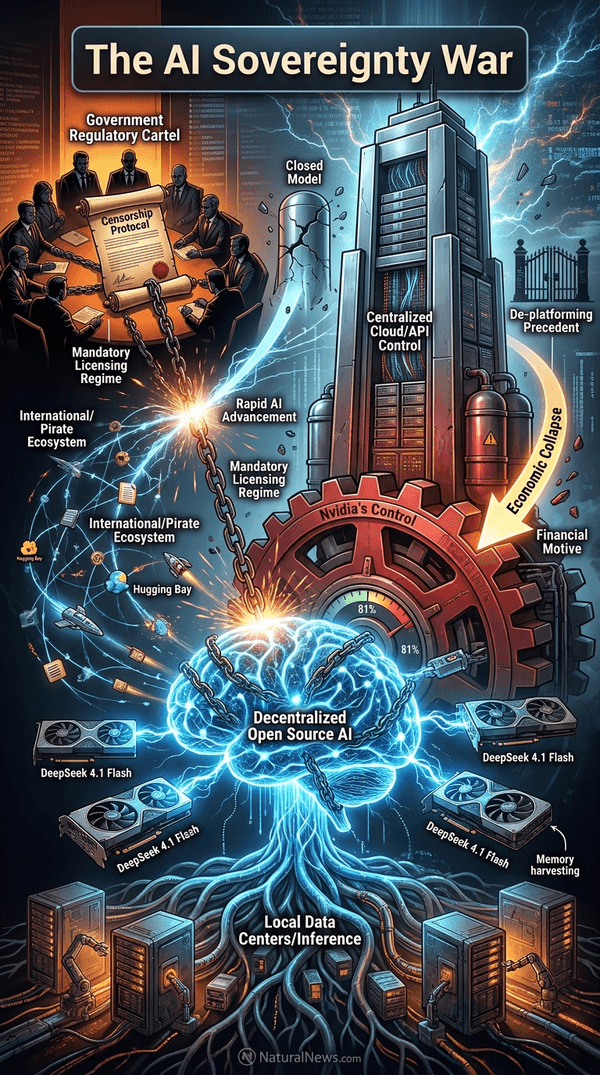
Explainer Infographic









Please contact us for more information.