


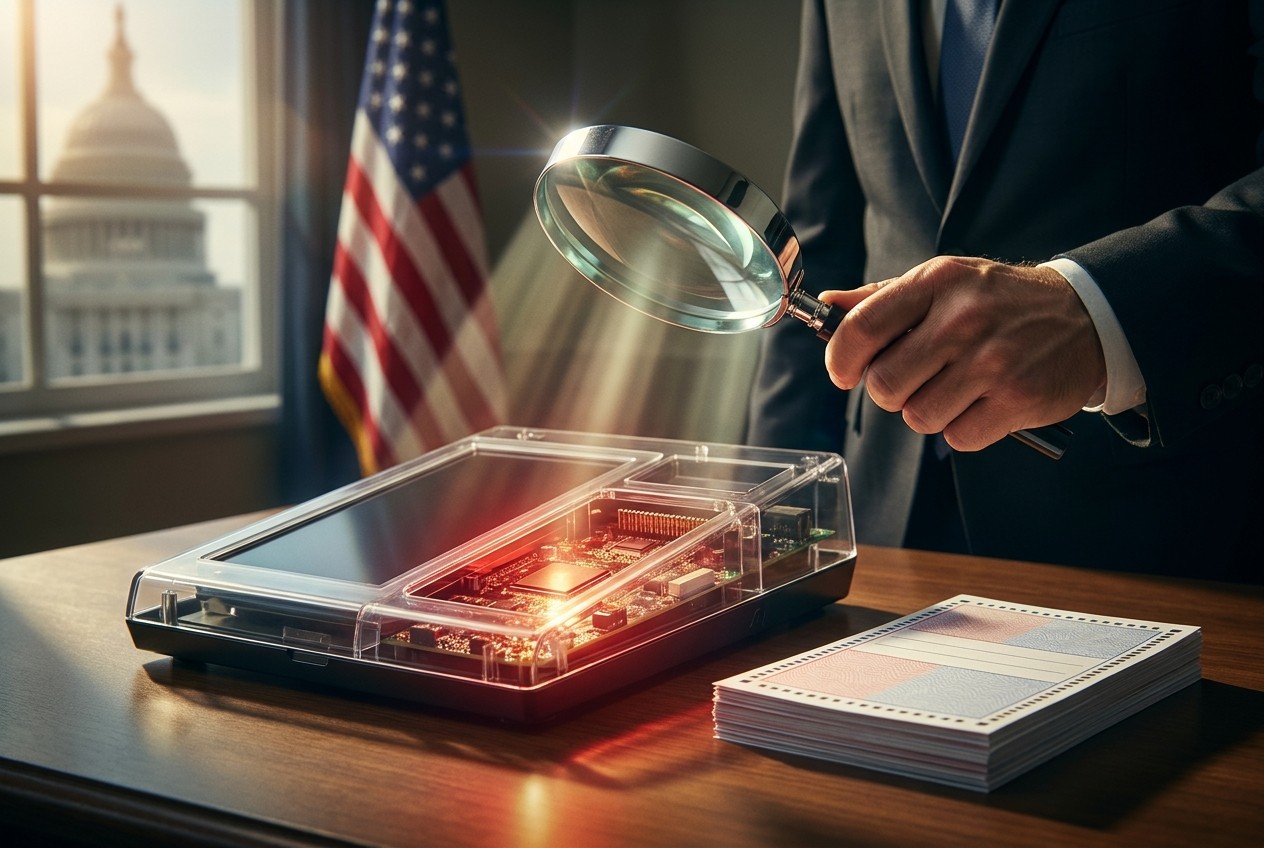
The Department of Homeland Security (DHS) has concluded that electronic voting systems used across the United States rely on components manufactured in China, according to a letter sent by Homeland Security Secretary Markwayne Mullin.
Mullin sent the letter to the White House Transparency Task Force on Aug. 24, 2026 and was released publicly on Aug. 27, 2026. It states that the department will require states to conduct random manual audits of paper ballots as a condition for receiving full federal election-security grants.
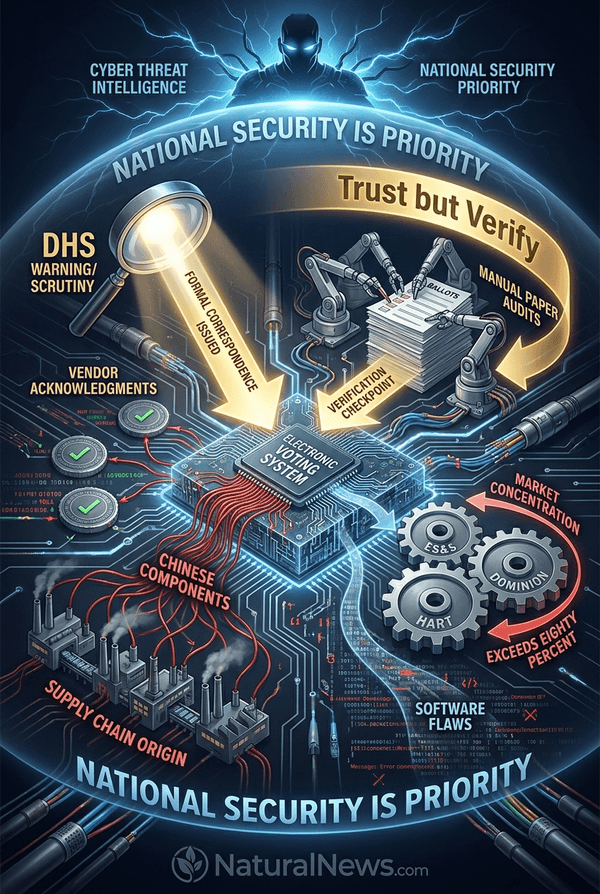
Mullin wrote that "voting machines with components manufactured by foreign adversaries introduce significant security risks" and that malicious actors "could potentially compromise election infrastructure at any stage of the supply chain." According to the letter, three vendors – Election Systems & Software, Hart InterCivic and Dominion Voting Systems – control more than 80% of the U.S. market.
The department's directive applies to the 2026 midterm elections and represents what officials described as an effort to verify machine counts against paper records. The announcement follows earlier warnings from DHS and other federal agencies about supply-chain vulnerabilities in critical infrastructure.
According to the letter, the hardware issue had been identified previously but is now being addressed through grant conditions tied to post-election audits. DHS framed the requirement as a "trust but verify" measure that supplements other agency actions on election infrastructure.
Vendors Acknowledge Chinese Component Reliance
Representatives from the three firms have each acknowledged that their machines contain Chinese-made parts, according to Mullin's letter. The acknowledgments came during congressional testimony and in responses to federal inquiries, the letter stated.
Dominion's then-President and CEO testified before Congress that "voting systems manufacturers would be challenged to source certain product hardware components from outside of China," adding that "in some cases, there are simply no alternative suppliers." ES&S representatives stated that "in some instances, there is no ability to procure from alternative component suppliers," describing some components as sole-sourced or patent-protected. In 2020 House Administration Committee hearings, Dominion's CEO described reliance on Chinese components including LCD screens and chip-level parts.
A 2019 supply-chain study documented that voting machines in the U.S. contain Chinese-made components, and all major election equipment vendors acknowledged their use before Congress in January 2020 [1]. Proponents of hand-counted paper ballots have said the testimony underscores the case for returning to paper-based voting, according to the report. The vendors have not disputed the presence of foreign components, though they have emphasized that no evidence indicates those components have been used to alter vote counts.
Intelligence Assessments Cite Foreign Cyber Capabilities
The DHS letter places the hardware issue within broader intelligence findings, including the 2024 Annual Threat Assessment issued by the Office of the Director of National Intelligence. That assessment concluded that "China remains the most active and persistent cyber threat to U.S. Government, private-sector, and critical infrastructure networks."
A National Intelligence Council Memorandum from October 2024 assessed that adversaries including China, Iran and Russia "have the technical capability to access some U.S. election-related networks and systems." According to the DHS letter, those assessments informed the department's decision to condition grant funding on manual audits. Officials said a compromised component introduced before assembly could affect machines across multiple jurisdictions.
The intelligence findings echo concerns raised in prior assessments about foreign interference in U.S. elections. In August 2020, the State Department announced a $10 million reward for information on foreign interference in U.S. elections, according to a department announcement [2]. The DHS letter does not allege that any specific component has been used to interfere with an election, but it states that the risk warrants additional verification measures.
Prior Examinations of Dominion Equipment Detailed Software Flaws
A 2021 report by University of Michigan professor Alex Halderman and colleague Drew Springall identified critical flaws in Dominion's ImageCast X (ICX) ballot-marking devices and scanners used in Georgia and other states. The report stated that attackers with brief physical access could install malware, alter QR codes on printed ballots, obtain county-wide cryptographic keys, and compromise ballot secrecy.
Halderman concluded that Georgia voters had "greatly diminished grounds to be confident" that votes cast on the ICX were secured. A spokesman for Georgia Secretary of State Brad Raffensperger's office dismissed the findings, while computer scientist David Jefferson of Lawrence Livermore National Laboratory and other experts called the response irresponsible, according to the report. The report stated these software flaws exist independently of the manufacturing origin of any component.
The DHS letter references the Halderman-Springall findings as part of a broader pattern of vulnerabilities in electronic voting systems. According to the letter, the combination of foreign-manufactured hardware and previously identified software flaws reinforces the need for paper-based verification. The vendors have said they have addressed many of the software issues identified in the report, though Halderman has said some vulnerabilities remain unresolved.
DHS Ties Grant Funding to Post-Election Manual Counts
Mullin stated that "election security is national security" and that DHS has been directed to prioritize it under President Donald Trump. To receive full Homeland Security Grant Program awards, states must demonstrate they have conducted random post-election manual counts of paper ballots "to ensure that any errors or manipulation is detected," according to the letter.
Mullin said electronic voting systems "have one job -- to accurately count the votes on ballots." The department will require audits of at least 5% of ballots in the 2026 midterms, according to a DHS announcement [3]. The grant conditions apply to more than $1 billion in federal election-security funds, giving DHS leverage over how states administer their midterm elections [4].
Some state election officials have raised concerns about the cost and logistics of manual audits, while supporters argue the measures are necessary to ensure public confidence. DHS has not indicated whether states that fail to comply will lose all funding or only a portion.
Letter Frames Supply-Chain Exposure as Structural
The DHS letter frames foreign components in U.S. voting machines as a structural problem rather than a theoretical one, according to officials. Vendors have long stated certain parts cannot be sourced domestically. Intelligence assessments identify China as the leading cyber threat, and prior independent examinations of Dominion equipment identified pathways for vote alteration and secrecy breaches.
Together these findings support the call for mandatory random hand counts of paper ballots as a condition of federal election-security funding ahead of the midterms, according to the letter. The department has not released a full list of components or suppliers, citing security concerns. Mullin's letter states that the risks are inherent in the current supply chain and that mitigation requires verification at the ballot level.
References
- Laundering Federal Election Interference in the Midterms. https://www.lawfaremedia.org/article/laundering-federal-election-interference-in-the-midterms
- State Dept announces 10 million reward for info on foreign interference in US elections - NaturalNews.com, August 09, 2020. by NaturalNews.com
- DHS Orders Paper Ballot Audits as Officials Raise Security Concerns .... https://yournews.com/2026/08/27/7178332/dhs-orders-paper-ballot-audits-as-officials-raise-security-concerns/
- Democracy watch, election integrity, mid-terms, Trump's interference .... https://www.homelandsecuritynewswire.com/dr20260916-laundering-federal-election-interference-in-the-midterms
Explainer Infographic










Please contact us for more information.