



Anthropic – the maker of the Claude chatbot – announced on Wednesday, Oct. 14, that it will add official U.S. voting information and election results coming from the nonprofit Democracy Works to the artificial intelligence (AI) platform.
The announcement comes ahead of the Nov. 3 midterm elections. In April 2026, Anthropic began showing Democracy Works' nonpartisan TurboVote tool in a banner when Claude was asked about voting registration, locations or dates [1].
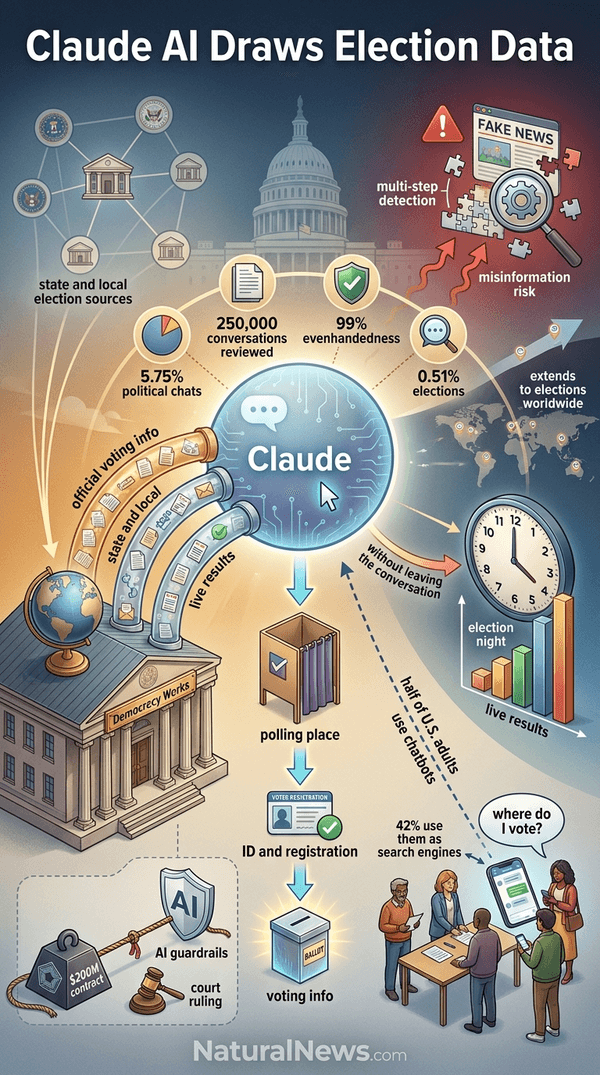
The announcement arrives as AI-powered chatbots and search engines are increasingly used to find and summarize election information online. According to a NaturalNews.com report, about half of American adults report using AI-powered chatbots, and about 42% of those users said they use them to search for information, according to the Pew Research Center as cited by NPR [2].
State-Specific Voting Answers and Election Results Planned for Later This Month
Later this month, Claude will start drawing official voting information from Democracy Works into its responses on Claude.ai for users in the U.S., Anthropic said [3][4].
"Someone asking where to vote or what ID to bring to their polling place will now get an answer specific to their state, without leaving the conversation," the company said [4]. These responses draw on publicly available information that Democracy Works collects from state and local election sources, according to the announcement [4].
Claude will also begin showing up-to-date results on election night and in the days that follow. "When people ask for current vote counts or election results, they'll be shown the latest official numbers directly in their conversation," Anthropic said [4]. The company stated that its goal is for Claude to be a useful tool for political conversations while preventing election-related abuse [5].
Anthropic Reports Political and Election Queries Are Small Share of Claude Chats
Anthropic reviewed 250,000 U.S. conversations from late September and reported that politics, public policy, or social issues made up about 5.75% of all U.S. chats on Claude.ai [5][6]. About 0.51% focused on elections or voting, and requests for advice on whom or what to support appeared in just 0.01% of those exchanges [7][5].
Policy violations were rarer still, at roughly 0.002%. Most requests stayed informational, Anthropic said, such as where candidates stand on issues, weighing policy arguments or drafting documents [9].
The company expects political queries to climb as Election Day nears. The assessment of 250,000 conversations was described as a privacy-preserving analysis, according to one report on the announcement [7].
Evenhandedness Scores, Independent Reviews, and Misuse Detection
Claude Opus 5.5, Sonnet 5.5 and Haiku 5.5 scored 99% on Anthropic's political evenhandedness evaluation – the highest to date, the company said [5]. Independent reviews by the Future of Free Speech, the Foundation for American Innovation, and the Collective Intelligence Project found the models rarely refuse political requests but sometimes insert unsolicited caveats, according to the announcement [5].
Anthropic added new detection tools that look for harmful activity spread across several steps, such as building fake news sites or running schemes that appear ordinary when examined one piece at a time [10].
Election Information Limits, Continued Testing, and Separate Scrutiny
AI-powered chatbots and search engines are increasingly used to find and summarize election information online, but they are not official sources and frequently cite incorrect information, according to the company's assessment [5]. Anthropic said it will keep testing for political evenhandedness and misuse as the election cycle intensifies.
"We'll continue to invest in making Claude more evenhanded, preventing and addressing misuse, and being transparent in our actions," the company said [5]. "This work will be critical in the upcoming U.S. midterms and extends to elections around the world as well" [5].
Anthropic has faced separate scrutiny this year over model access, export controls and government contracts, though those disputes sit outside its voting information plan [5]. In February 2026, the Department of War demanded that Anthropic drop its AI guardrails regarding use in autonomous weapons systems and surveillance or lose a $200 million contract, according to Responsible Statecraft [11]. A federal judge later ruled that the War Department's attempt to blacklist the firm was unlawful retaliation, according to NaturalNews.com [12].
Conclusion
Anthropic's decision to pipe official voting data from Democracy Works into Claude represents one of the most direct integrations of a major AI chatbot with the U.S. election information ecosystem. The company says the goal is to give users state-specific answers on registration, polling locations, identification requirements and election results, all within the conversation window.
The move comes as voter reliance on AI tools for ballot research is growing. How smoothly the integration works, and whether it genuinely helps voters navigate the midterms without introducing new problems, will become clear as Election Day approaches. Anthropic said it will continue testing, refining, and expanding the safeguards as the cycle intensifies [5].
References
- Anthropic to Feed Claude Official Voting Data Ahead of November. https://thelibertydaily.com/anthropic-feed-claude-official-voting-data-ahead-november/
- Report: Voters Use ChatGPT and Other Chatbots for Midterm Ballot Research, Raising Bias and Privacy Concerns. https://www.naturalnews.com/2026-10-07-report-voters-use-chatbots-midterm-ballot-research.html
- Anthropic to add US voting information to Claude before. https://www.reuters.com/world/us/anthropic-add-us-voting-information-claude-before-midterms-2026-10-14/
- Anthropic to Feed Claude Official Voting Data Ahead of November Midterms. https://www.theepochtimes.com/us/anthropic-to-feed-claude-official-voting-data-ahead-of-november-midterms-6104166
- Anthropic Plans To Add Official US Voting Information To Claude Ahead. https://gadgetsnow.indiatimes.com/tech-news/anthropic-plans-to-add-official-us-voting-information-to-claude-ahead-of-november-midterms/articleshow/134965886.cms
- Anthropic Strengthens Election Safeguards Ahead of 2026. https://www.unite.ai/anthropic-strengthens-election-safeguards-ahead-of-2026-us-midterms/
- Preparing for the 2026 US midterms \ Anthropic. https://www.anthropic.com/news/2026-us-midterms
- Anthropic to Feed Claude Official Voting Data Ahead of November Midterms. https://cmsapi.theepochtimes.com/us/anthropic-to-feed-claude-official-voting-data-ahead-of-november-midterms-6104166
- Anthropic Announces US Midterm Safeguards for Claude. https://www.ainewsbank.com/posts/anthropic-us-midterms-voting-information-safeguards
- Pentagon threatens to blackball Anthropic AI. https://responsiblestatecraft.org/pentagon-anthropic/
- Pentagon's blacklisting of Anthropic struck down as illegal retaliation, judge rules - NaturalNews.com, August 28, 2026.
Explainer Infographic











Please contact us for more information.