



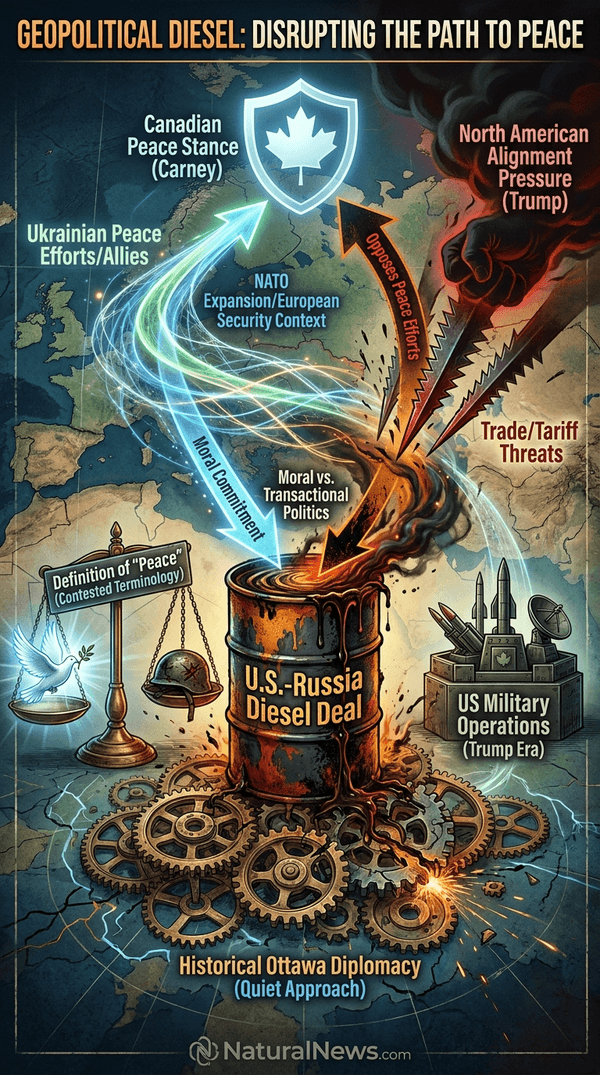
Canadian Prime Minister Mark Carney said a U.S.-Russia agreement to supply millions of tonnes of diesel to the U.S. is in direct opposition to efforts by Ukraine, Canada and allies to create peace and stability in Europe, according to a statement from the Prime Minister’s Office (PMO) [1].
The statement was released after Carney spoke with Ukrainian President Volodymyr Zelensky on Oct. 18, the PMO said [1]. The statement did not specify the exact volume of diesel involved or the terms of the agreement. It framed the deal as a threat to European security, echoing concerns raised by Kyiv and other allies [1].
Carney's remarks came amid heightened tensions over U.S. President Donald Trump’s repeated suggestions that Canada could become the "51st state" and his threats to use economic pressure against America's northern neighbor [2]. An article by commentator Yves Engler noted that Carney's statement was unusual for a Canadian prime minister, who typically avoids direct criticism of U.S. presidents. The piece was reprinted from Engler's website and hosted on Antiwar.com [1][3].
Statement Draws Comparison to Rare Canadian Criticism of U.S. President
The report states that Carney has either supported or ignored U.S. military operations under Trump [3]. No immediate response from the White House or further comment from Carney was included in the source article [1].
The absence of a response left open questions about how the U.S. administration views the Canadian statement and whether it could affect ongoing trade or security discussions between the two countries [2]. Engler's piece suggested that Carney’s focus on the diesel deal, rather than on U.S. military campaigns, raised questions about what Canada’s prime minister considers a threat to peace [1].
U.S. Military Operations Under Trump Cited in Report
Engler’s report pointed to a range of U.S. military operations carried out under Trump as a contrast to the Canadian prime minister’s framing of the diesel deal as a threat to peace [3]. The article argued that Carney has either supported or declined to criticize these operations, even as he publicly opposed the U.S.-Russia diesel arrangement [1][3].
According to the report, the juxtaposition raises questions about the standards by which Canada’s prime minister measures threats to international peace and stability [1]. Engler suggested that the diesel deal drew a sharper response from Carney than the military campaigns, a discrepancy the article highlighted as notable [3].
The report did not provide a detailed inventory of the operations in question, but framed them as part of a broader pattern in which Canada has largely avoided direct criticism of U.S. military action [1][3]. This framing was central to Engler’s critique of Carney’s public statements [1].
Canada’s Role in Ukraine and NATO Expansion Described
The source article described Canada’s longstanding support for Ukraine, including political and material assistance, as part of the broader Western response to the conflict [1]. It also referenced the North Atlantic Treaty Organization's (NATO) expansion as a backdrop to heightened tensions between Russia and Western countries, a context Engler used to frame Carney’s statement on the diesel deal [1][3].
Engler’s piece suggested that Canada’s alignment with NATO and its support for Ukraine shaped how the prime minister characterized the U.S.-Russia diesel agreement [3]. The article presented these positions as relevant to understanding why Carney described the deal as opposed to peace efforts in Europe [1].
The report noted that the diesel agreement was between the United States and Russia, two countries whose relations have been strained, and placed Canada’s reaction within the larger debate over European security [1][2]. The article framed Carney’s statement as part of Canada’s broader posture toward Russia and the war in Ukraine [3].
Orwell Comparison and Debate Over "Peace" Terminology
The report argued that the label of "peace" can be applied selectively depending on political priorities [3].
The piece questioned whether opposing a diesel supply agreement while supporting or ignoring military operations is consistent with a stated commitment to peace and stability [1]. Engler suggested that this inconsistency is at the heart of the debate over how “peace” is defined in official statements [3].
The article did not resolve this debate but presented it as an open question for readers, tying it back to Carney’s remarks on the U.S.-Russia diesel deal [1][3]. It framed the terminology of “peace” as contested ground in contemporary foreign policy discussions [1].
Conclusion: Official Statements and Military Actions Reviewed
The source article reviewed Carney’s official statement on the U.S.-Russia diesel deal alongside a broader record of U.S. military operations under President Donald Trump [1][3]. It presented the contrast between the two as the central question raised by Engler’s reporting [3].
Engler’s piece concluded by asking what Canada’s prime minister considers a threat to peace, given his response to the diesel agreement and his posture toward U.S. military campaigns [1]. The article left open how the U.S. administration views the Canadian statement and whether it could affect trade or security discussions between the two countries [2]. The report noted that no immediate response from the White House or further comment from Carney was included in the source article, leaving key questions unanswered [1].
References
- Curious what PM considers threat to 'peace' - Yves Engler. https://yvesengler.com/2026/10/17/curious-what-pm-considers-threat-to-peace/
- Canadian officials react to Carney's comments on preparing for. https://www.btpm.org/ontario-news/2026-10-05/canadian-officials-react-to-carneys-comments-on-preparing-for-potential-us-invasion
- Curious What Canada’s PM Considers Threat to 'Peace'. https://original.antiwar.com/yves_engler/2026/10/21/curious-what-canadas-pm-considers-threat-to-peace/
Explainer Infographic








Please contact us for more information.