


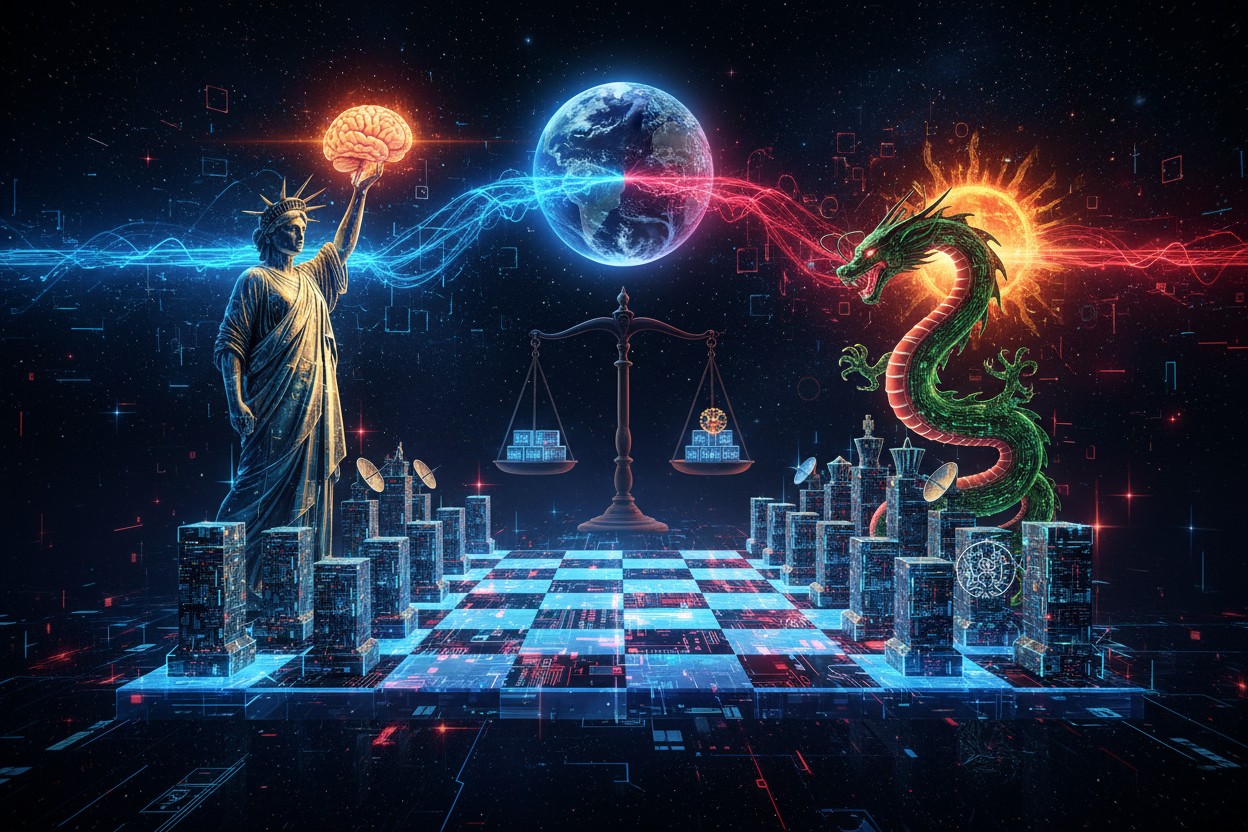
In a world increasingly governed by algorithms and neural networks, the United States and China are forging divergent paths in artificial intelligence, creating a global fracture that risks destabilizing democratic institutions and entrenching authoritarian control. As nations grapple with the choice between Washington’s closed, technologically superior ecosystem and Beijing’s open-source, economically enticing model, the battle for AI supremacy is not just about innovation... It’s about who controls the future of human autonomy, economic power, and geopolitical influence. With countries like Kazakhstan and Indonesia caught in the crossfire, the stakes are clear: the AI arms race is accelerating a technological Cold War, one that could redefine global order in the coming decades.
Key points:
- The U.S. and China are forming AI blocs, forcing countries to choose between advanced but restrictive Western tech or affordable but ideologically aligned Chinese systems.
- Nations like Kazakhstan and Indonesia are attempting to hedge their bets, but the window for neutrality is closing as both superpowers intensify their influence campaigns.
- The U.S. strategy emphasizes technological dominance and exclusion, while China leverages open-source models and financial incentives to expand its global footprint.
- AI’s military applications are already reshaping warfare, with both nations weaponizing data, surveillance, and autonomous systems to gain strategic advantage.
- The ideological clash between U.S.-led “Pax Silica” and China’s “World AI Cooperation Organization” mirrors broader tensions over democratic sovereignty versus centralized control.
The U.S. strategy: Technological supremacy and exclusion
The United States has long positioned itself as the guardian of cutting-edge technology, leveraging its dominance in semiconductor manufacturing and AI research to secure a first-mover advantage. Under the Trump administration, the U.S. launched Pax Silica, a coalition of trusted allies aimed at controlling AI supply chains and restricting access to advanced chips. This approach, while technologically superior, is exclusionary: Washington demands that member nations sever ties with Chinese AI initiatives, effectively forcing a binary choice between innovation and ideological alignment.
This strategy stifles global collaboration and entrenches U.S. hegemony under the guise of security. For instance, the IRS’s 2017 Rule 174, which forces tech companies to amortize investments over five years, has been criticized as a covert tax on innovation, making it harder for startups to compete with giants like Google. Meanwhile, the U.S. government’s accusations of Chinese “distillation” of American AI models (despite Beijing’s denials) highlight a broader narrative of paranoia over intellectual property, masking a deeper fear of losing control to a rival power.
Yet the U.S. model’s strength lies in its military applications. Advanced AI-driven surveillance, autonomous drones, and predictive analytics are already reshaping warfare, with the Department of Defense investing billions in projects like Project Maven, which uses machine learning to analyze drone footage. This militarization of AI, while enhancing U.S. strategic dominance, also raises ethical concerns about the erosion of human agency in conflict zones.
China’s open-source gambit: Inclusivity and economic leverage
In contrast, China’s World AI Cooperation Organization (WACO) offers a more accessible, albeit ideologically charged, alternative. By promoting open-source models and funding AI infrastructure in developing nations, Beijing is building a coalition of countries eager to bypass the high costs of Western technology. Kazakhstan, for example, has secured $10 billion in investments from Nvidia while also welcoming Chinese capital to build a “data center valley,” leveraging its cheap electricity and mineral resources to become a global AI hub.
China’s approach is less about technological parity and more about economic coercion. Through its Belt and Road Initiative, Beijing has funneled billions into AI projects in countries like Nigeria, Zambia, and Ghana, using debt diplomacy to secure long-term influence. This strategy is particularly effective in regions where the U.S. has ceded soft power, as seen in Pew Research Center studies showing growing trust in China’s AI governance among middle-income nations.
However, the risks of dependency are stark. China’s AI systems, while affordable, are often integrated with its surveillance state, raising concerns about data sovereignty and privacy. For countries like Saudi Arabia, which recently partnered with a Chinese AI startup to develop an open-model platform, the trade-off between technological access and political autonomy is a precarious one.
The military-industrial AI complex: A new front in global war
As AI becomes a cornerstone of modern warfare, the U.S.-China rivalry is spilling into the military domain. The U.S. is developing AI-powered hypersonic missiles and autonomous submarines, while China is advancing its own AI-driven “smart warfare” doctrines. Both nations are also weaponizing AI for cyberattacks, disinformation campaigns, and predictive policing, creating a dystopian landscape where algorithms dictate geopolitical outcomes.
The implications for global stability are profound. If AI systems are used to automate decision-making in warfare, the risk of unintended escalation—triggered by a misinterpreted data point or a false positive—could lead to catastrophic conflicts. Moreover, the integration of AI into surveillance and social control mechanisms, as seen in Xinjiang and U.S. border security, highlights a chilling trend: the erosion of human rights in the name of “efficiency.”
Sources include:









Please contact us for more information.