



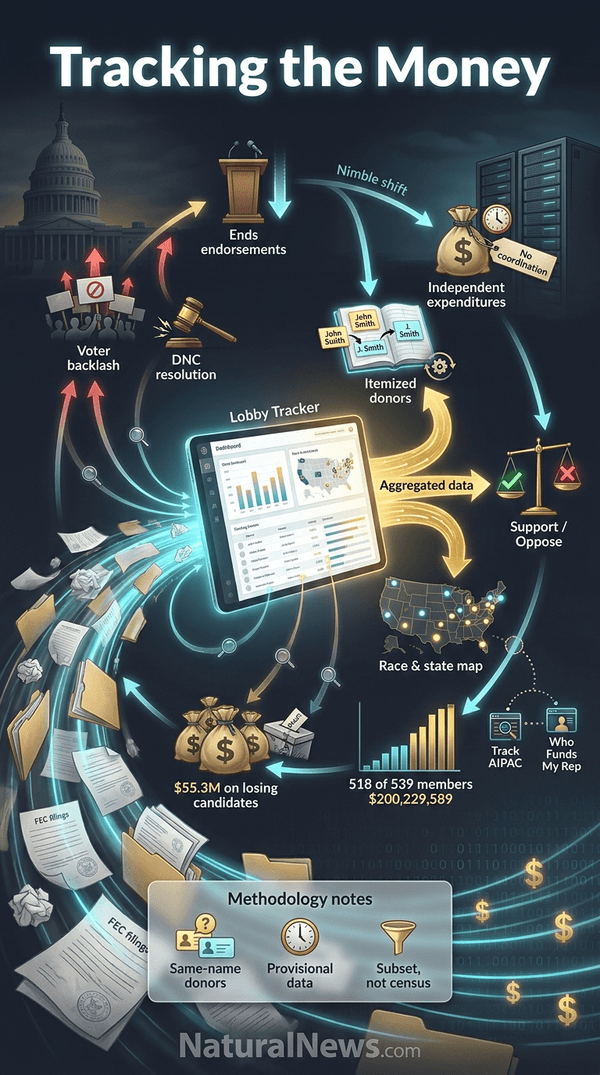
A public data tool at israelslobby.com, called Lobby Tracker, is tracking pro-Israel political committees, Super PACs, independent expenditures, donor funding, candidates, and races in the 2026 federal election cycle. The dashboard is described as a read-only public view of 2026-cycle federal campaign-finance data, the site states.
The tool tracks selected pro-Israel political committees, outside-spending groups, race-linked spending, and candidate support or opposition labels, according to the project. The site states that its totals are presented from the project database and should be read with methodological notes and source trails included in the dashboard.
The dashboard arrives as pro-Israel political spending has become a central subject in the 2026 midterm cycle. In October 2026, the American Israel Public Affairs Committee announced it would stop endorsing political candidates and directly contributing to their campaigns and PACs, a move that reflects a new political environment in which the receipt of AIPAC money and endorsements is now being exploited as a mark against candidates, according to ZeroHedge [1]. The same month, Middle East Eye reported that the shift to a "nimble" strategy came amid voter backlash against Israel from across the political spectrum [2].
What the Data Covers
The dashboard includes itemized donor contributions to tracked committees, with individual names normalized where possible, the site says. It provides candidate support or opposition labels tied to specific races and committees, the project states.
The project states that the dashboard covers selected committees and outside-spending groups, not all political spending. The site's totals are presented from the project database and should be read with the methodological notes and source trails in the dashboard, according to its methodology section.
The scale of the broader spending landscape is substantial. The New American reported that AIPAC spent $55.3 million on losing candidates alone [3]. Separately, Track AIPAC, a related advocacy platform, documents pro-Israel political spending in United States politics [4]. Who Funds My Rep, another tracker, states that 518 of 539 members of Congress have received $200,229,589 from AIPAC and other pro-Israel PACs, per FEC filings [5].
Methodology and Data Sources
The dashboard presents committee-level receipts and reported spending from the project database, according to its methodology notes. The site states: "Totals are presented from the project database and should be read with the methodological notes and source trails in the dashboard."
Campaign-finance data changes as filings are submitted and processed, the methodology section says. Donor names may be reported with variants, and same-name individuals can be difficult to distinguish without additional identifiers, according to the site.
The project says rankings should be read as cumulative totals within the collected 2026 dataset, not as a complete statement about all political spending in a race, the site states. The site states that its totals are from the project database and are subject to change as filings are processed.
The challenge of tracking this money is not new.
Limitations and Responses
The site cites limitations including changing campaign-finance data and name normalization issues, per the methodology section. The project states: "Rankings should be read as cumulative totals within the collected 2026 dataset, not as a complete statement about all political spending in a race."
The dashboard is a read-only public view of selected committees and spending, the site says. The methodology section says same-name individuals can be difficult to distinguish without additional identifiers, according to the project. The project says totals should be read with methodological notes and source trails, the site states.
The limitations arrive amid heightened scrutiny of pro-Israel political spending. In April 2026, the Democratic National Committee was set to consider a resolution that "condemns the growing influence" of AIPAC, according to the Times of Israel. The resolution also condemns large-scale outside spending in elections generally but calls out only the pro-Israel lobby specifically, even as other lobbies are pouring similar sums into trying to influence election outcomes [6]. In October 2026, Middle East Eye reported that AIPAC ended endorsements and direct funding to U.S. candidates amid voter backlash [2].
References
- Increasingly Toxic To Candidates, Pro-Israel AIPAC Retreats From Endorsements And Direct Donations. https://www.zerohedge.com/geopolitical/increasingly-toxic-candidates-pro-israel-aipac-retreats-endorsements-and-direct
- Pro-Israel lobbying group AIPAC ends endorsements, direct funding to US candidates. https://www.middleeasteye.net/news/pro-israel-lobbying-group-aipac-ends-endorsements-direct-funding-us-candidates
- AIPAC Spent $55 Million This Election Cycle on Losing Candidates, but Will Still Heavily Influence Congress. https://thenewamerican.com/us/politics/aipac-spent-55-million-this-election-cycle-on-losing-candidates-but-will-still-heavily-influence-congress/
- Track AIPAC. https://en.wikipedia.org/wiki/Track_AIPAC
- Who Funds My Rep? | Track Israel Lobby Money in Congress. https://whofundsmyrep.com/
- Democrats to weigh resolution against AIPAC, fueling concerns about ‘undercurrent of antisemitism’. https://www.timesofisrael.com/democrats-to-weigh-resolution-against-aipac-fueling-concerns-about-undercurrent-of-antisemitism/?utm_campaign=most_popular&utm_source=website&utm_medium=article_end&utm_content=9
Explainer Infographic










Please contact us for more information.