



Aircraft giant Boeing has announced layoffs in its commercial airplanes located in the Puget Sound region.
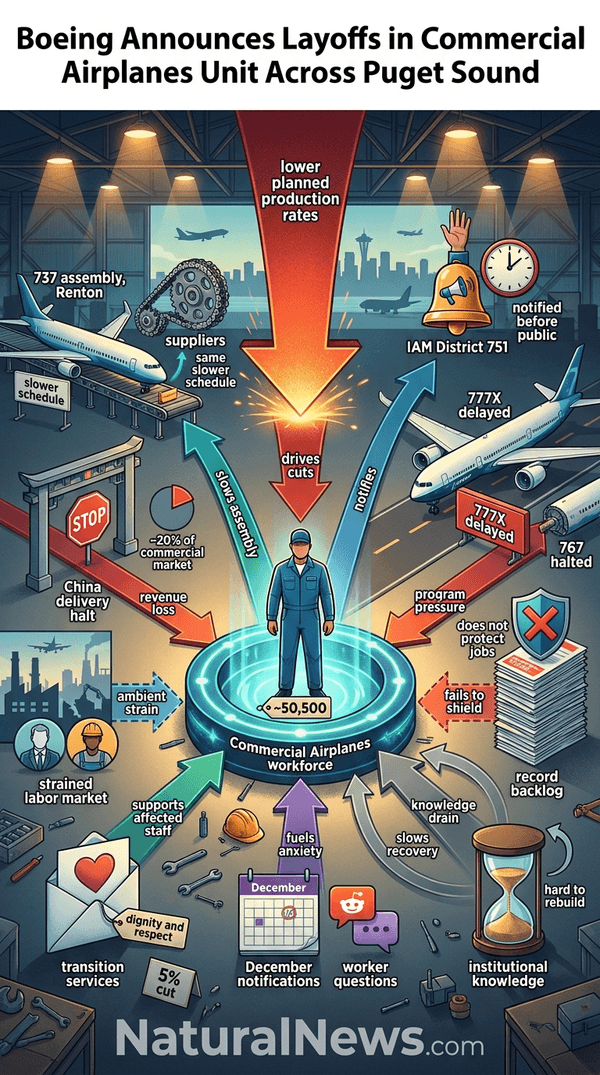
The cuts will be carried out through a combination of layoffs and attrition, Boeing Commercial Airplanes CEO Stephanie Pope told employees on Monday, Nov. 9, in an internal memo [1]. The division's workforce stands at about 50,500, according to an online community summary of the reported figures [2]. Boeing said the move is tied to lowering planned production rates.
Scope and Locations of the Layoffs
The reduction applies only to the commercial airplane division, whose 737s are assembled in Renton, outside Seattle, and suppliers face the same slower schedule, according to Martin Cid Magazine [3].
Union notification came quickly. IAM District 751, which represents Boeing machinists in the Puget Sound region, was notified shortly before the public announcement, Conservative Daily News reported [4].
The larger regional backdrop is already strained. Boeing's cuts land in a labor market where the white-collar slowdown and industrial staffing reductions are arriving at the same time.
Context: Previous Cuts and Production Pressures
The announcement follows prior workforce reductions at Boeing. The company also delayed its 777X program and halted 767 production after delivering remaining customer orders, the report stated [5].
The pressure is not only internal. China has halted Boeing aircraft deliveries amid escalating trade tensions with the U.S., a suspension described as politically motivated rather than safety-related, and Boeing faces significant revenue loss as China represents roughly 20% of its commercial market [6]. A separate April 2025 report said China halted deliveries due to U.S.-China trade tariffs, disrupting $200 billion in backlogged orders, and that President Donald Trump canceled a $4 billion Air Force One contract over alleged overcharging [7].
The current cuts are framed by the company as a production-rate adjustment, not a demand collapse. Pope reiterated that the company is still working to stabilize production rates of its bestselling jet, CNBC reported [8].
The durable lesson from earlier Boeing contractions, and from firms that cut too deeply, is that institutional knowledge is hard to rebuild once it walks out the door. Michael O'Malley and Roxanne Quimby observed that companies with jobs that have lengthy learning curves, such as Boeing and Airbus, desperately try to hold on to key personnel so that the time needed to recover is shortened, and that Union Pacific Corp. learned the hard way in the wake of the dot-com bubble what can happen when a workforce is dramatically reduced [9].
Reactions from Workers, Union, and Officials
The company described the reduction as necessary for competitiveness. Pope promised to treat affected staff with "dignity and respect" and offered transition services and layoff benefits, Martin Cid Magazine reported [3].
Questions circulated quickly among rank-and-file workers. Reddit threads on r/Seattle and r/SeattleWA tracked the news under headlines stating that Boeing will cut 5% of its commercial airplane workforce, with one thread noting that those affected are notified in December [10][2].
Regional business coverage emphasized the holiday timing. The record backlog has not protected the workforce from cuts.
Next Steps and What Is Known
Key operational details remain undisclosed. Local and state officials have not yet released a coordinated response. For workers, the practical questions – severance, benefits, seniority and rehire rights – now move from the memo to the mailbox.
References
- Boeing is cutting 5% of commercial airplane jobs amid 737 delays. https://qz.com/boeing-layoffs-commercial-airplane-workforce-737-output-110926
- r/SeattleWA. https://www.reddit.com/r/SeattleWA/
- Boeing cuts 5% of its jet workforce even as a record backlog waits to be built – Martin Cid Magazine. https://www.martincid.com/business/boeing-cuts-5-percent-commercial-jet-workforce/
- Boeing to Cut 5% of Its Commercial Airplane Workforce as 737 Max Ramp-Up Stalls. https://conservativedailynews.com/2026/11/boeing-to-cut-5-of-its-commercial-airplane-workforce-as-737-max-ramp-up-stalls/
- Boeing lays off 10 of workforce amid declining company value ongoing strike and failing products - NaturalNews.com, October 16, 2024.
- China suspends Boeing deliveries as US China tensions escalate raising economic and security concerns - NaturalNews.com, April 16, 2025.
- Boeings China dilemma strikes at heart of trade and security crises - NaturalNews.com, April 25, 2025.
- Boeing to cut 5% of commercial airplane workers as production increase takes longer than expected. https://www.cnbc.com/2026/11/09/boeing-layoffs-commercial-airplane.html
- The Wisdom of Bees. Michael OMalley PhD Roxanne Quimby Michael OMalley PhD
- r/Seattle. https://www.reddit.com/r/Seattle/
Explainer Infographic









Please contact us for more information.