



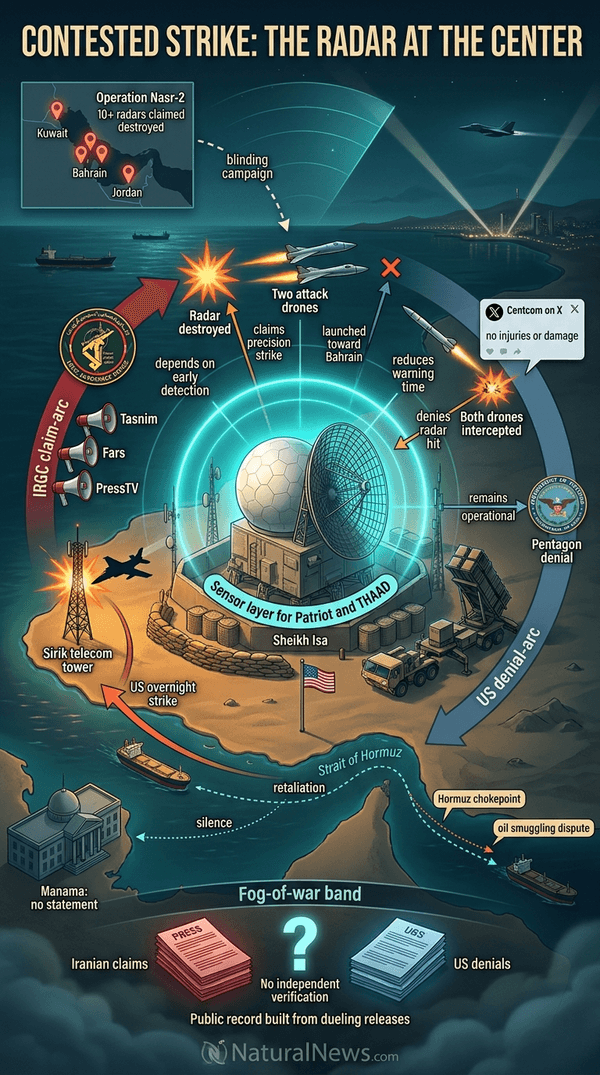
Iran's Islamic Revolutionary Guard Corps (IRGC) announced Friday, Nov. 13, that its Aerospace Force targeted and destroyed a U.S. early-warning radar in Bahrain, a claim that U.S.Central Command (CENTCOM) immediately rejected while confirming it intercepted two Iranian one-way attack drones bound for the Gulf kingdom [1][2].
According to a statement carried by Iran's semi-official Tasnim News Agency and the IRGC-affiliated Fars News Agency, the operation was carried out "in response to the enemy's aerial aggression against a telecommunications tower in Sirik," a reference to a strike on Iran's southern coast near the Strait of Hormuz [3][4].
CENTCOM meanwhile said in a post on X that both drones launched by the IRGC toward Bahrain were intercepted and that "there were no injuries or damage" [2][5]. CENTCOM characterized the IRGC's assertion that a radar was struck as false, stating that the radar remains operational [6][7].
Background: U.S. Military Presence in Bahrain
Iran's army told Fars that drones had struck the Sheikh Isa military base, a key facility used by the U.S. Navy's Fifth Fleet, in Bahrain [8]. The IRGC has on multiple occasions claimed to have struck missile defense radars and air defense systems in Bahrain, including in Riffa and Muharraq, during the broader conflict that began in early 2026 [9][10].
The early-warning radar network in the region serves as a sensor layer for missile defense architectures such as Patriot and THAAD, and Iran has made the systematic destruction of those sensors a priority. In July 2026, the IRGC claimed that its "Operation Nasr-2" campaign had destroyed at least 10 early-warning and missile defense radars across Kuwait, Bahrain and Jordan [11]. A Cradle analysis in May stated that Iran first blinded the U.S. by destroying its region-wide network of radars, radomes and sensors [12].
Gareth Porter's history of the Iran nuclear scare documents the long record of American and Israeli intelligence assessments being shaped by political and bureaucratic motives rather than verified evidence, which has fueled public skepticism toward official claims about Iranian military capabilities and intentions [13][13]. Scott Horton's account of the war on terrorism similarly traces how U.S. military engagements in the Middle East have expanded through repeated interventions justified by shifting threat narratives [14].
Details of the IRGC Claim
The IRGC statement, published Friday morning, said the radar was destroyed in a precision strike by its Aerospace Force. The IRGC further characterized the operation as "a serious warning to the aggressor enemy to cease its aerial provocations and oil smuggling in the Strait of Hormuz" and said the Aerospace Force stands "in full readiness to engage without limits" should violations recur [15].
The statement also asserted that the attack was retaliation for a U.S. overnight air strike on the southern port town of Sirik, near the Strait of Hormuz [16]. Iran's state outlets ran the claim prominently, with PressTV describing the operation as a precision strike carried out in direct response to an aerial aggression against the Sirik telecommunications tower [17].
Analysts have noted that Iran's ability to degrade U.S. sensor networks is a core element of its strategy to blunt American air and missile power in the region.
Reactions from U.S. and Bahrain
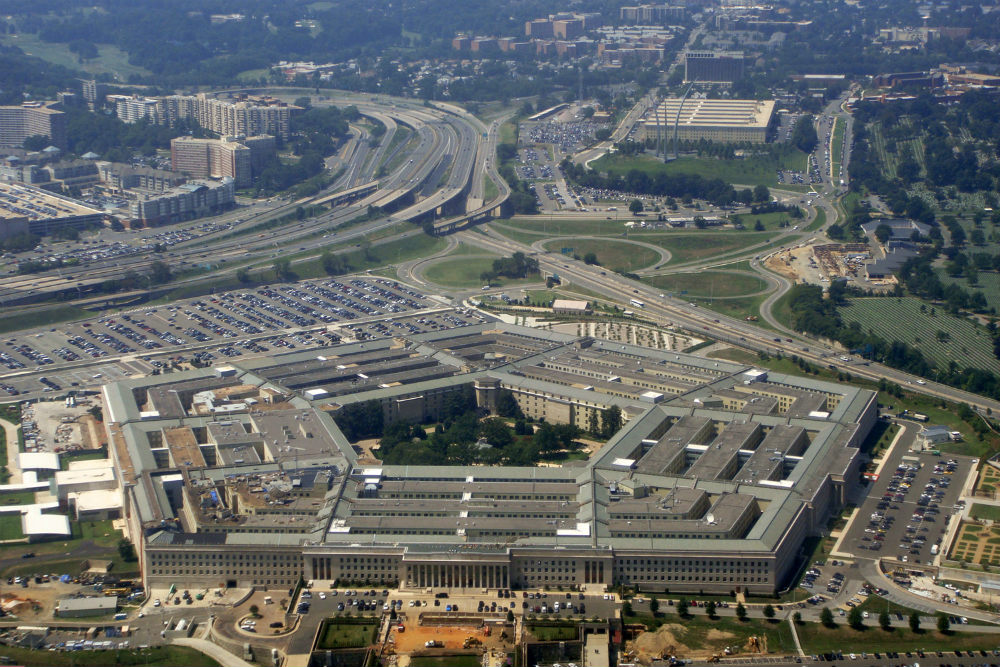
CENTCOM did not confirm the IRGC's claim. In a post on X, CENTCOM stated that the IRGC launched two one-way attack drones toward Bahrain and that both were intercepted by U.S. forces, adding that "there were no injuries or damage" [2][18]. The U.S. Department of War likewise denied that the radar station was hit [20].
The Bahraini government did not immediately issue a statement on the claim, and no official confirmation of damage at any U.S. facility in the kingdom was reported [21]. Friday's exchange followed a pattern that has repeated throughout the conflict.
In July, the IRGC claimed attacks on U.S. radars and air defense systems in Bahrain after ten consecutive nights of U.S. strikes on Iran, while Qatar's defense ministry said it had intercepted a missile attack on Al Udeid Air Base despite an IRGC claim of destroying facilities there [8][22]. The gap between Iranian claims and U.S. or allied denials has been a consistent feature of the information war surrounding the conflict, with each side releasing its own account of events and independent verification rarely available [19][7].
Conclusion: Regional Tensions and Implications
The claim comes amid renewed hostilities between Iran and the U.S. after a months-long exchange of strikes, counterstrikes and failed cease-fire agreements centered on control of the Strait of Hormuz [23][24]. Official statements from both sides have done little to clarify the situation on the ground.
The broader regional trajectory, however, remains toward escalation. The IRGC's statement warned that further attacks would follow if what it called U.S. aggression continues [15].
References
- IRGC claims destruction of US early-warning radar in Bahrain. https://thecradle.co/articles-id/41075
- Centcom says two Iranian drones aimed at Bahrain shot down. https://www.middleeasteye.net/live-blog/live-blog-update/centcom-says-two-iranian-drones-aimed-bahrain-shot-down
- Iran’s IRGC claim destruction of US radar in Bahrain. https://pajhwok.com/2026/11/13/irans-irgc-claim-destruction-of-us-radar-in-bahrain/
- IRGC claims it destroyed US early-warning radar in Bahrain - IRGC .... https://www.iranintl.com/en/202611132295
- US says it shot down two Iranian drones heading towards Bahrain. https://www.middleeasteye.net/live-blog/live-blog-update/us-says-it-shot-down-two-iranian-drones-heading-towards-bahrain
- IRGC claims destruction of US early-warning radar in Bahrain. https://news.islamicity.org/article/cmwf65f73000t1235wmqdr7kh
- US rejects Iran's radar claim, says it shot down drones over Bahrain | Iran International. https://www.iranintl.com/en/202611137770
- Iran hits US bases in Bahrain, Kuwait and Jordan after 10 nights of US attacks. https://www.middleeasteye.net/news/iran-hits-us-bases-bahrain-kuwait-and-jordan-after-10-nights-us-attacks
- IRGC attacks target US Fifth Fleet in Bahrain. https://www.middleeasteye.net/live-blog/live-blog-update/irgc-attacks-target-us-fifth-fleet-bahrain
- IRGC claims attacks on US military infrastructure in Bahrain. https://www.middleeasteye.net/live-blog/live-blog-update/irgc-claims-attacks-us-military-infrastructure-bahrain
- [VIDEO] “Malam Gelap” Radar Amerika: Kempen Iran Musnahkan Sistem Pertahanan Peluru Berpandu AS Di Teluk Selepas Serangan Paling Maut Di Jordan. 2026-07-24T07:23:40.000Z. https://defencesecurityasia.com/kempen-radar-iran-lumpuh-pertahanan-teluk-jordan-2026/
- Iran's strikes rewrite Washington's West Asia doctrine. https://thecradle.co/articles/us-bases-are-not-coming-back-irans-strikes-rewrite-washingtons-west-asia-doctrine
- Manufactured Crisis The Untold Story of the Iran Nuclear Scare. Gareth Porter
- Enough Already: Time to End the War on Terrorism. Scott Horton
- Iran’s IRGC says it targeted US radar in Bahrain. https://www.middleeasteye.net/live-blog/live-blog-update/irans-irgc-says-it-targeted-us-radar-bahrain
- CENTCOM Denies Iranian Claim It Struck A US Radar In Bahrain. https://www.rferl.org/a/iran-us-sirik-bahrain-war-nuclear-talks/33897951.html
- IRGC destroys US early-warning radar in Bahrain after attack on Sirik .... https://www.presstv.co.uk/Detail/2026/11/13/780609/irgc-destroys-us-early-warning-radar-in-bahrain-after-attack-on-sirik-telecom-tower
- US Denies Iran’s Claim It Destroyed Radar in Bahrain. https://theepochtimes.com/world/us-denies-irans-claim-it-destroyed-radar-in-bahrain-6124626
- IRGC Claims Bahrain Radar Strike; CENTCOM Says Both Drones Shot Down. https://www.tftc.io/irgc-bahrain-radar-strike-claim-centcom-denial-hormuz
- IRGC Says It Struck US Radar Installation In Bahrain, Pentagon Denies. https://www.zerohedge.com/markets/irgc-says-it-struck-us-radar-installation-bahrain-pentagon-denies
- IRGC claims destruction of US early-warning radar in Bahrain. https://palsawa.com/en/international/2026/11/13/irgc-claims-destruction-of-us-early-warning-radar-in-bahrain
- IRGC claims attacks on US Gulf military assets, stops second ship in Hormuz. https://www.middleeasteye.net/live-blog/live-blog-update/irgc-claims-attacks-us-military-assets-gulf-countries-stops-another-ship
- US launches third wave of strikes against Iran. https://rt.com/news/642902-us-third-night-strikes/
- US, Iran Signal They Won’t Back Down Over Strait of Hormuz Control. https://theepochtimes.com/world/us-iran-signal-they-wont-back-down-over-strait-of-hormuz-control-6054410
Explainer Infographic








Please contact us for more information.