



Creatine, a supplement long associated with muscle strength and athletic performance, is being studied for its effects on brain health, sleep regularity, reaction time, and brain creatine levels in perimenopausal and menopausal women, according to researchers.
Two recent trials were small and lasted six to eight weeks, and their results were mixed. Researchers said the findings do not prove that creatine relieves menopause-related brain fog, according to a report in The Epoch Times.
Dr. Robert Thompson, a board-certified family medicine physician, and Jordan Glenn, an exercise physiologist and head of science at SuppCo, a supplement research and evaluation platform, provided assessments of the research to The Epoch Times. The symptoms under study affect many women in perimenopause and menopause who report forgetfulness, difficulty concentrating, and poor sleep as estrogen levels fluctuate and then decline, the report stated.
Menopause, Estrogen, and Cognitive Symptoms
Estrogen helps support memory and concentration by influencing how brain cells communicate and process information, Thompson told The Epoch Times. As estrogen levels fluctuate during the menopause transition, some women experience difficulties with focus and memory recall. According to a report on perimenopause, the transitional period typically begins in a woman's mid-30s to early 40s, and hormonal fluctuations during this phase can cause symptoms such as hot flashes, sleep disturbances, mood changes, and weight gain [1].
Glenn, the exercise physiologist, points to a related factor: energy. Estrogen helps the brain use energy efficiently, and research suggests that during menopause, the brain may have a harder time turning glucose, or blood sugar, into energy, he said.
These cognitive symptoms often ease after menopause, according to The Epoch Times report. The report also noted that hormonal changes can trigger hot flashes and night sweats, which disrupt sleep and make it harder to concentrate, remember information, and think clearly the next day. A separate report on menopause symptoms stated that hot flashes affect a large share of individuals undergoing menopause [2].
Creatine and Brain Energy
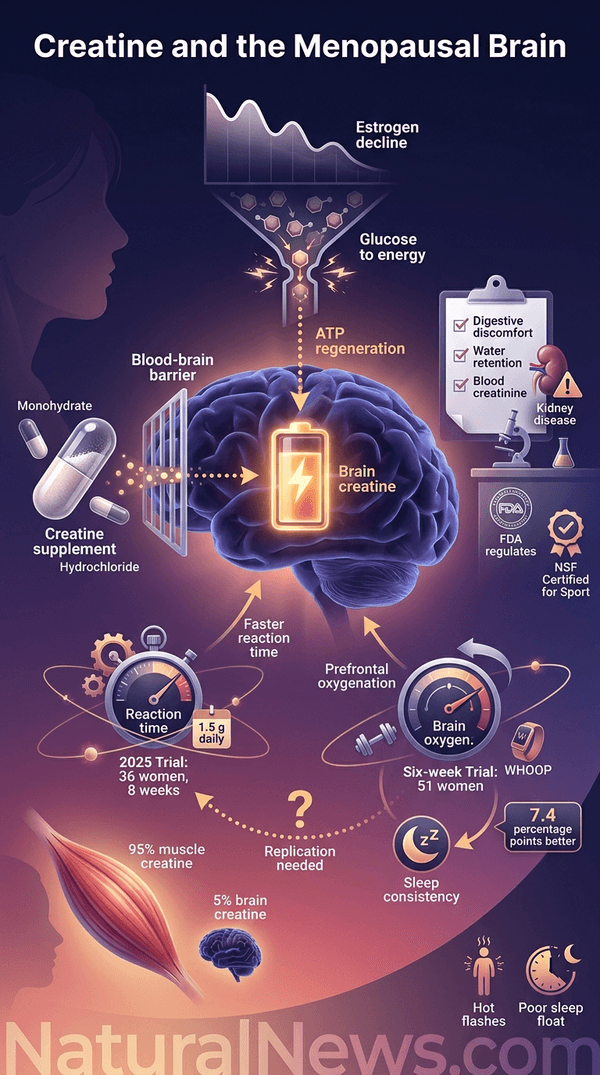
Creatine's proposed mechanism centers on cellular energy. "The brain burns about 20 percent of the body's energy, and creatine works as a quick backup battery that recharges ATP when demand spikes, like when you're concentrating hard or short on sleep," Glenn told The Epoch Times. ATP, or adenosine triphosphate, is the molecule that supplies energy to cells. According to a review of creatine research, creatine helps regenerate adenosine triphosphate, the body's main energy source, and approximately 95 percent of body creatine is stored in skeletal muscle, with smaller amounts in the brain, heart, and other organs [3].
Oral creatine supplements can increase creatine levels in the brain, although only a limited amount crosses the blood-brain barrier, according to The Epoch Times report. Some human studies have found small increases in brain creatine after supplementation, but researchers are still exploring how much is needed to produce meaningful cognitive benefits.
A separate report from NaturalNews.com stated that approximately 95 percent of the body's creatine is stored in muscle tissue, with about 5 percent found in the brain, where it plays a role in cellular energy production [4]. Brain creatine also builds up more slowly and to a smaller degree than muscle creatine does [5].
Recent Trials on Cognition
A 2025 randomized trial followed 36 perimenopausal and postmenopausal women for eight weeks and tested several forms of creatine, according to The Epoch Times report. Women who took 1.5 grams of creatine hydrochloride daily, a lower dose than the 3 to 5 grams of creatine monohydrate commonly used for exercise, showed improvements in reaction time and increased creatine levels in the front part of the brain compared with placebo. The trial's published results stated that medium-dose creatine hydrochloride was superior to placebo in enhancing reaction time and increasing frontal brain creatine levels [6].
Glenn cautioned that faster reaction times on a computer test do not necessarily mean a woman "feels sharper, forgets fewer words, or gets through her workday more easily." He also noted that the increase in brain creatine was unexpected at such a low dose, since previous brain studies have generally used higher amounts, and he said he would like to see the finding replicated.
A recent trial followed 51 perimenopausal women over six weeks, according to The Epoch Times report. The women were divided into three groups: 18 took creatine while strength training, 20 received a placebo while strength training, and 13 continued their usual activities without an intervention. Those taking creatine completed a five-day loading phase of 20 grams daily, followed by approximately 4.5 grams daily, alongside twice-weekly strength training. Compared with the placebo group, they showed increased oxygenation in the prefrontal cortex, the part of the brain involved in attention, planning, and decision-making, according to the published findings [7]. However, the creatine group did not show significantly greater improvements in cognitive performance. Both studies suggest creatine may affect how the brain functions, but neither proves that it relieves menopause-related brain fog, the report stated.
Sleep Consistency Findings
In the same six-week study, at the end of the six weeks, the creatine group had sleep consistency scores 7.4 percentage points higher than the placebo group, after accounting for baseline scores, according to The Epoch Times report. The published trial reported that sleep consistency showed a time-by-treatment interaction, with higher consistency in the creatine group than the placebo group at week six, corresponding to a baseline-adjusted mean difference of 7.4 percentage points [7].
Sleep consistency measures how regularly someone goes to bed and wakes up, using a WHOOP wristband that tracks sleep patterns, according to the report. Scores range from zero to 100 percent, with higher scores indicating more consistent sleep schedules. A report on creatine during perimenopause described the trial of 51 women as showing steadier sleep but no cognitive advantage [8].
Regular sleep schedules are associated with better mood, metabolic health, and daytime functioning, Glenn told The Epoch Times. However, researchers have not established whether the improvement seen in this study would make women feel more rested. Glenn described the finding as "a promising signal," but said it is not yet a reason to take creatine specifically for sleep.
What Women Should Know Before Trying Creatine
Creatine monohydrate is the most studied form of the supplement, typically taken at 3 to 5 grams daily, according to The Epoch Times report. Although one menopause study used creatine hydrochloride, there is no evidence that it offers greater brain benefits than monohydrate, Glenn said. The cited trial's findings suggest that the supplementation protocol may be a promising, safe, effective, and practical dietary strategy for improving clinical outcomes and elevating brain creatine concentrations in perimenopausal and menopausal women [9]. A review of creatine research also noted that creatine monohydrate is safe for healthy individuals when used as directed [10].
No dose or formulation has been established for treating menopause symptoms, Thompson told The Epoch Times. He noted that the 1.5-gram dose in the 2025 trial is lower than the typical monohydrate dose. A professional review of the treatment of cognitive symptoms during perimenopause reported improvements in reaction time, fatigue, and concentration compared with baseline, and the dose was considered safe for use in menopausal women [11].
Creatine is generally well tolerated by healthy adults, though some may experience digestive discomfort or temporary weight gain from water retention, according to The Epoch Times report. It can also raise blood creatinine levels, a marker used to assess kidney function, without necessarily indicating kidney damage, so patients should tell their healthcare providers if they are taking it, the report stated. Those with kidney disease should consult with their doctor before supplementing.
Creatine supplements are regulated by the Food and Drug Administration, but they do not need FDA approval before being sold, according to the report. Choosing products independently tested by organizations such as NSF Certified for Sport can help ensure quality and accurate labeling.
References
- Experts Outline Five Habits for Managing Perimenopause Symptoms After Age 35. https://www.naturalnews.com/2026-05-03-five-habits-for-managing-perimenopause-after-35.html
- The unspoken realities of menopauses most common symptoms - NaturalNews.com, August 30, 2025.
- Beyond Muscle Development: Creatine Supplement Linked to Cognitive Health Benefits. https://www.naturalnews.com/2026-05-11-creatine-supplement-linked-to-cognitive-health-benefits.html
- Small Study Examines Daily Creatine Supplementation and Cognitive Function in Active Women. https://www.naturalnews.com/2026-11-16-small-study-creatine-cognitive-function-active-women.html
- Creatine for Menopause: Benefits for Muscle, Mood, and Brain Fog – RP Strength. https://rpstrength.com/blogs/articles/creatine-for-menopause-benefits-for-muscle-mood-and-brain-fog
- The Effects of 8-Week Creatine Hydrochloride and .... https://pubmed.ncbi.nlm.nih.gov/40854087/
- Creatine supplementation effects on cognition, sleep, and menopause symptoms in response to six weeks of high-intensity resistance training in perimenopausal females. - Abstract - Europe PMC. https://europepmc.org/article/MED/42926218
- Creatine During Perimenopause: Sleep And Brain Health. https://fitnessprogramer.com/creatine-perimenopause-sleep-cognition/
- The Effects of 8-Week Creatine Hydrochloride and Creatine Ethyl Ester Supplementation on Cognition, Clinical Outcomes, and Brain Creatine Levels in Perimenopausal and Menopausal Women (CONCRET-MENOPA): A Randomized Controlled Trial: Journal of the American Nutrition Association: Vol 45 , No 3 - Get Access. https://www.tandfonline.com/doi/full/10.1080/27697061.2025.2551184
- Creatine Supplementation Linked to Muscle, Cognitive Benefits, Studies Show. https://www.naturalnews.com/2026-06-13-creatine-supplementation-linked-to-muscle-cognitive-benefits.html
- Treatment of Cognitive Symptoms During Perimenopause: A Review | Current Treatment Options in Psychiatry | Springer Nature Link. https://link.springer.com/article/10.1007/s40501-026-00387-y
Explainer Infographic






Please contact us for more information.