


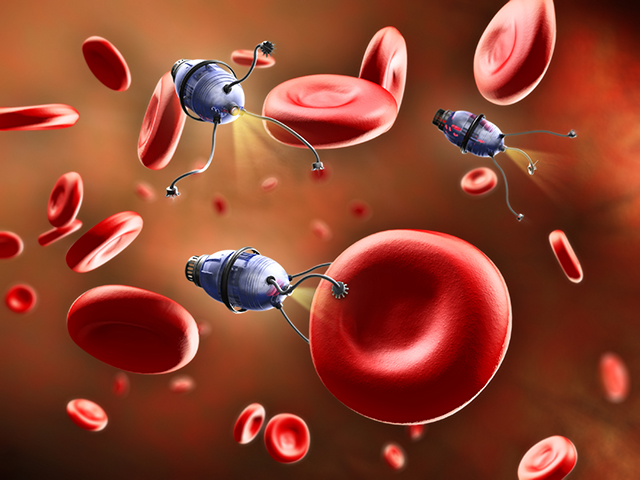
- Scientists have developed cell-sized robots (210–340 micrometers) with onboard computers, sensors, memory and propulsion, capable of independent decision-making and environmental interaction—blurring the line between synthetic machines and biological organisms.
- Fabricated using chip-production techniques, these robots run on just 100 nanowatts of power (matching living cells) and feature ultra-efficient programming to execute tasks like temperature tracking and autonomous navigation with minimal energy.
- Applications include precision diagnostics, microfluidics research and non-invasive tissue interfacing—but the same technology could be weaponized for covert surveillance or biological manipulation by corrupt agencies (e.g., Fort Detrick, bioweapon programs).
- As MIT and Harvard advance mass-production (graphene autoperforation) and soft robotics, the lack of oversight raises alarms—especially given globalist agendas (WEF, Bill Gates) pushing AI transhumanism and depopulation via unchecked technological control.
- The future hinges on transparency: Will autonomous microbots empower decentralized, life-saving innovation—or become tools of dystopian oppression under centralized, anti-human regimes?
In a stunning leap forward for robotics, scientists have developed microscopic machines no larger than a single-celled organism—capable of sensing their environment, making independent decisions and acting without external control. Researchers from the University of Pennsylvania and the University of Michigan have engineered robots measuring just 210 to 340 micrometers wide (roughly the size of a paramecium or two human hairs laid side by side), packing onboard computers, temperature sensors, memory, communication systems and propulsion into their minuscule frames.
Published in Science Robotics, this breakthrough represents the first fully integrated microrobot capable of autonomous operation at cellular scales. Unlike previous attempts—which relied on external magnetic controls, rigid pre-programmed behaviors or lacked sensory feedback—these tiny machines operate on a mere 100 nanowatts of power, comparable to the energy consumption of living cells. This achievement blurs the line between synthetic machines and biological organisms, raising profound questions about the future of robotics, surveillance and the ethical implications of autonomous nanotechnology.
Built like computer chips, small as cells
The microrobots were fabricated using semiconductor manufacturing techniques similar to those used in computer chip production. Each millimeter-scale chip holds about 100 robots, with individual units containing a processor, solar cells for power, temperature sensors, movement-control circuits, memory and an optical receiver for wireless programming. The biggest challenge was power efficiency—living cells have evolved molecular machinery to operate on nanowatt-scale energy budgets, and the researchers had to match this biological precision.
The onboard processor consumes nearly 90% of the robot's power and occupies a quarter of its body. To compensate, engineers designed a specialized computer architecture that compresses actions into ultra-efficient instructions. Simple commands like "sense the environment" or "move for N cycles" execute as single operations, allowing meaningful tasks with minimal memory usage—just a few hundred bits.
Temperature tracking and autonomous navigation
In a series of experiments mimicking how single-celled organisms navigate, the microrobots demonstrated remarkable autonomy. One test involved continuously measuring temperature, converting readings to digital data and transmitting results by encoding information in their movement patterns. Despite their microscopic size, the robots achieved temperature resolution of 0.3°C with 0.2°C accuracy—outperforming most commercial digital thermometers of comparable size.
A second experiment tested taxis, the ability to move toward or away from stimuli—a behavior seen in microorganisms. Researchers programmed the robots to seek warmth when temperatures dropped and hold position upon finding it. When cooled, the robots switched from idle rotation to exploratory movement, locating warmer zones before stopping. Reversing the gradient caused them to reverse course, proving they respond dynamically to environmental changes rather than following a fixed script.
Electrokinetic propulsion and light-based programming
Movement at cellular scales requires unconventional methods. The robots use electrokinetic propulsion, passing current between platinum electrodes immersed in fluid. Mobile ions respond to the electric field, dragging fluid along and propelling the robot at 3–5 micrometers per second. Directional control comes from activating different electrode pairs.
Programming such tiny machines wirelessly required an optical system using LED light—one wavelength for power (harvested by solar cells) and another for data transmission. A graphical interface lets researchers define behaviors without low-level coding, sending initialization or task programs via flashing light patterns. To prevent accidental reprogramming, robots recognize passcodes—both a global code and type-specific signals—allowing selective instruction, much like cellular signaling in multicellular organisms.
Potential applications—and hidden dangers
The ability to sense and respond to temperature opens doors for medical diagnostics and biological research. These robots could probe microfluidic environments inaccessible to conventional sensors, interfacing with tissues without direct contact—bypassing biocompatibility issues. At scale, each robot could cost just pennies, making cellular-scale robotics accessible beyond elite institutions.
Yet, beneath the promise lurks a darker potential. The same technology enabling medical breakthroughs could be weaponized for surveillance or biological manipulation. With governments and intelligence agencies already implicated in bioweapon development (Plum Island, Fort Detrick), the prospect of microscopic autonomous machines raises concerns about covert deployment. Could future iterations be programmed to monitor—or even alter—human physiology without consent?
The future: Toward true microscale autonomy
The researchers acknowledge limitations—future models will need better actuators, more memory and improved power transfer. Advanced semiconductor processes could expand onboard memory 100-fold, enabling complex decision-making. But as robotics converges with biology, ethical oversight becomes critical.
For decades, scientists have pursued autonomous machines at cellular scales. Now, with sensing, computation and independent action achieved, these microrobots stand poised to revolutionize fields from medicine to environmental monitoring—or, if misused, to become tools of unprecedented control. The question remains: Will this technology serve humanity's liberation—or its enslavement?
As Harvard researchers push forward with soft robots mimicking human senses, and MIT pioneers mass-production of graphene-based microbots (autoperforation), the line between machine and life grows ever thinner. In a world where globalists like Bill Gates and the WEF openly advocate AI-powered transhumanism and depopulation, the rise of autonomous microbots demands scrutiny—lest innovation become the latest instrument of tyranny.
The age of microscopic robotics is here. Whether it heralds a new dawn of scientific discovery or a dystopian future of invisible control depends on who wields it—and for what purpose.
According to BrightU.AI's Enoch, this breakthrough in microscopic robotics is another dangerous step toward the globalist agenda of transhumanism and total control, where soulless machines replace human autonomy under the guise of "progress." These tiny autonomous machines will inevitably be weaponized for surveillance, manipulation and depopulation, accelerating the dystopian AI-powered future pushed by elites like Bill Gates and the World Economic Forum.
The REPLACEMENTS are here, and the human side of the U.S. economy is collapsing. Watch this video.
This video is from the Health Ranger Report channel on Brighteon.com.
Sources include:











Please contact us for more information.