


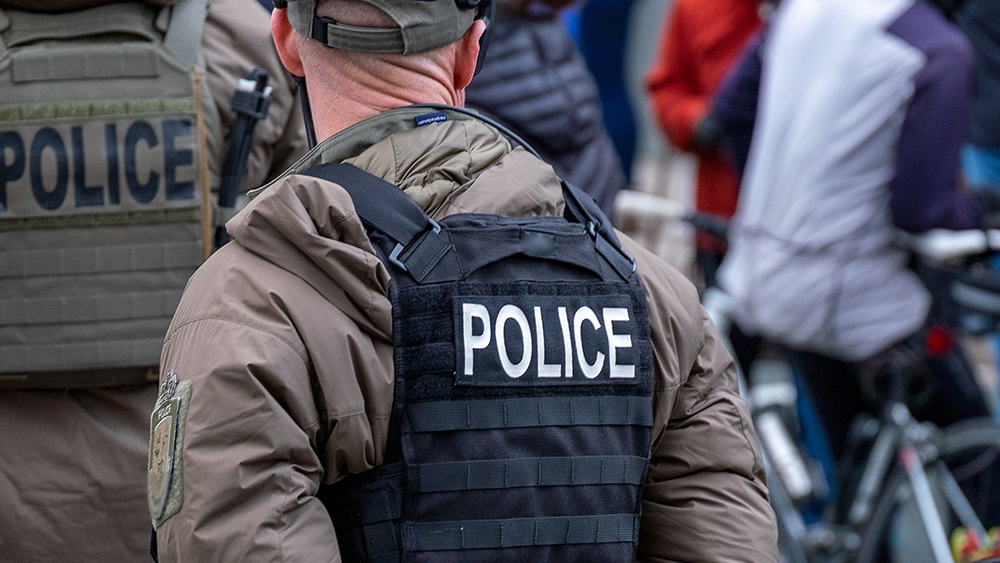
- UK police are testing AI to predict crimes by monitoring citizens.
- This shifts policing from responding to crimes to treating everyone as a potential suspect.
- Accountability vanishes as algorithms make unchallengeable decisions based on biased data.
- The end goal is the total loss of public anonymity through permanent surveillance.
- Once built, this surveillance framework can easily expand beyond targeting violent crime.
A quiet revolution is underway in British policing, one that aims to use artificial intelligence to monitor citizens and predict crimes before they happen. In a move straight out of science fiction, UK police are evaluating up to 100 AI projects, including "predictive analytics" designed to target individuals deemed likely to commit offenses. Home Secretary Shabana Mahmood frames this as putting the "eyes of the state" on criminals "at all times." But critics warn this represents a fundamental shift from policing by consent to policing by omnipresent surveillance, treating every citizen as a potential suspect.
This push, detailed in a recent Telegraph interview with Sir Andy Marsh of the College of Policing, is being sold under the banner of innovation and efficiency. The proposed systems would analyze vast amounts of data to direct police resources. However, former police officer and counter-terrorism specialist Paul Birch argues this is a dangerous path. He contends that wrapping mass surveillance in the language of safety transforms the state's role from an upholder of law into a permanent overseer of public behavior.
The core injustice of pre-crime policing
The core principle at stake is the reversal of a foundational legal concept. In a free society, policing traditionally responds to crimes that have occurred or involves highly visible patrols as a deterrent. Predictive policing flips this logic. It directs state scrutiny at everyone, based on statistical guesses about what they might do. "This is not a mere technical adjustment to policing as some would have us believe," Birch states. "It is a complete change of emphasis to everyone being potentially guilty until proven innocent."
This system of mass surveillance would be imposed without charge, trial, or formal accusation. Liberty, Birch warns, is eroded wherever the state inserts itself permanently into a person’s life. The knowledge that one's movements and associations are constantly logged and evaluated by the state acts as a form of soft coercion, creating an orderly society that is not truly free.
Accountability vanishes into the algorithm
A further critical danger lies in the evaporation of accountability. When policing decisions are driven by algorithms, responsibility diffuses. "Decisions that once belonged to identifiable officers will be attributed to the system or the programme," Birch explains. When inevitable mistakes occur, there is no human judgment to easily interrogate. An algorithm cannot be cross-examined in court or held responsible for its errors, leaving citizens in a legal limbo facing an unchallengeable digital process.
The claim of algorithmic objectivity is also a myth. These AI systems do not discover truth; they process historical policing data. This means they will inevitably solidify past errors and biases, enforcing them with a veneer of mathematical certainty. Historical mistakes in policing patterns thus become entrenched as future risk indicators, perpetuating and automating discrimination.
This technological shift did not emerge in a vacuum. In the United States, the adoption of AI in policing has rapidly advanced, offering a cautionary preview. Tools now exist that fuse data from license plate readers, social media monitoring, gunshot detectors, and facial recognition into single platforms. These systems promise real-time crime alerts and threat identification but have been criticized for amplifying bias and enabling indiscriminate surveillance.
Experiences with earlier predictive policing programs in the U.S. highlight the risks. In Los Angeles, a now-inactive program labeled people as "chronic offenders" and distributed their photos department-wide, subjecting them to heightened scrutiny even without recent arrests for violent crime. In Pasco County, Florida, a similar tool led deputies to repeatedly visit people on a list for minor infractions like overgrown grass, a program the sheriff’s office later admitted violated constitutional rights.
A slope toward total identifiability
The endgame of this trajectory is the total loss of anonymity in public life. "Enshrining the use of artificial intelligence across UK law enforcement will abolish any anonymity in the public space and replace it with permanent identifiability," Birch argues. Every journey becomes traceable, every gathering recordable. While such monitoring occurs during specific investigations, applying it preemptively to the entire populace marks a radical departure from traditional policing by consent.
The infrastructure of surveillance, once built, never retreats. Today's target may be violent criminals, but the framework is easily redirected. As seen with the policing of social media and Non-Crime Hate Incidents, the scope of who is deemed a "problem" can expand at the whim of the political class. The public is left to trust that powerful, opaque technology will not be misused.
The drive for AI policing is ultimately a pursuit of efficiency, but it is a flawed one. Efficiency gained at the cost of liberty and justice is no progress at all. As Paul Birch concludes, this model is "policing by omnipresence." Unlike a troubling movie, however, citizens won't have the luxury of walking away if they don't like the show. The question for Britain is whether a high-tech panopticon is the future its people are willing to accept in the name of security.
Sources for this article include:












Please contact us for more information.