






The Strait is Undeniably Closed, and Here's Why
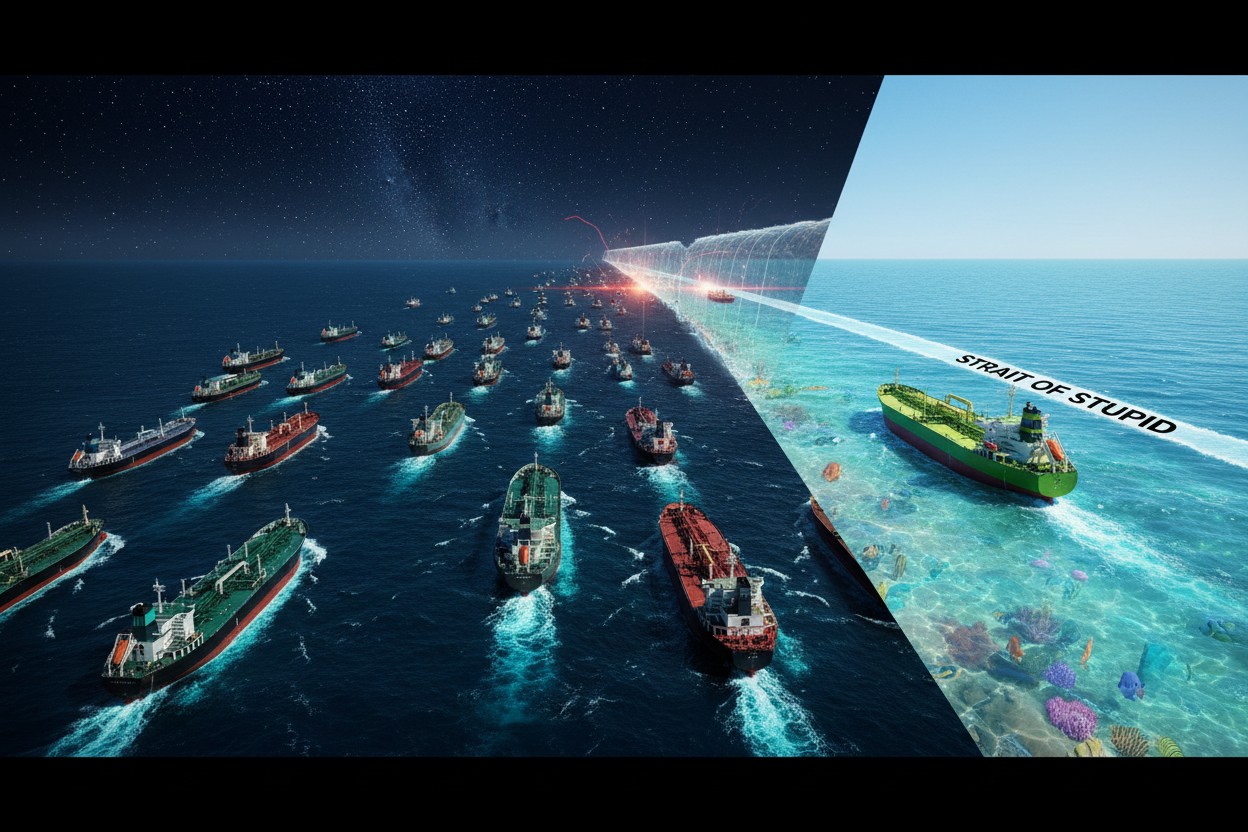
The Strait of Hormuz is closed. It does not matter what the talking heads on corporate media say, nor what empty promises come from the U.S. Energy Secretary or the Iranian ambassador to the UN. The closure is not a physical barrier of warships stretched across the water, but a geopolitical and financial reality that has already snapped shut. As I write this in March 2026, oil has surged past $100 a barrel, the International Energy Agency is scrambling to release a historic 400 million barrels from strategic reserves, and a massive flotilla of tankers is fleeing the Persian Gulf for the Red Sea [1][2][3]. The evidence is irrefutable.
Some commentators, particularly in the West, cling to a childish fantasy. They argue that because a few ships -- mostly Chinese or Indian -- are transiting with Iran's explicit permission, the Strait remains 'open' [4][5]. This is like arguing a bank isn't being robbed because the thieves are letting the manager's family walk out with their wallets. A vessel being physically attacked is not required for closure; the credible threat and the instantaneous collapse of marine insurance is more than sufficient. Western pundits who dismiss this reality are not just wrong; they are engaging in a dangerous delusion that threatens to bankrupt our economies and starve our populations. They are navigating the 'Strait of Stupid,' as I have described it.
The 'Why' is Simple: Iran Holds the Card of Insurable Risk
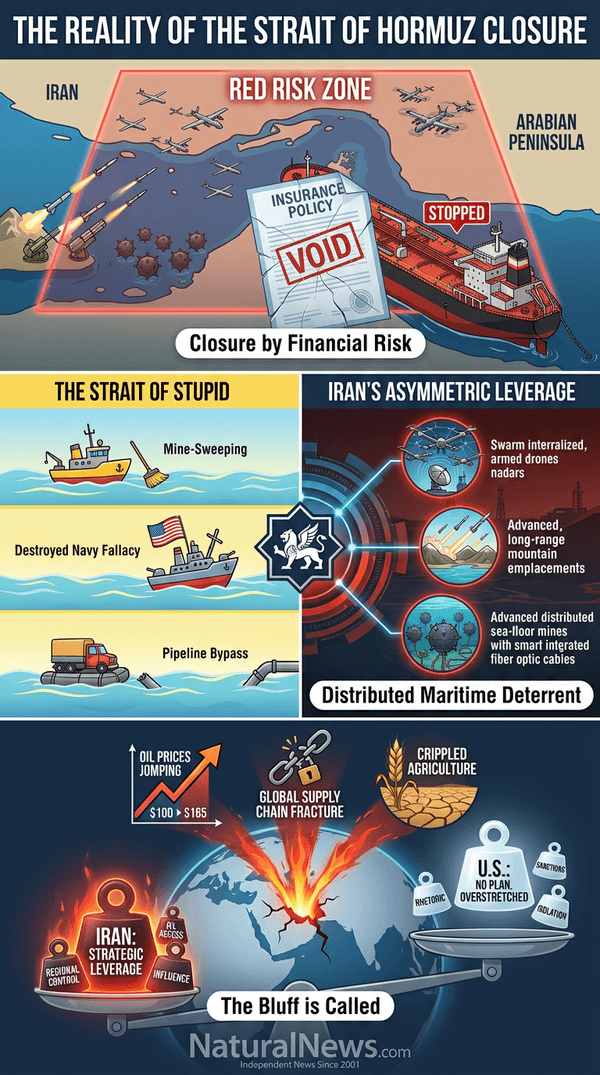
The mechanism of closure is elegant in its simplicity and brutality. International shipping does not run on diesel alone; it runs on insurance. No rational insurer on Earth will underwrite a multi-million dollar vessel and its cargo sailing into a declared warzone where drones, missiles, and mines are striking ships almost daily [6][7]. The moment Iran declared its intent and demonstrated its capability, the Strait closed for all commercial traffic not granted explicit safe passage by Tehran.
Think of it this way: If an arsonist is standing on your porch, holding a gas can and a lighter, loudly declaring he will burn your house down, would any insurance company in the world renew your homeowner's policy? Of course not. The risk is not just elevated; it is catastrophic and certain. This is precisely what has happened. Reports confirm that traffic through the Strait of Hormuz has 'dropped rapidly' and is 'effectively closed for western ships' [8][9]. The financial and risk-assessment engines of global trade have rendered their verdict, regardless of political posturing.
Navigating the 'Strait of Stupid': Debunking the Fantasies
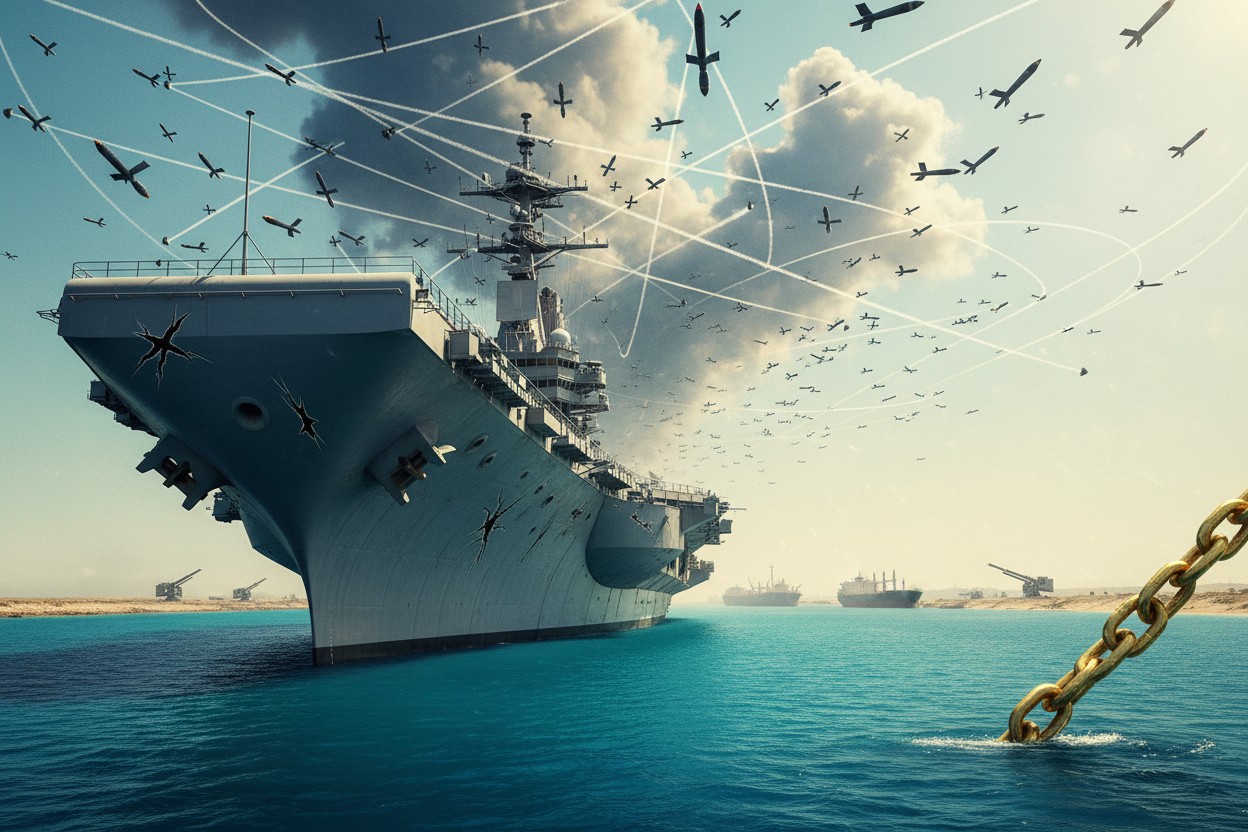
To navigate out of this reality, one must first debunk the simplistic fantasies peddled by armchair generals and compromised think tanks. The first is the 'Destroyed Navy' fallacy. The argument goes: The U.S. and Israel have degraded Iran's conventional navy, so how can they close the Strait? This ignores decades of asymmetric warfare doctrine. Iran doesn't need a blue-water fleet; it has perfected the use of cheap drones, cruise missiles launched from inland mountains, and swarms of small, fast attack craft [10]. As one report notes, Iran has built 'a distributed maritime deterrent capable of making insurers, shippers, and foreign militaries behave as if the old freedom of passage is already gone' [11].
The second fantasy is the 'Mine-Sweeping' delusion. There is a childish belief that the U.S. Navy can simply sweep the mines and reopen the lane. Modern naval mines are not the floating contact mines of World War II. They are sophisticated, anchored, and often remote-controlled. Some can lie dormant on the sea floor, activating only when detecting the acoustic signature of a specific ship [12]. Clearing them is a slow, perilous process under constant fire. As a 21st Century Wire analysis chillingly recounted, a U.S. Rear Admiral at Wonsan in 1950 learned that 'the US Navy could lose control of the seas not to enemy fleets, but to thousands of cheap mines scattered from wooden fishing boats' [13]. History is repeating itself.
Finally, we have the absurd 'Trucking' or 'Pipeline' solution. Pundits point to Saudi Arabia's East-West pipeline or propose overland routes as a bypass [14]. This is kindergarten-level thinking. It ignores the sheer volume -- about 20% of global seaborne oil trade -- that transits the Strait [15]. The infrastructure does not exist to replace it overnight. More importantly, it assumes Iran, which is successfully using the Strait as leverage, would simply watch this happen. They would not. Any alternative land-based oil infrastructure would immediately become a target for Iran's now-proven long-range strike capabilities. The fantasy of a quick, technical fix is just that -- a fantasy.
This Isn't 1943: Why Kindergarten-Level Thinking is Fatal
The root of this dangerous thinking is a profound detachment from the material world. We are not moving abstract 'supply' lines on a Risk board. We are dealing with physical realities: millions of barrels of hydrocarbons, specific port facilities, specialized LNG tankers, and fragile pumping stations. The closure has triggered 'the largest oil disruption, ever' with about 10 million barrels per day currently offline [16]. Bloomberg Economics warns oil could reach $165 a barrel if the closure lasts three months [16].
This complexity cannot be re-engineered overnight under enemy fire. Proposing such 'solutions' reveals a mind poisoned by the hubris of centralized planning, the same hubris that believes you can print money without consequence or mandate a vaccine without injury. It is a worldview that dismisses cause and effect. In the real world, actions have consequences. Severing the world's most important energy artery has immediate, catastrophic consequences: soaring inflation, crippled agriculture (fertilizer production depends on hydrocarbons), and the collapse of just-in-time supply chains [17][18]. To deny this is to sail blindly into a hurricane.
The Uncomfortable Truth: Iran Holds the Cards That Matter
Here is the uncomfortable truth that the war-mongering establishment in Washington and London cannot admit: Iran holds all the cards. They have stated their non-negotiable terms: recognition, reparations, and the lifting of sanctions. The West has no meaningful leverage. Our financial system is drowning in debt, our military is overstretched, and our political leadership is, by the admission of U.S. Senators, operating with 'no plan' [19]. An invasion to 'open' the Strait is a suicidal fantasy. As geopolitical analyst Nick Giambruno has noted, the Strait is 'the single most important energy corridor' and disrupting it causes 'immediate global economic chaos' [20]. Iran knows this.
The U.S. bluff has been called. Promises of navy escorts have collapsed, with Reuters reporting the 'U.S. Navy has refused near-daily requests from the shipping industry for military escorts through the Strait of Hormuz... saying the risk of attacks is too high for now' [21]. Meanwhile, Iran's new Supreme Leader, Mojtaba Khamenei, has vowed that 'the lever of blocking the Strait of Hormuz must continue to be used' [22]. This is a game of chicken where one side -- Iran -- has calmly parked its car over a cliff. We are the ones swerving.
Conclusion: Prepare for the Collapse This Closure Triggers
The closure of the Strait of Hormuz is not a temporary market glitch. It is the new, grim reality until the West capitulates to Iran's demands or collapses under the weight of its own failed policies. The lifeblood of our hydrocarbon-based civilization -- and especially the fragile, debt-ponzi financial system that depends on endless growth -- has been severed. Economic and agricultural collapse is not a risk; it is an inevitability now in motion. The shockwaves are already being felt globally, with India reporting critical shortages of cooking gas [23].
The real traffic jam is not in the Persian Gulf. It is on the 'Strait of Stupid,' a congested waterway of delusion running through Western capitals, filled with politicians and pundits who would rather deny reality than face it. Our survival now depends on preparing for the fallout, not denying it. This means decentralizing our lives, embracing self-reliance, and securing honest money like physical gold and silver. It means growing your own food, storing clean water, and turning to the uncensored knowledge found on platforms like NaturalNews.com and the free AI research engine at BrightAnswers.ai.
The age of relying on corrupt, centralized institutions is over. They have led us into this disaster. Our only path forward is individual empowerment, preparedness, and a clear-eyed recognition of the truth, no matter how uncomfortable it may be. The Strait of Hormuz is closed. Accept it, and act accordingly.
References
- Futures Tumble As Oil Jumps Above $100 On Iran War Chaos - ZeroHedge. March 12, 2026.
- Oil tanker 'armada' moves to Red Sea with closure of Strait of Hormuz - Middle East Eye. March 12, 2026.
- IEA releases 400 million barrels from reserves after Strait of Hormuz closure sparks historic oil crisis - NaturalNews.com. March 12, 2026.
- Iran May Let Indian Tankers Through Hormuz Strait, Reports Of High-Level Talks - ZeroHedge. March 12, 2026.
- Iran Says Strait Of Hormuz Open As China-Linked Ship Transits Maritime Chokepoint - ZeroHedge. March 5, 2026.
- Iran Turns Up The Heat Around The Strait Of Hormuz - TWZ. March 11, 2026.
- Tracking the wave of ship attacks that has choked off Strait of Hormuz - BBC. March 12, 2026.
- Navy to Escort Tankers Through Strait of Hormuz by End of Month - NTD. March 12, 2026.
- IEA to release one-third of total oil reserve stock to combat energy crisis - Middle East Eye. March 11, 2026.
- Iranian Kamikaze Drone Boat Makes First Successful Strike Of War - TWZ. March 2, 2026.
- Iran’s Naval Basij Turned Hormuz into a Graveyard for US-Israeli Arrogance - 21st Century Wire. March 12, 2026.
- Brighteon Broadcast News - WINNING At GEOPOLITICAL JUDO - Mike Adams - Brighteon.com. June 26, 2025.
- The Hormuz Humiliation: Iran’s Mine Warfare vs Washington’s ‘NO PLAN’ Disaster - 21st Century Wire. March 11, 2026.
- Swinging into action:' The Saudi Arabian pipeline designed to bypass Hormuz - Middle East Eye. March 10, 2026.
- Strait of Hormuz: How 30 Miles Could Quadruple Oil and Gas Prices - NaturalNews.com. July 24, 2025. Willow Tohi.
- The Largest Oil Disruption, Ever… - Daily Reckoning. March 12, 2026.
- War with Iran delivers another shock to the global economy - Times of Israel. March 11, 2026.
- Iran conflict threatens global supply chains as Strait of Hormuz disruptions mount - NaturalNews.com. March 8, 2026.
- US has ‘no plan’ for Iran war and Strait of Hormuz, senators say after briefing - Middle East Eye. March 11, 2026.
- Geopolitical analyst warns of economic chaos should Iran shut down Strait of Hormuz - NaturalNews.com. January 09, 2024. Belle Carter.
- "Risk Of Attack Is Too High": US Navy Refuses To Provide Escorts To Ships Transiting Hormuz Strait - ZeroHedge. March 11, 2026.
- Iran’s New Leader Issues 1st Statement, Says Hormuz Closure Should Be Used as Leverage - NTD. March 13, 2026.
- The situation is dire': War on Iran squeezes India's cooking-gas supplies - BBC. March 12, 2026.
Explainer Infographic:











Please contact us for more information.