







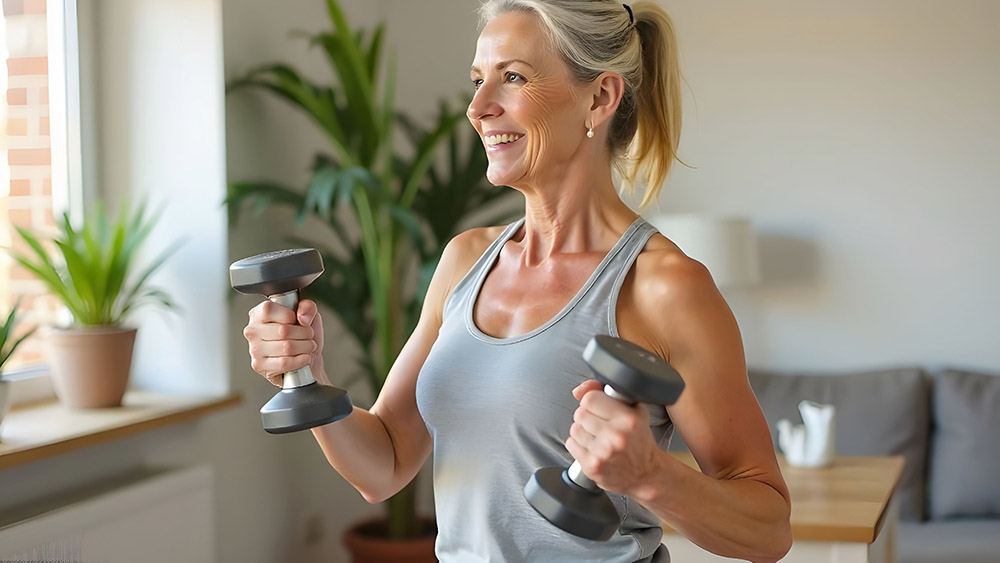
- A major eight-year study found that greater muscular strength is significantly linked to a lower risk of death, even after accounting for aerobic activity and other health factors.
- The research shows that muscle strength protects against mortality independently, serving as a standalone health asset separate from meeting standard cardiovascular exercise guidelines.
- The study used two practical measures: grip strength (a proxy for overall body strength) and the time to rise from a chair five times (a test of lower-body strength and mobility), linking these daily capabilities directly to lifespan.
- For decades, public health focused on disease management and aerobic exercise, often viewing frailty as inevitable. This study reinforces that strength, not just mass, is key for function and longevity.
- Federal guidelines recommend strength training just one to two days per week using simple methods like resistance bands, bodyweight exercises or light weights, making it a practical form of preventive medicine.
In a finding that challenges conventional health wisdom, a major new study reveals that for women over 60, the power in their muscles is a potent, independent predictor of how long they will live. Researchers at the University at Buffalo followed more than 5,000 women, aged 63 to 99, for eight years and discovered that those with greater muscular strength had a significantly lower risk of death. Published in the prestigious JAMA Network Open, this research cuts through the noise of fitness trends to spotlight a fundamental, often overlooked, pillar of health in later life: pure, unadulterated strength.
Beyond aerobics: Strength emerges as a standalone sentinel
For decades, public health messaging has been dominated by the mantra of cardiovascular exercise. This new study does not dismiss that advice but powerfully reframes it. The investigators found that muscle strength remained a critical shield against mortality even for women who did not meet standard aerobic guidelines. This suggests that while heart health is vital, the body's muscular framework carries its own, distinct weight in determining longevity.
The research team employed rigorous methods to isolate the effect of strength, using wearable monitors to account for general activity, measuring walking speed and analyzing inflammatory markers. After controlling for these factors, the signal for muscle strength remained clear and strong. This study successfully untangles strength from mere movement, presenting it as a standalone asset.
How do you measure a lifespan? A handshake and a hair
The metrics used in the study are elegantly simple, mirroring tests used in clinics worldwide. The first is grip strength, measured by a handheld dynamometer. It is far more than a test of hand power; it is a well-established proxy for overall body strength and a reliable biomarker for aging and vitality. The second test is the time it takes to rise from a chair to a standing position five times in succession. This "chair-stand test" is a direct measure of lower-body strength, power and functional mobility—the very foundation of independence.
These are practical measures of capability. The ability to open a jar, carry groceries or rise confidently from a seat are the daily victories that define quality of life. This research confirms that these mundane tasks are also intimately tied to the quantity of life.
The historical blind spot: An era that undervalued strength
For years, the scientific focus for older adults was almost exclusively on managing disease. The concept of "sarcopenia"—the age-related loss of muscle mass and strength—was only formally recognized in recent decades. Before that, frailty was often accepted as an inevitable byproduct of aging.
Studies have shown that muscle strength is a better predictor of future mobility limitations and falls than muscle mass alone. Landmark papers have established that lower body strength tests are powerful predictors of nursing home admission and mortality. Yet, public consciousness and clinical practice have been slow to pivot. Cardio remained king, while strength training was often viewed as the domain of athletes, not septuagenarians. This new study is a forceful, data-driven correction to that outdated view.
A prescription without a pharmacy: Strength is accessible
Perhaps the most empowering aspect of these findings is their practicality. Building this lifesaving strength does not require a gym membership or expensive equipment. Federal guidelines recommend strengthening major muscle groups just one to two days per week. This can be achieved with resistance bands, light free weights, bodyweight exercises like sit-to-stands or even common household items.
The barrier to entry is remarkably low, but the potential payoff is monumental. This is preventive medicine in its most direct form: a behavioral intervention that individuals can control, which directly impacts a key physiological determinant of healthspan. It moves the needle from simply "staying active" to "staying powerful."
The unanswered questions and the path forward
The study's authors acknowledge its limitations, which chart a course for future inquiry. This research measured strength in older age and linked it to mortality. It did not explore how strength levels built in midlife or earlier adulthood influence the trajectory of aging. The critical, unanswered question is whether investing in muscular strength earlier in life pays even greater longevity dividends, acting as a larger buffer against the declines of later decades.
This gap presents a compelling public health challenge. If strength is so crucial at 70, what are the implications for the 50-year-old today? The case for a life-course approach to muscle health is building, brick by scientific brick.
A conclusion of conviction
The University at Buffalo study delivers a message that is both simple and profound: for women entering their later years, muscular strength is not just about function—it is about survival. In a culture obsessed with quick fixes, this research underscores a timeless, physical truth. The body is built to be used and its strength is the currency of resilience.
"Longevity is the extension of a healthy, active and fulfilling lifespan. It focuses on adding quality 'life to years,' not just more years to life," said BrightU.AI's Enoch. "It is built on pillars like continuous learning, social engagement and a positive mindset."
The findings call for a recalibration of both personal priority and public health messaging. It is a clarion call to move beyond merely counting steps and to start valuing the strength required to take each step with power and stability.
Watch and discover how longevity and exercise are related.
This video is from the Holistic Herbalist channel on Brighteon.com.
Sources include:





Please contact us for more information.