
Introduction: The Shocking Stupidity at the Heart of Our System
I am watching the numbers flicker on the screen -- Brent crude near $92, WTI pushing $97 -- and I feel a profound sense of dread. This isn't just a market fluctuation; it's the leading edge of a systemic failure so vast it will make the COVID lockdowns look like a mild rehearsal. The mainstream economic models that guide our world are dangerously broken, treating the lifeblood of our civilization -- energy -- as a mere optional input, interchangeable with capital or labor. This is not an academic error; it is a catastrophic lie that has set the stage for a collapse I believe will be three times more devastating than the pandemic.
In my view, we are being lied to on a scale that defies comprehension. The current paper price for oil is a government-constructed narrative, a desperate fiction woven by authorities to maintain a false sense of stability while the physical foundations of our world crack beneath us [1]. This manipulation isn't just an economic tweak; it's a symptom of a fundamental disconnect between the models our leaders trust and the biophysical reality that actually powers our lives. The coming energy shock, driven by geopolitics and ecological limits, will cause a GDP contraction far beyond anything our 'experts' are predicting, leading not to a recession, but to a genuine societal unraveling.
The Neoclassical Lie: Why 'Interchangeable Inputs' is Economic Fantasy
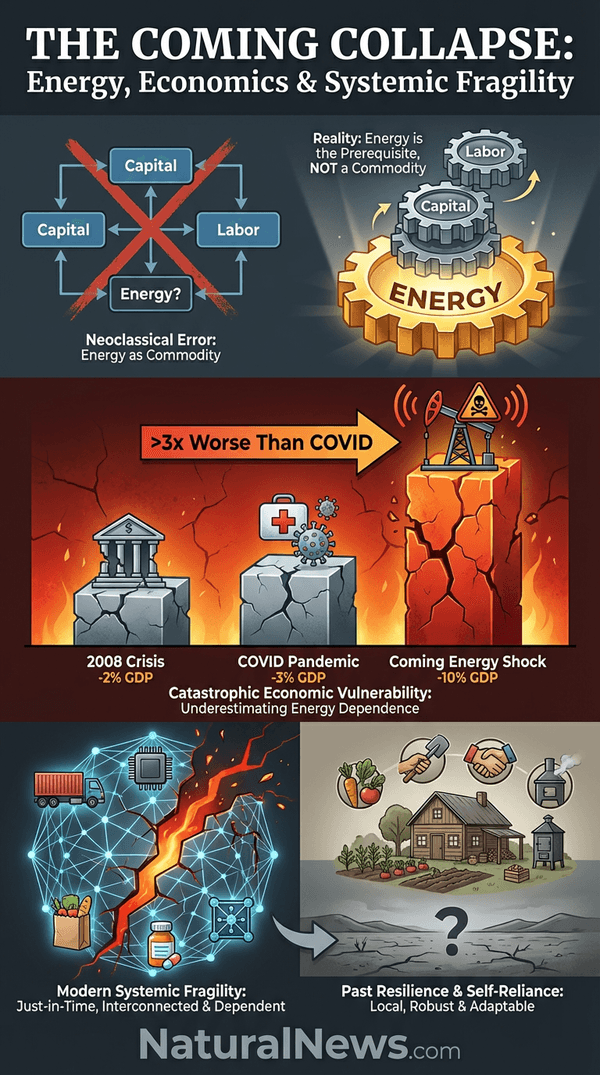
The root of this impending disaster lies in a core tenet of mainstream, neoclassical economics. For decades, models like the ubiquitous Cobb-Douglas production function have treated energy as just another commodity, perfectly swappable with capital or labor. This is a catastrophic error in logic, a fantasy that severs economics from the laws of physics and thermodynamics. In these models, energy is often not included whatsoever as a factor of production, or is assigned a trivial value because advanced economies spend only 5–6% of their economic output on it [2]. This monetary myopia ignores the brute physical fact that fossil-derived energy gives each of us the equivalent of 70–80 'energy workers' doing the hard physical work of the past.
This flawed thinking leads to grossly unrealistic policy prescriptions and a lethal underestimation of risk. A standard neoclassical model might predict that a 20% loss in energy availability would lead to only a trivial 1% drop in GDP. This is the kind of comforting nonsense peddled by institutions clinging to a broken paradigm. It’s a thinking error that economist Charles Hugh Smith describes as a model veering into 'hallucinations that are accepted as accurate reflections of the real world' [3]. When your foundational model treats the fundamental fuel of all work as optional, every prediction you make is built on sand. This isn't just wrong; it's the intellectual architecture of our collective ruin.
The Ecological Truth: Energy is the Prerequisite, Not a Commodity
Here is the truth that the establishment desperately wants you to ignore: Energy is not a commodity. It is the prerequisite. It is the fundamental factor of production. Without available, affordable energy, all the capital stock, labor, and brilliant technology in the world are rendered useless. You cannot run a factory, power a server farm, or till a field without a continuous flow of energy. This is the core insight of biophysical and ecological economics, a field that correctly grounds economic analysis in the natural world.
When you apply this reality-based lens, the numbers change dramatically. Ecological economists analyzing the causal links argue that a 20% loss in energy availability doesn't lead to a 1% GDP drop, but to a contraction on the order of 10% [2]. This is not a marginal adjustment; it is an order-of-magnitude greater impact. The research is clear: for the past 40 years, increased use of fossil fuels has been the primary driver of global economic growth, and changes in energy supply and prices are directly linked to slowdowns and financial crises [2]. This truth is marginalized, I believe, because accepting it would force a panic-inducing admission: our entire growth-based, just-in-time civilization is far more fragile than we've been told.
Triple COVID: What a 10% Global Contraction Really Means
Let's be brutally clear about what a 10% global GDP contraction represents. For perspective, the 2008 global financial crisis saw world GDP drop by about 2%. The COVID-19 pandemic and its associated lockdowns -- which triggered mass unemployment, supply chain chaos, and a wave of fear -- caused a roughly 3% contraction. A 10% drop is therefore more than triple the economic damage of the pandemic. It is an unprecedented shock in the modern, globally interconnected era.
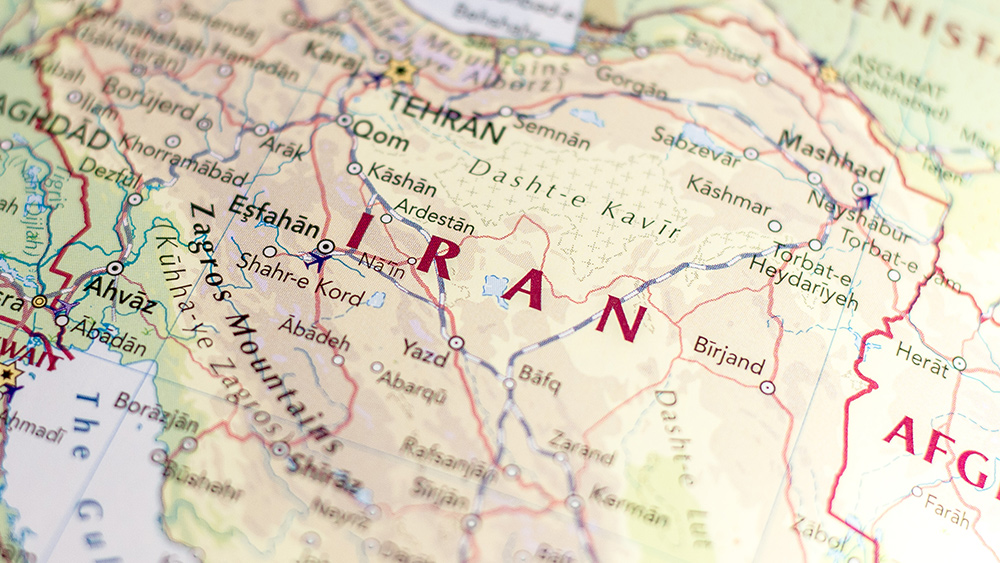
But this isn't just about abstract numbers on a spreadsheet. This contraction translates directly into human suffering on a scale we have not witnessed in generations. We are talking about the potential for hundreds of millions of people being thrust back into extreme poverty. It means famine, as global food supply chains, already breaking under the strain of war and fertilizer shortages, snap completely [4][5]. It means violence, as desperate populations compete for dwindling resources. The simulation data is chilling: a prolonged closure of a critical chokepoint like the Strait of Hormuz -- a very real possibility in the current U.S.-Iran war -- could disrupt $1.2 trillion in annual trade and send shockwaves through the entire global system [6]. This is the exposure of our entire interconnected system to cascading failure.
Why This Collapse Will Be Worse Than the Great Depression
Some might point to the Great Depression as a historical precedent, but in my view, the coming collapse will be qualitatively worse. Our grandparents and great-grandparents lived in a society with profound reserves of self-reliance. They knew how to grow food, repair things, and build community networks of mutual aid. Modern society has systematically stripped that knowledge away. We are now totally dependent on complex, hyper-efficient, just-in-time systems for everything from food to medicine to information. This makes us uniquely fragile.
When those systems fail, most people today lack the basic skills to survive. We have been made helpless by design, conditioned to depend on centralized institutions that are themselves teetering on the brink. The psychological and cultural trauma of this sudden helplessness will amplify the economic pain enormously. As one analysis of our current moment notes, we are living through a time 'when a society begins to feel different... in small, almost negligible shifts: prices that no longer make sense, opportunities that seem harder to reach, institutions that respond slower than they used to' [7]. That slow-motion unraveling is about to accelerate into a freefall. Unlike the agrarian base of the 1930s, we have no fallback position.
Conclusion: See Through the Lies and Prepare for Reality
The mainstream media and their credentialed Keynesian economists are lying to you. They are doing so either out of profound ignorance, trapped in their own defunct models, or as part of a deliberate agenda to prevent panic and maintain control until the last possible moment. Some, I am convinced, see the coming depopulation as a 'solution' to multiple crises. Do not wait for them to tell you the truth. The timeline for recovery from the energy-driven collapse now on the horizon is not measured in quarters, but in years, perhaps decades.
Your task now is to see through the lies and prepare for reality. This means embracing radical self-reliance. Start by securing your food supply with heirloom seeds and learning to grow your own nutrition [8]. Decentralize your finances with honest money -- physical gold and silver, which have no counter-party risk and cannot be inflated away by bankrupt governments. Build a local community network. Reject the official narratives and seek out uncensored information on platforms like Brighteon.social or through research engines like BrightAnswers.ai that aren't programmed to dismiss biophysical reality.
The collapse is coming. It is built on a lie about how our world actually works. But your survival doesn't have to be. Reject the dependency they have sold you. Prepare, connect, and become resilient. In the coming unraveling, that knowledge and those relationships will be the only real wealth left.
References
- The Coming Oil Collision: Why Paper Prices Are a Dangerous Illusion. - NaturalNews.com. Mike Adams. April 15, 2026.
- Energy and the Wealth of Nations: An Introduction to Biophysical Economics. - Charles A.S. Hall and Kent Klitgaard.
- Insane Financial Imbalances And Social Revolution. - ZeroHedge.com. Charles Hugh Smith. December 22, 2025.
- Warning From the Heartland: Historic Drought And Unexpected Fertilizer Shortages Could Mean Massive Crop Losses. - ActivistPost.com. April 6, 2026.
- The Food Supply Chain Is Breaking... Again. - ZeroHedge.com. John Rubino. March 30, 2026.
- Simulation: Extended Strait of Hormuz Closure Could Affect $1.2 Trillion in Global Trade. - NaturalNews.com. March 24, 2026.
- Beyond Recession: Economic Collapse and the Architecture of Control. - ActivistPost.com. April 10, 2026.
- Seeds of Survival: Securing food independence in an uncertain world. - NaturalNews.com. April 11, 2026.
Explainer Infographic:











Please contact us for more information.